 Add to Chrome
 Add to Firefox
 Add to Edge
Attacking and Defending Multi-Agent Collaborative Filtering Systems Through Connectivity
Aug 04, 2026
Multi-agent collaborative filtering (CF) systems coordinate autonomous LLM-powered user and item agents through natural-language interaction to refine preferences and generate recommendations. These systems inherit vulnerabilities from both their data-driven nature and their multi-agent interactions, which manifest in distinct ways. Understanding how connectivity modulates vulnerability in these systems could facilitate the development of more robust recommendation pipelines. In this work, we adapt attacks and defenses from the general multi-agent systems (MAS) literature to the agent-based CF setting, evaluating them under systematically varied connectivity in the AgentCF framework, where CF connectivity is characterized along two axes: (i) candidate count (the number of item candidates per turn per user, measuring user-side interaction density) and (ii) catalog concentration (the degree of item catalog overlap across users). Our contributions include: (1) Adaptation: we reproduce MAS-inspired attacks and defenses in the agentic CF domain, confirming partial transferability of original observations. (2) Characterization: we characterize how the two aspects of connectivity shape attack and defense outcomes, revealing role asymmetries between user and item agents, non-monotonic temporal dynamics in attack efficacy, and divergent patterns across dissemination and extraction attack goals. Additionally, as an exploratory extension, we assess the applicability of epidemic-inspired static metrics in ranking CF configurations by expected attack outcome, potentially enabling cost-efficient robustness assessment. Implementation is available at https://github.com/anjunhu/ConnACF

Inherently Interpretable Time Series Classification via Multiple Instance Learning
Nov 23, 2023

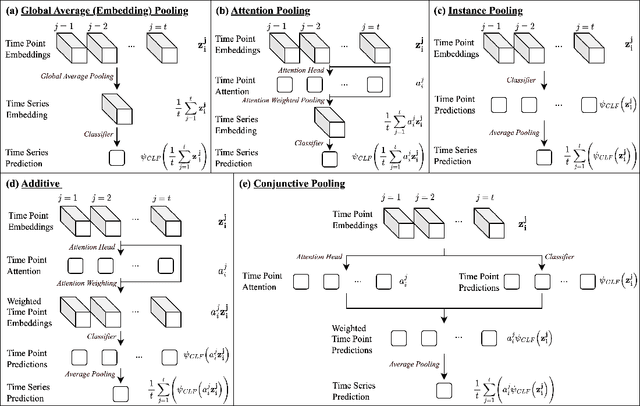
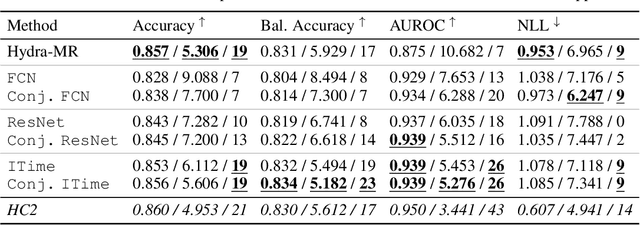
Conventional Time Series Classification (TSC) methods are often black boxes that obscure inherent interpretation of their decision-making processes. In this work, we leverage Multiple Instance Learning (MIL) to overcome this issue, and propose a new framework called MILLET: Multiple Instance Learning for Locally Explainable Time series classification. We apply MILLET to existing deep learning TSC models and show how they become inherently interpretable without compromising (and in some cases, even improving) predictive performance. We evaluate MILLET on 85 UCR TSC datasets and also present a novel synthetic dataset that is specially designed to facilitate interpretability evaluation. On these datasets, we show MILLET produces sparse explanations quickly that are of higher quality than other well-known interpretability methods. To the best of our knowledge, our work with MILLET, which is available on GitHub (https://github.com/JAEarly/MILTimeSeriesClassification), is the first to develop general MIL methods for TSC and apply them to an extensive variety of domains
Low-count Time Series Anomaly Detection
Aug 24, 2023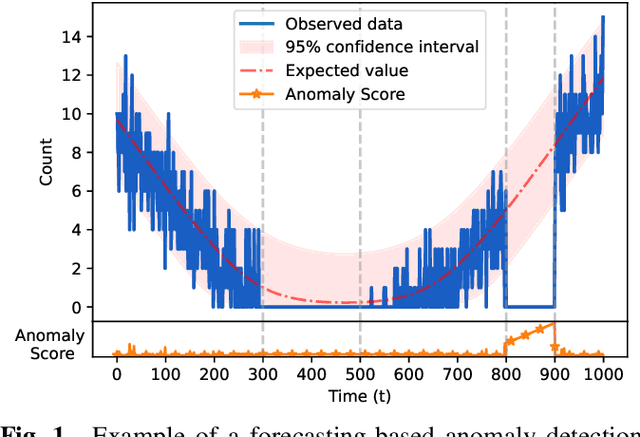
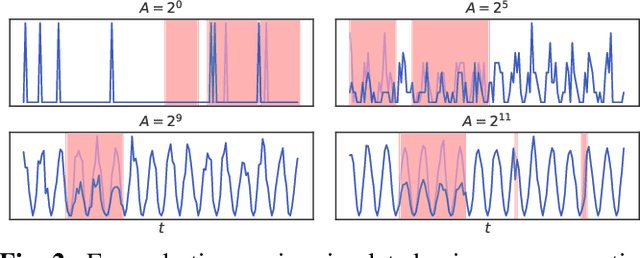
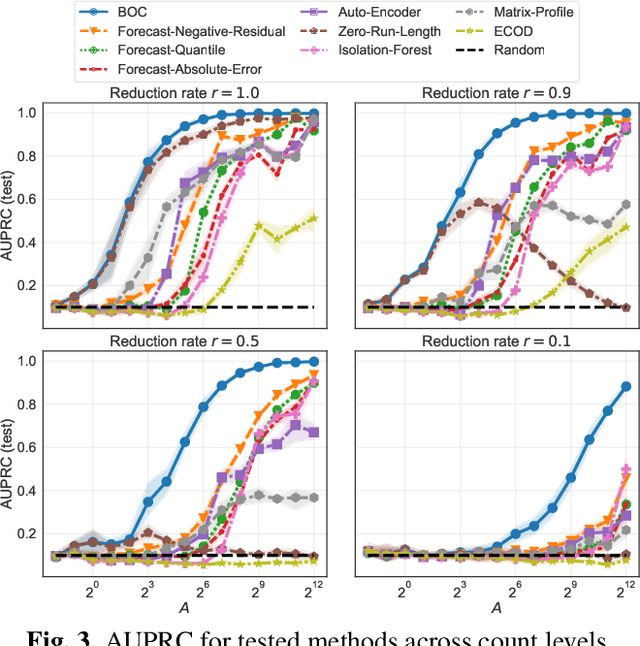
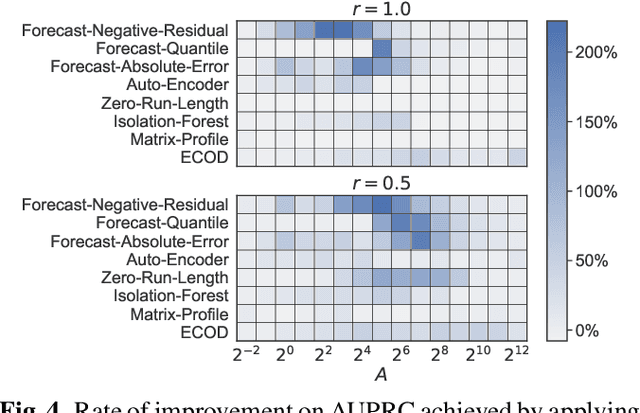
Low-count time series describe sparse or intermittent events, which are prevalent in large-scale online platforms that capture and monitor diverse data types. Several distinct challenges surface when modelling low-count time series, particularly low signal-to-noise ratios (when anomaly signatures are provably undetectable), and non-uniform performance (when average metrics are not representative of local behaviour). The time series anomaly detection community currently lacks explicit tooling and processes to model and reliably detect anomalies in these settings. We address this gap by introducing a novel generative procedure for creating benchmark datasets comprising of low-count time series with anomalous segments. Via a mixture of theoretical and empirical analysis, our work explains how widely-used algorithms struggle with the distribution overlap between normal and anomalous segments. In order to mitigate this shortcoming, we then leverage our findings to demonstrate how anomaly score smoothing consistently improves performance. The practical utility of our analysis and recommendation is validated on a real-world dataset containing sales data for retail stores.