 Add to Chrome
 Add to Firefox
 Add to Edge
Deep Single-Index Fréchet Regression
Jun 05, 2026
Predicting outputs that are located in non-Euclidean spaces, such as probability distributions, networks, and symmetric positive-definite matrices, is becoming increasingly important in modern data analysis, particularly when inputs are high-dimensional. We propose DeSI (Deep Single-Index Fréchet Regression), a semiparametric framework for regression with metric space-valued outputs and multivariate inputs that assumes a single-index structure for the conditional Fréchet mean. DeSI estimates an interpretable index direction, which quantifies the relative importance of inputs, using a deep neural network, and performs Fréchet regression along the resulting one-dimensional index in the target metric space. This structure mitigates the curse of dimensionality while retaining interpretability, which stands in contrast to standard deep neural networks. We establish theoretical guarantees for DeSI, including uniform approximation and convergence rates, and demonstrate its strong predictive performance through simulations on distributions, networks, and symmetric positive-definite matrices, as well as an application to compositional mood data from New Jersey.

Deep Fréchet Regression
Jul 31, 2024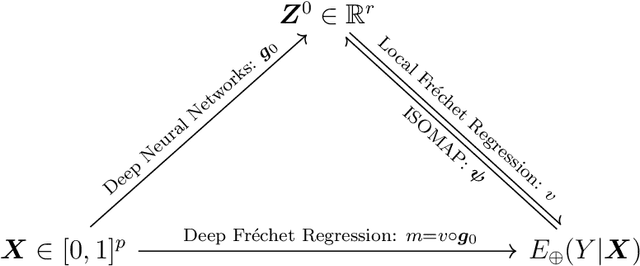
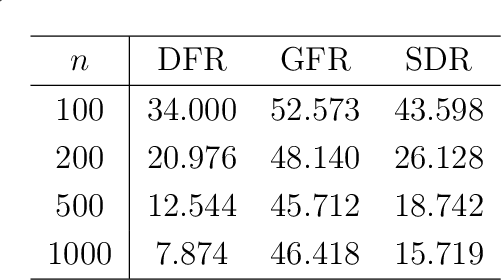
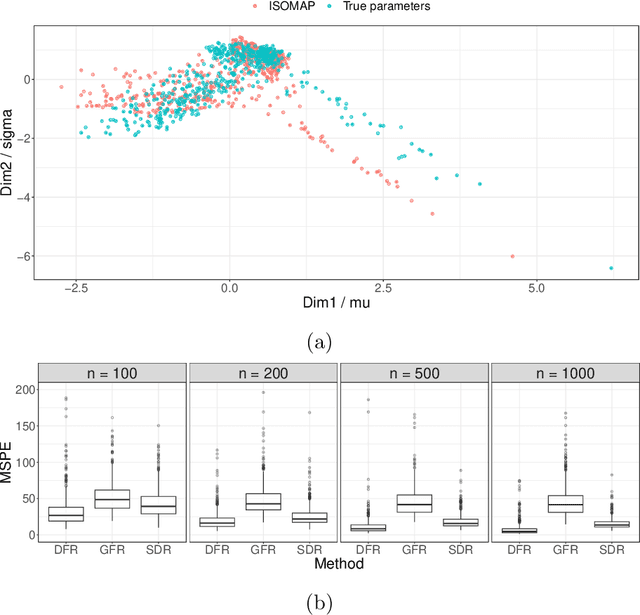
Advancements in modern science have led to the increasing availability of non-Euclidean data in metric spaces. This paper addresses the challenge of modeling relationships between non-Euclidean responses and multivariate Euclidean predictors. We propose a flexible regression model capable of handling high-dimensional predictors without imposing parametric assumptions. Two primary challenges are addressed: the curse of dimensionality in nonparametric regression and the absence of linear structure in general metric spaces. The former is tackled using deep neural networks, while for the latter we demonstrate the feasibility of mapping the metric space where responses reside to a low-dimensional Euclidean space using manifold learning. We introduce a reverse mapping approach, employing local Fr\'echet regression, to map the low-dimensional manifold representations back to objects in the original metric space. We develop a theoretical framework, investigating the convergence rate of deep neural networks under dependent sub-Gaussian noise with bias. The convergence rate of the proposed regression model is then obtained by expanding the scope of local Fr\'echet regression to accommodate multivariate predictors in the presence of errors in predictors. Simulations and case studies show that the proposed model outperforms existing methods for non-Euclidean responses, focusing on the special cases of probability measures and networks.