 Add to Chrome
 Add to Firefox
 Add to Edge
Towards Unsupervised Causal Representation Learning via Latent Additive Noise Model Causal Autoencoders
Dec 15, 2025
Unsupervised representation learning seeks to recover latent generative factors, yet standard methods relying on statistical independence often fail to capture causal dependencies. A central challenge is identifiability: as established in disentangled representation learning and nonlinear ICA literature, disentangling causal variables from observational data is impossible without supervision, auxiliary signals, or strong inductive biases. In this work, we propose the Latent Additive Noise Model Causal Autoencoder (LANCA) to operationalize the Additive Noise Model (ANM) as a strong inductive bias for unsupervised discovery. Theoretically, we prove that while the ANM constraint does not guarantee unique identifiability in the general mixing case, it resolves component-wise indeterminacy by restricting the admissible transformations from arbitrary diffeomorphisms to the affine class. Methodologically, arguing that the stochastic encoding inherent to VAEs obscures the structural residuals required for latent causal discovery, LANCA employs a deterministic Wasserstein Auto-Encoder (WAE) coupled with a differentiable ANM Layer. This architecture transforms residual independence from a passive assumption into an explicit optimization objective. Empirically, LANCA outperforms state-of-the-art baselines on synthetic physics benchmarks (Pendulum, Flow), and on photorealistic environments (CANDLE), where it demonstrates superior robustness to spurious correlations arising from complex background scenes.

Redefining the Shortest Path Problem Formulation of the Linear Non-Gaussian Acyclic Model: Pairwise Likelihood Ratios, Prior Knowledge, and Path Enumeration
Apr 18, 2024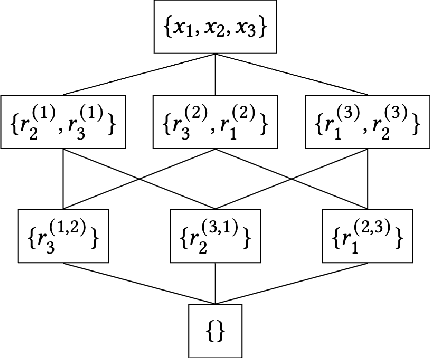
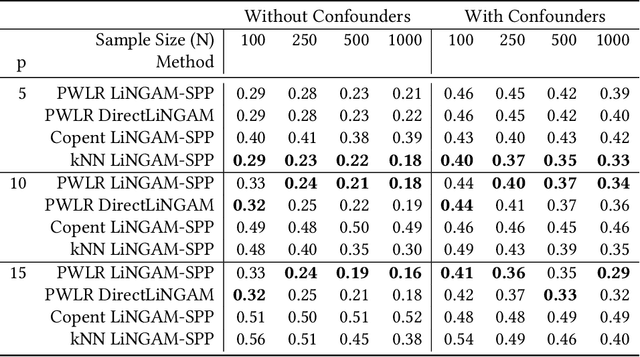
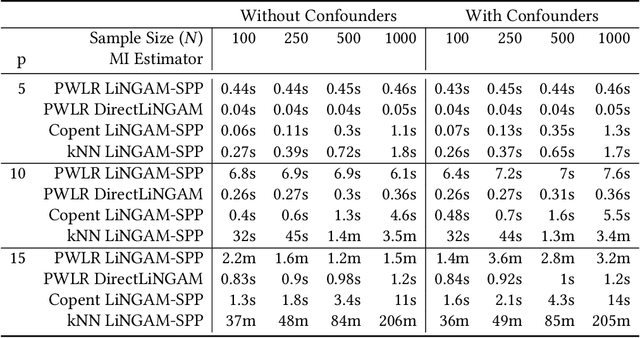
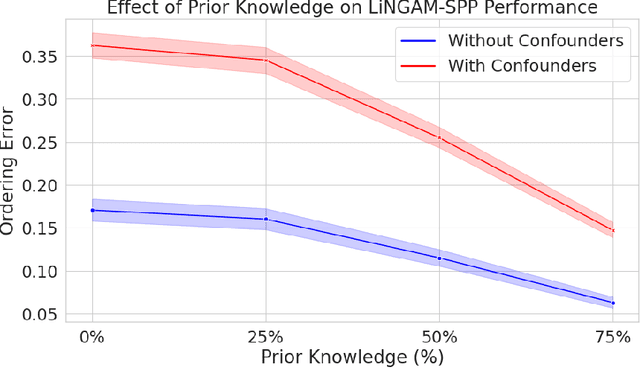
Effective causal discovery is essential for learning the causal graph from observational data. The linear non-Gaussian acyclic model (LiNGAM) operates under the assumption of a linear data generating process with non-Gaussian noise in determining the causal graph. Its assumption of unmeasured confounders being absent, however, poses practical limitations. In response, empirical research has shown that the reformulation of LiNGAM as a shortest path problem (LiNGAM-SPP) addresses this limitation. Within LiNGAM-SPP, mutual information is chosen to serve as the measure of independence. A challenge is introduced - parameter tuning is now needed due to its reliance on kNN mutual information estimators. The paper proposes a threefold enhancement to the LiNGAM-SPP framework. First, the need for parameter tuning is eliminated by using the pairwise likelihood ratio in lieu of kNN-based mutual information. This substitution is validated on a general data generating process and benchmark real-world data sets, outperforming existing methods especially when given a larger set of features. The incorporation of prior knowledge is then enabled by a node-skipping strategy implemented on the graph representation of all causal orderings to eliminate violations based on the provided input of relative orderings. Flexibility relative to existing approaches is achieved. Last among the three enhancements is the utilization of the distribution of paths in the graph representation of all causal orderings. From this, crucial properties of the true causal graph such as the presence of unmeasured confounders and sparsity may be inferred. To some extent, the expected performance of the causal discovery algorithm may be predicted. The refinements above advance the practicality and performance of LiNGAM-SPP, showcasing the potential of graph-search-based methodologies in advancing causal discovery.