 Add to Chrome
 Add to Firefox
 Add to Edge
Balancing Accuracy and Speed: A Multi-Fidelity Ensemble Kalman Filter with a Machine Learning Surrogate Model
Dec 13, 2025
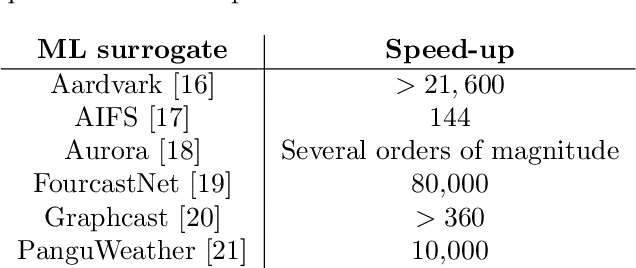
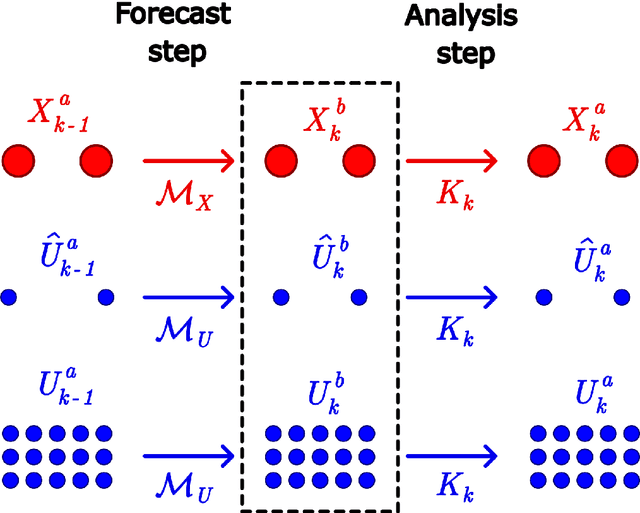
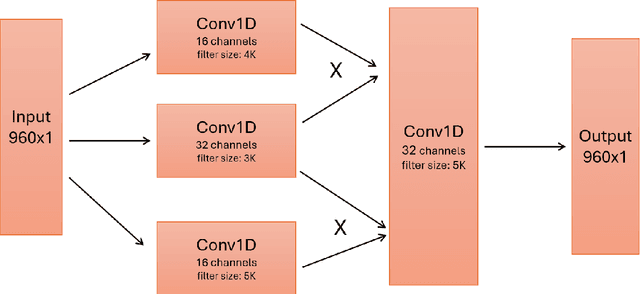

Currently, more and more machine learning (ML) surrogates are being developed for computationally expensive physical models. In this work we investigate the use of a Multi-Fidelity Ensemble Kalman Filter (MF-EnKF) in which the low-fidelity model is such a machine learning surrogate model, instead of a traditional low-resolution or reduced-order model. The idea behind this is to use an ensemble of a few expensive full model runs, together with an ensemble of many cheap but less accurate ML model runs. In this way we hope to reach increased accuracy within the same computational budget. We investigate the performance by testing the approach on two common test problems, namely the Lorenz-2005 model and the Quasi-Geostrophic model. By keeping the original physical model in place, we obtain a higher accuracy than when we completely replace it by the ML model. Furthermore, the MF-EnKF reaches improved accuracy within the same computational budget. The ML surrogate has similar or improved accuracy compared to the low-resolution one, but it can provide a larger speed-up. Our method contributes to increasing the effective ensemble size in the EnKF, which improves the estimation of the initial condition and hence accuracy of the predictions in fields such as meteorology and oceanography.

Integration of Active Learning and MCMC Sampling for Efficient Bayesian Calibration of Mechanical Properties
Nov 21, 2024Recent advancements in Markov chain Monte Carlo (MCMC) sampling and surrogate modelling have significantly enhanced the feasibility of Bayesian analysis across engineering fields. However, the selection and integration of surrogate models and cutting-edge MCMC algorithms, often depend on ad-hoc decisions. A systematic assessment of their combined influence on analytical accuracy and efficiency is notably lacking. The present work offers a comprehensive comparative study, employing a scalable case study in computational mechanics focused on the inference of spatially varying material parameters, that sheds light on the impact of methodological choices for surrogate modelling and sampling. We show that a priori training of the surrogate model introduces large errors in the posterior estimation even in low to moderate dimensions. We introduce a simple active learning strategy based on the path of the MCMC algorithm that is superior to all a priori trained models, and determine its training data requirements. We demonstrate that the choice of the MCMC algorithm has only a small influence on the amount of training data but no significant influence on the accuracy of the resulting surrogate model. Further, we show that the accuracy of the posterior estimation largely depends on the surrogate model, but not even a tailored surrogate guarantees convergence of the MCMC.Finally, we identify the forward model as the bottleneck in the inference process, not the MCMC algorithm. While related works focus on employing advanced MCMC algorithms, we demonstrate that the training data requirements render the surrogate modelling approach infeasible before the benefits of these gradient-based MCMC algorithms on cheap models can be reaped.