 Add to Chrome
 Add to Firefox
 Add to Edge
Joint distribution of upstream runoff governs downstream river-discharge prediction uncertainty in distributed ML models
Jul 03, 2026
Uncertainty quantification of hydrological predictions is necessary to inform operational decisions. Recent generative machine-learning methods have advanced probabilistic streamflow prediction, but have remained confined to lumped models that predict a basin outlet directly. At the same time, deterministic LSTM runoff models are increasingly applied at grid or catchment scale and routed through river networks to produce spatially continuous, physically consistent discharge fields. This technical note argues that moving probabilistic prediction from lumped to distributed models introduces a specific new requirement: the joint distribution of upstream runoff generation must be sampled jointly. In lumped inference, the model predicts the outlet distribution directly and can modulate spread from basin attributes. In distributed inference, downstream discharge is obtained by routing many upstream runoff predictions, so independent local sampling averages uncertainty away. Using Japan as a case study, we train two probabilistic basin-scale runoff LSTMs and route their runoff through a Hayami routing scheme. Randomly matching upstream ensemble members produces severely under-dispersed downstream ensembles, whereas a simple quantile matching strategy restores much of the spread of the direct basin-scale reference. The shift from lumped to distributed probabilistic hydrology therefore requires explicit attention to the spatial joint structure of runoff uncertainty.

Hydra-LSTM: A semi-shared Machine Learning architecture for prediction across Watersheds
Oct 21, 2024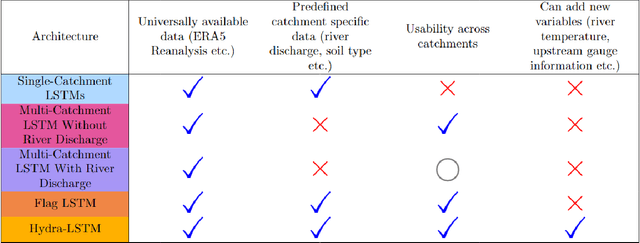
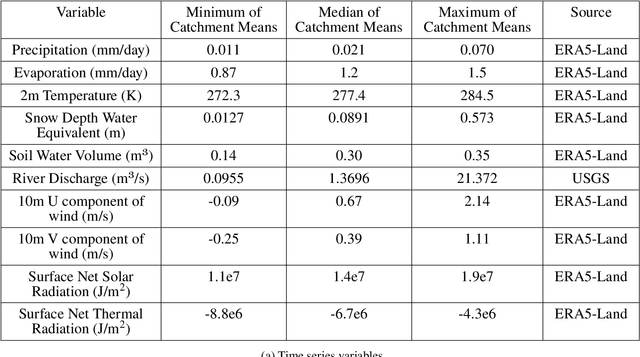
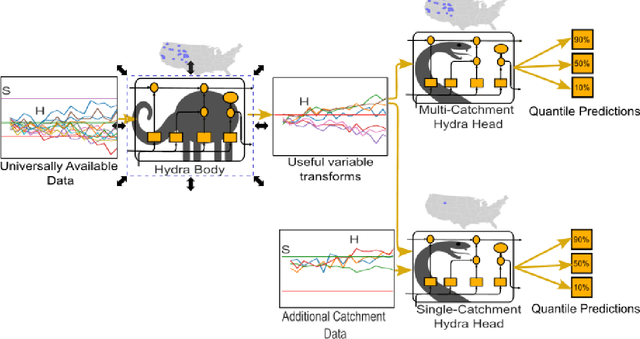
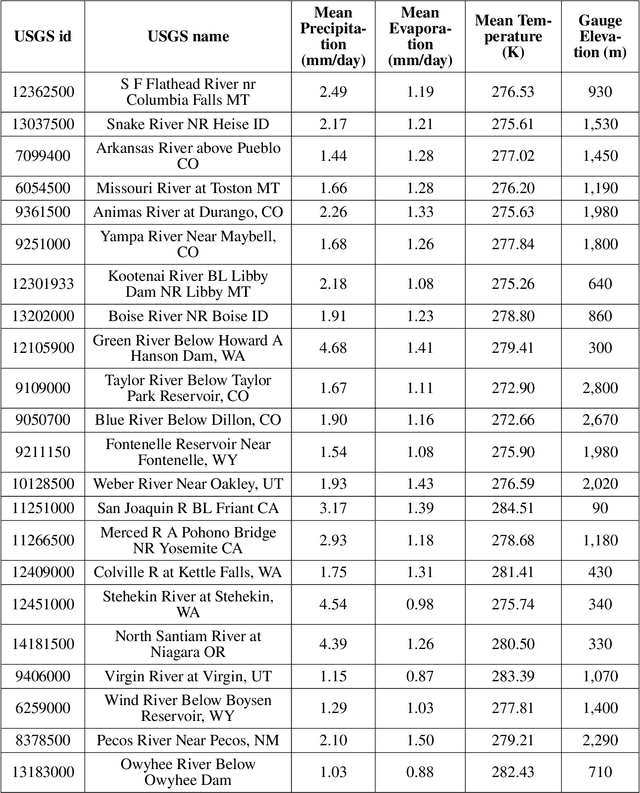
Long Short Term Memory networks (LSTMs) are used to build single models that predict river discharge across many catchments. These models offer greater accuracy than models trained on each catchment independently if using the same data. However, the same data is rarely available for all catchments. This prevents the use of variables available only in some catchments, such as historic river discharge or upstream discharge. The only existing method that allows for optional variables requires all variables to be considered in the initial training of the model, limiting its transferability to new catchments. To address this limitation, we develop the Hydra-LSTM. The Hydra-LSTM processes variables used across all catchments and variables used in only some catchments separately to allow general training and use of catchment-specific data in individual catchments. The bulk of the model can be shared across catchments, maintaining the benefits of multi-catchment models to generalise, while also benefitting from the advantages of using bespoke data. We apply this methodology to 1 day-ahead river discharge prediction in the Western US, as next-day river discharge prediction is the first step towards prediction across longer time scales. We obtain state-of-the-art performance, generating more accurate median and quantile predictions than Multi-Catchment and Single-Catchment LSTMs while allowing local forecasters to easily introduce and remove variables from their prediction set. We test the ability of the Hydra-LSTM to incorporate catchment-specific data by introducing historical river discharge as a catchment-specific input, outperforming state-of-the-art models without needing to train an entirely new model.