 Add to Chrome
 Add to Firefox
 Add to Edge
LIDARLearn: A Unified Deep Learning Library for 3D Point Cloud Classification, Segmentation, and Self-Supervised Representation Learning
Apr 12, 2026
Three-dimensional (3D) point cloud analysis has become central to applications ranging from autonomous driving and robotics to forestry and ecological monitoring. Although numerous deep learning methods have been proposed for point cloud understanding, including supervised backbones, self-supervised pre-training (SSL), and parameter-efficient fine-tuning (PEFT), their implementations are scattered across incompatible codebases with differing data pipelines, evaluation protocols, and configuration formats, making fair comparisons difficult. We introduce \lib{}, a unified, extensible PyTorch library that integrates over 55 model configurations covering 29 supervised architectures, seven SSL pre-training methods, and five PEFT strategies, all within a single registry-based framework supporting classification, semantic segmentation, part segmentation, and few-shot learning. \lib{} provides standardised training runners, cross-validation with stratified $K$-fold splitting, automated LaTeX/CSV table generation, built-in Friedman/Nemenyi statistical testing with critical-difference diagrams for rigorous multi-model comparison, and a comprehensive test suite with 2\,200+ automated tests validating every configuration end-to-end. The code is available at https://github.com/said-ohamouddou/LIDARLearn under the MIT licence.

Introducing the Short-Time Fourier Kolmogorov Arnold Network: A Dynamic Graph CNN Approach for Tree Species Classification in 3D Point Clouds
Apr 01, 2025
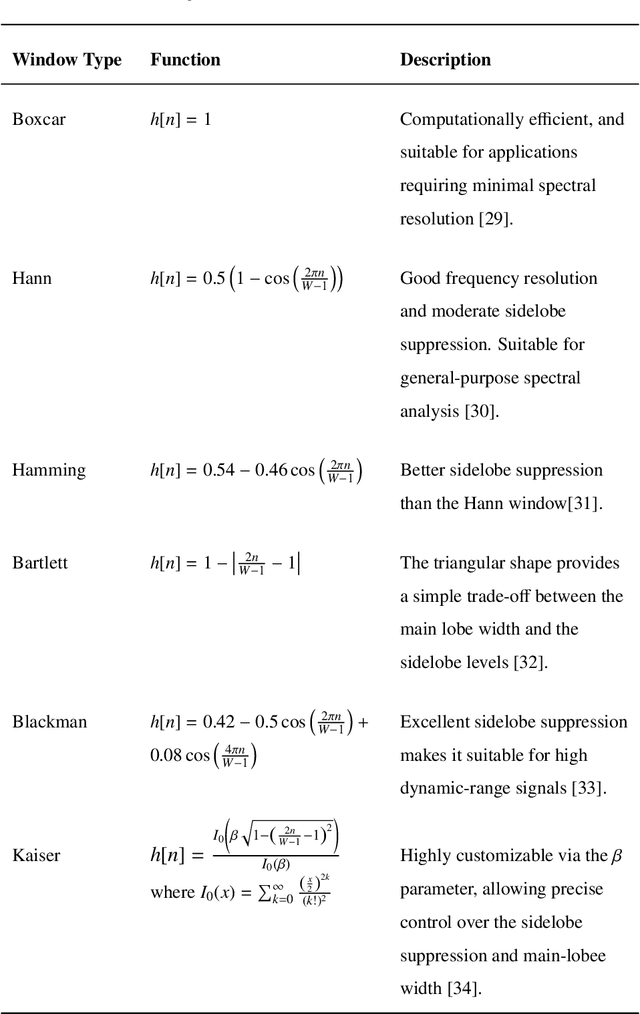

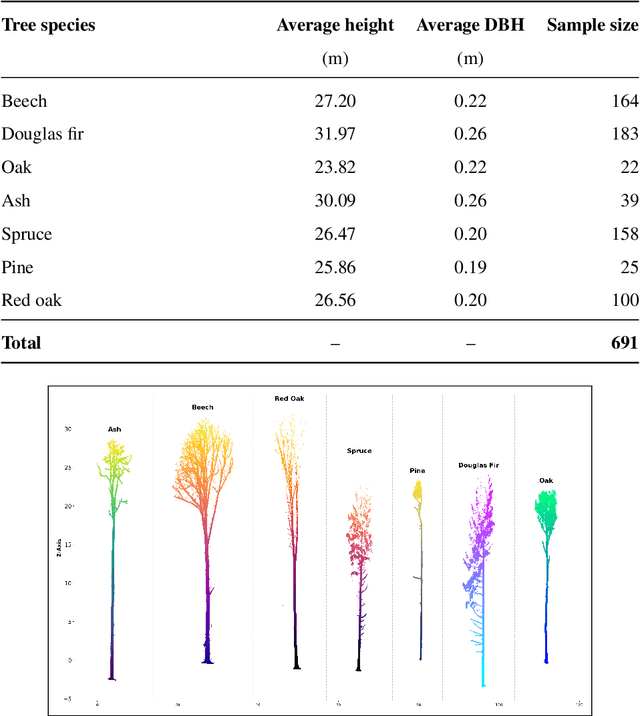
Accurate classification of tree species based on Terrestrial Laser Scanning (TLS) and Airborne Laser Scanning (ALS) is essential for biodiversity conservation. While advanced deep learning models for 3D point cloud classification have demonstrated strong performance in this domain, their high complexity often hinders the development of efficient, low-computation architectures. In this paper, we introduce STFT-KAN, a novel Kolmogorov-Arnold network that integrates the Short-Time Fourier Transform (STFT), which can replace the standard linear layer with activation. We implemented STFT-KAN within a lightweight version of DGCNN, called liteDGCNN, to classify tree species using the TLS data. Our experiments show that STFT-KAN outperforms existing KAN variants by effectively balancing model complexity and performance with parameter count reduction, achieving competitive results compared to MLP-based models. Additionally, we evaluated a hybrid architecture that combines MLP in edge convolution with STFT-KAN in other layers, achieving comparable performance to MLP models while reducing the parameter count by 50% and 75% compared to other KAN-based variants. Furthermore, we compared our model to leading 3D point cloud learning approaches, demonstrating that STFT-KAN delivers competitive results compared to the state-of-the-art method PointMLP lite with an 87% reduction in parameter count.