 Add to Chrome
 Add to Firefox
 Add to Edge
Trustworthy Smart Fabs via Professional Proxies: Scaling Safe and Sustainable by Design (SSbD) through Industrial Data Spaces
Jun 08, 2026
The convergence of the 2026 European Union Safe and Sustainable by Design (SSbD) framework, Corporate Sustainability Due Diligence Directive (CSDDD), and Carbon Border Adjustment Mechanism (CBAM) introduce a severe governance bottleneck for advanced semiconductor manufacturing facilities ("Smart Fabs"). Regulatory compliance demands have surpassed the capacity of manual corporate reporting, creating a direct conflict between multi-stakeholder transparency and corporate data privacy. This paper addresses this challenge by introducing a zero-trust socio-technical orchestration framework that operationalizes a six-layer SSbD reference architecture within trustworthy industrial data spaces. We propose a shift from reactive automation to autonomous governance through "Professional Proxies"-role-based agentic workflows executing within hardware-isolated trust zones. Structured as an interoperable network protocol stack, the framework coordinates an automated, five-step "relay race" between Facility, Process Engineering, and Finance proxy teams to align factory-floor yield models with macro-level sustainability mandates. By executing Virtual Metrology (VM) predictions and Federated Machine Learning (FML) inside hardware-rooted Trusted Execution Environments (TEEs), this architecture resolves the Data Sovereignty Paradox, demonstrating how fabs can export cryptographically signed compliance tokens via International Data Spaces (IDS) connectors without exposing proprietary process recipes. Ultimately, this framework provides technology managers with a verifiable, evidence-based pathway toward resilient, net-zero Industry 5.0 ecosystems.

Sustainability and Artificial Intelligence: Necessary, Challenging, and Promising Intersections
Jun 08, 2026Both digital economy and digital technology researchers increasingly recognize the need to better address the role that artificial intelligence (AI) plays in shaping the evolution of the environmental, social and governance aspects of development. It appears that sustainability and AI research converge on the features of wicked problems that are complex, interconnected and dynamic. Building off such convergence, this article aims to map out the necessary, challenging, and promising intersections by providing an overview of the state of art research. Based on 541 bibliographic data collected from the Web of Science (WoS) database, the findings reveal the increasingly central body of work on green and sustainable science and technology in bridging various disciplines, main journals and key topics and concepts. The findings reveal how such interactions can be necessary, challenging, and promising. The article concludes with few general arguments regarding how to diversify and expand the community of practice regarding AI for sustainable development, especially in the areas of expected AI application areas and institutions.
* This is an author preprint version. For the final authenticated version of record, please use the official publication via the IEEE Xplore database. DOI: 10.1109/MSIEID52046.2020.00076
How much is said in a microblog? A multilingual inquiry based on Weibo and Twitter
Jun 13, 2015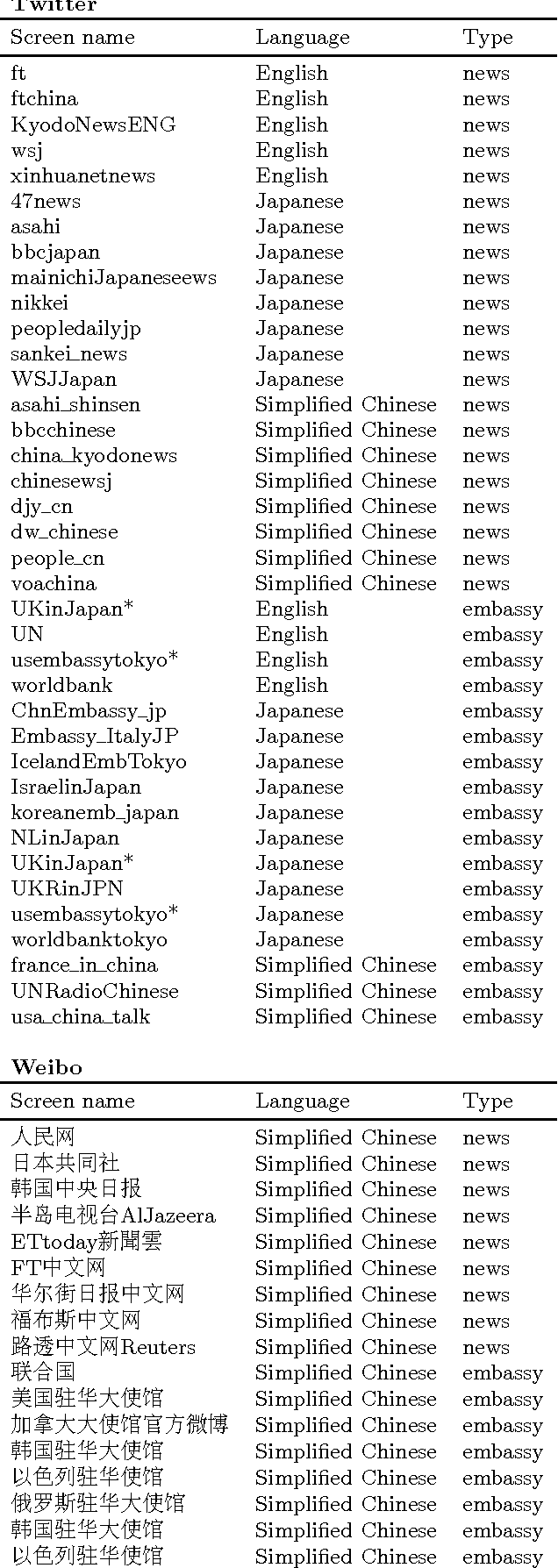
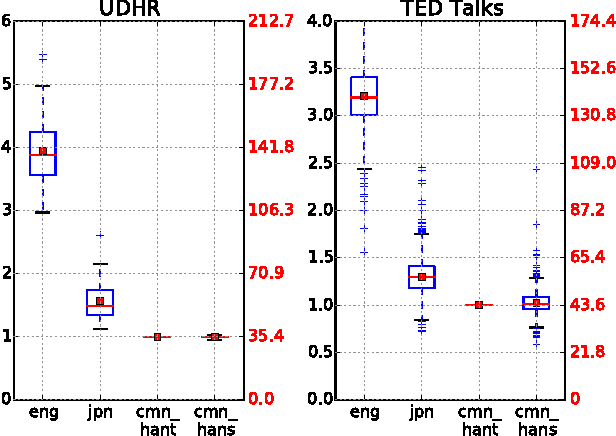
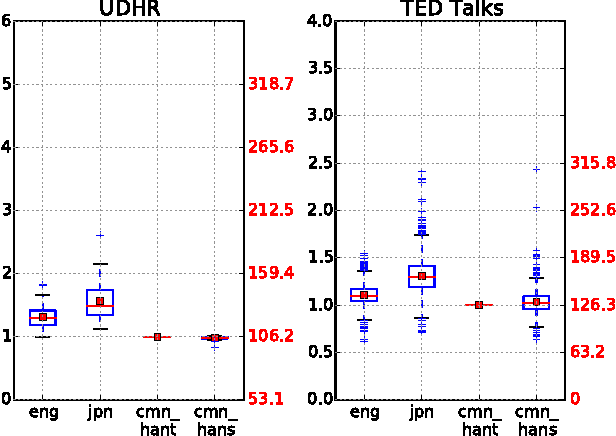
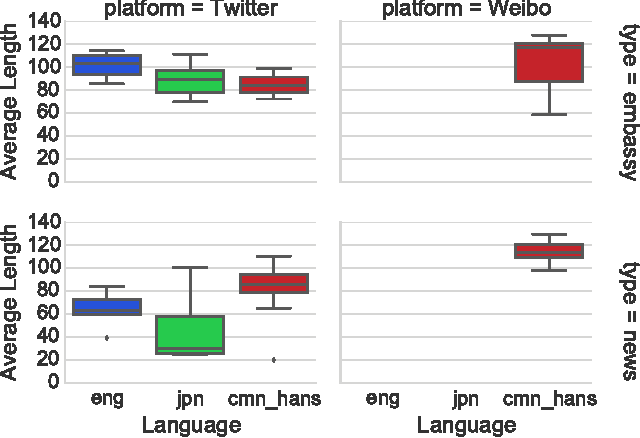
This paper presents a multilingual study on, per single post of microblog text, (a) how much can be said, (b) how much is written in terms of characters and bytes, and (c) how much is said in terms of information content in posts by different organizations in different languages. Focusing on three different languages (English, Chinese, and Japanese), this research analyses Weibo and Twitter accounts of major embassies and news agencies. We first establish our criterion for quantifying "how much can be said" in a digital text based on the openly available Universal Declaration of Human Rights and the translated subtitles from TED talks. These parallel corpora allow us to determine the number of characters and bits needed to represent the same content in different languages and character encodings. We then derive the amount of information that is actually contained in microblog posts authored by selected accounts on Weibo and Twitter. Our results confirm that languages with larger character sets such as Chinese and Japanese contain more information per character than English, but the actual information content contained within a microblog text varies depending on both the type of organization and the language of the post. We conclude with a discussion on the design implications of microblog text limits for different languages.