 Add to Chrome
 Add to Firefox
 Add to Edge
From Capability Models to Automated Planning: An AAS-Native Approach for Automatic PDDL Generation
Jun 01, 2026
Engineers designing production systems need to verify that a given layout supports all required production sequences. Automated planning techniques can answer such questions, but formulating the required planning problems in the Planning Domain Definition Language (PDDL) demands specialized expertise that production engineers typically lack. Asset Administration Shells (AAS) have emerged as the standardized Digital Twin for industrial assets in Industry 4.0. We show that AAS capability models, structured using four established Industry 4.0 standards (VDI 3682 for process descriptions, IEC 61360-1 for semantic property qualification, IDTA 02011 for type hierarchies, and IDTA 02016 for instance descriptions), contain sufficient information to generate complete PDDL problems automatically. Unlike prior work that introduced PDDL-specific submodels, our approach derives all planning elements from domain-level descriptions of resource functions, so-called capabilities, allowing engineers to model capabilities without any exposure to PDDL syntax or planning concepts. Our extraction algorithm transforms distributed Multi-AAS architectures into complete PDDL planning problems. We validate the approach on AAS models of a laboratory production system, comparing four layout variants using optimal planning to demonstrate how engineers can systematically explore design trade-offs by modifying the AAS model and regenerating the planning domain

Integrating AI Planning Semantics into SysML System Models for Automated PDDL File Generation
Jun 07, 2025This paper presents a SysML profile that enables the direct integration of planning semantics based on the Planning Domain Definition Language (PDDL) into system models. Reusable stereotypes are defined for key PDDL concepts such as types, predicates, functions and actions, while formal OCL constraints ensure syntactic consistency. The profile was derived from the Backus-Naur Form (BNF) definition of PDDL 3.1 to align with SysML modeling practices. A case study from aircraft manufacturing demonstrates the application of the profile: a robotic system with interchangeable end effectors is modeled and enriched to generate both domain and problem descriptions in PDDL format. These are used as input to a PDDL solver to derive optimized execution plans. The approach supports automated and model-based generation of planning descriptions and provides a reusable bridge between system modeling and AI planning in engineering design.
Model-based Workflow for the Automated Generation of PDDL Descriptions
Aug 15, 2024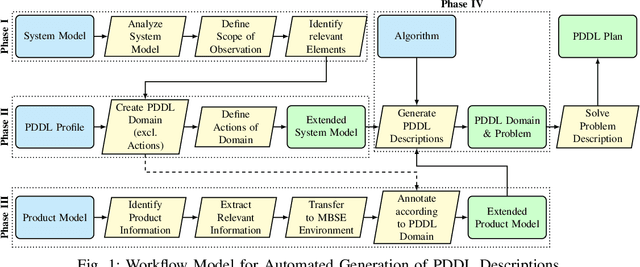
Manually creating Planning Domain Definition Language (PDDL) descriptions is difficult, error-prone, and requires extensive expert knowledge. However, this knowledge is already embedded in engineering models and can be reused. Therefore, this contribution presents a comprehensive workflow for the automated generation of PDDL descriptions from integrated system and product models. The proposed workflow leverages Model-Based Systems Engineering (MBSE) to organize and manage system and product information, translating it automatically into PDDL syntax for planning purposes. By connecting system and product models with planning aspects, it ensures that changes in these models are quickly reflected in updated PDDL descriptions, facilitating efficient and adaptable planning processes. The workflow is validated within a use case from aircraft assembly.