 Add to Chrome
 Add to Firefox
 Add to Edge
Wireless communications with user equipment mounted Reconfigurable Intelligent Surfaces
Dec 20, 2024
In traditional Reconfigurable Intelligent Surfaces (RIS) systems, the RIS is mounted on stationary structures like buildings, walls, or posts. They have shown promising results in enhancing the performance of wireless systems like capacity and MSE in poor channel conditions. The traditional RIS is a monolithic structure containing a large number of reflecting elements (passive or active). In this paper, we propose the idea of mounting a small number of RIS elements (usually between 2 to 4 ) on user equipment (UEs) like mobile phones, laptops, and tablets, to name a few. A joint coordinated optimization of phase shifts of all the passive RIS elements on the participating UEs is envisioned to enhance the performance of wireless communication between an intended transmitter and receiver in the MSE sense. Given that the RIS elements are mounted on the UEs, the challenging channel estimation problem with RIS is significantly simplified. For the case when there is a line-of-sight (LOS) channel and with a large number of participating RIS-mounted UEs, the LOS is converted into a multipath-rich-scattering channel even for millimeter wave and Terahertz operating ranges that enable higher spatial multiplexing gains, thereby significantly improving the MSE performance compared to traditional RIS channels. We support the above claims using simulations.

Constrained Resource Allocation Problems in Communications: An Information-assisted Approach
Dec 07, 2021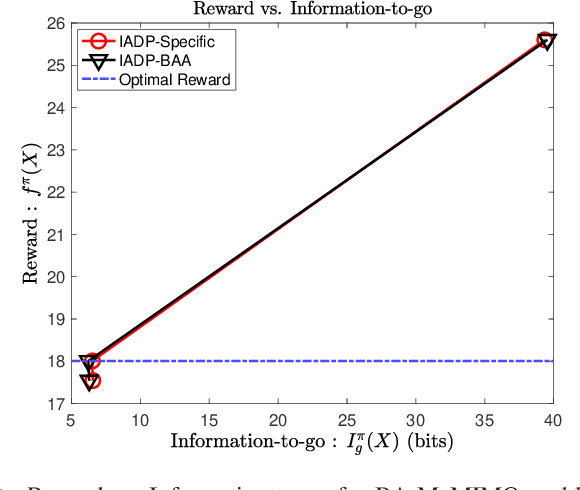
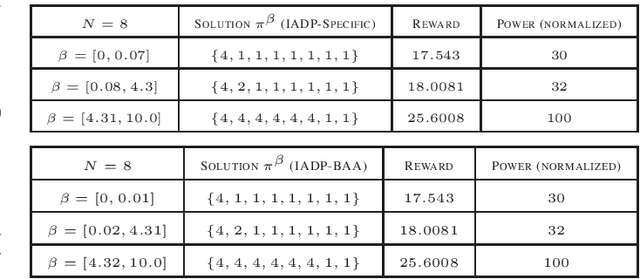
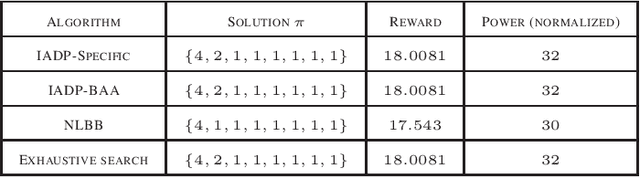
We consider a class of resource allocation problems given a set of unconditional constraints whose objective function satisfies Bellman's optimality principle. Such problems are ubiquitous in wireless communication, signal processing, and networking. These constrained combinatorial optimization problems are, in general, NP-Hard. This paper proposes two algorithms to solve this class of problems using a dynamic programming framework assisted by an information-theoretic measure. We demonstrate that the proposed algorithms ensure optimal solutions under carefully chosen conditions and use significantly reduced computational resources. We substantiate our claims by solving the power-constrained bit allocation problem in 5G massive Multiple-Input Multiple-Output receivers using the proposed approach.
A Low-Complexity Multi-Survivor Dynamic Programming for Constrained Discrete Optimization
May 13, 2021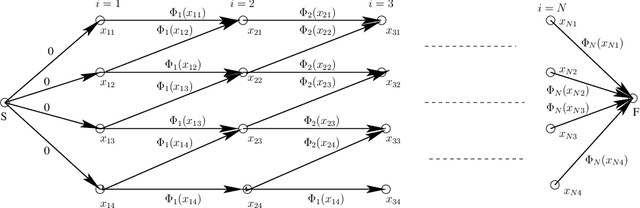
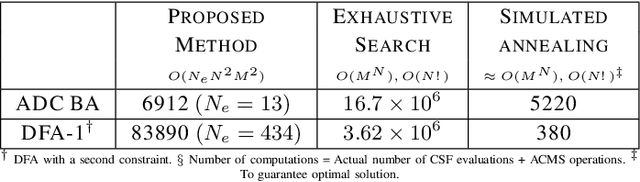

Constrained discrete optimization problems are encountered in many areas of communication and machine learning. We consider the case where the objective function satisfies Bellman's optimality principle without the constraints on which we place no conditions. We first show that these problems are a generalization of optimization in constrained Markov decision processes with finite horizon used in reinforcement learning and are NP-Hard. We then present a novel multi-survivor dynamic programming (msDP) algorithm that guarantees optimality at significant computational savings. We demonstrate this by solving 5G quantizer bit allocation and DNA fragment assembly problems. The results are very promising and suggest that msDP can be used for many applications.
An Optimal Low-Complexity Energy-Efficient ADC Bit Allocation for Massive MIMO
Apr 12, 2021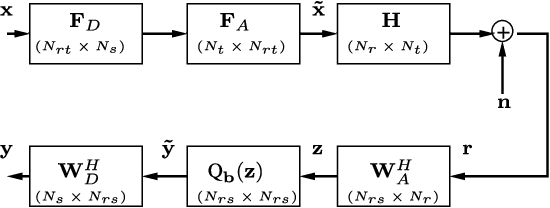
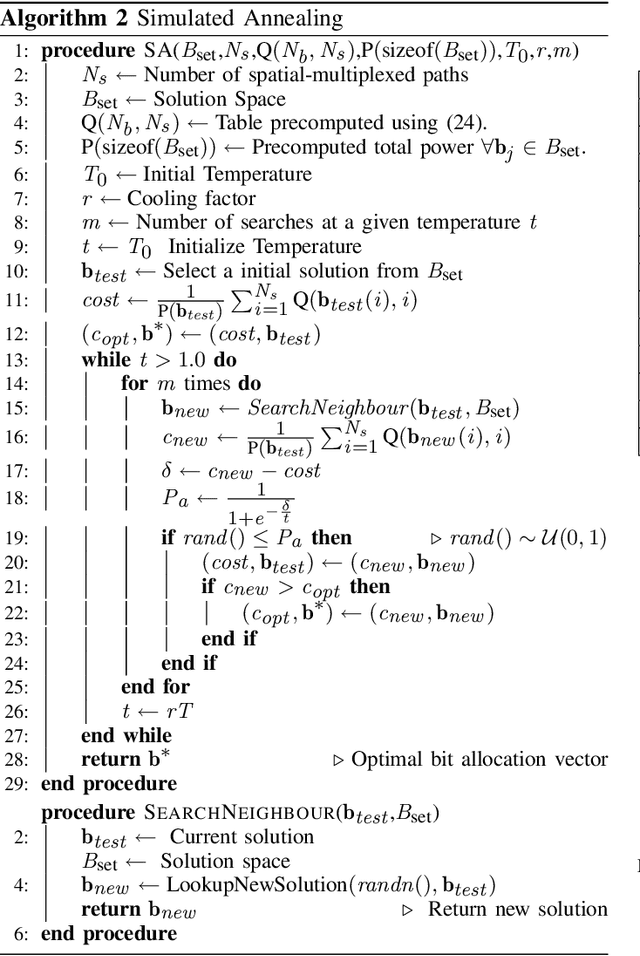
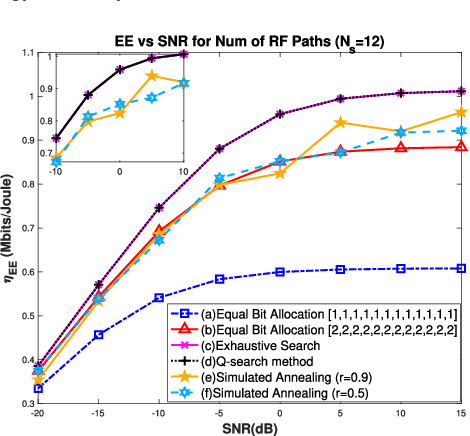
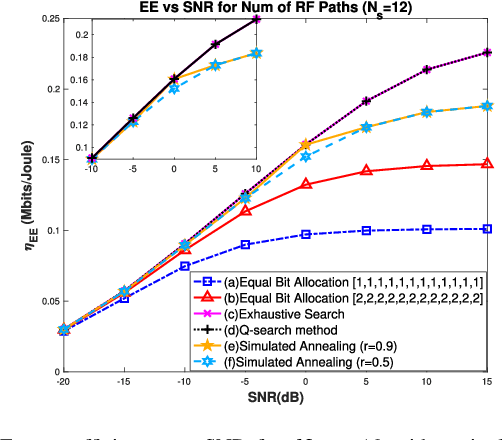
Fixed low-resolution Analog to Digital Converters (ADC) help reduce the power consumption in millimeter-wave Massive Multiple-Input Multiple-Output (Ma-MIMO) receivers operating at large bandwidths. However, they do not guarantee optimal Energy Efficiency (EE). It has been shown that adopting variable-resolution (VR) ADCs in Ma-MIMO receivers can improve performance with Mean Squared Error (MSE) and throughput while providing better EE. In this paper, we present an optimal energy-efficient bit allocation (BA) algorithm for Ma-MIMO receivers equipped with VR ADCs under a power constraint. We derive an expression for EE as a function of the Cramer-Rao Lower Bound on the MSE of the received, combined, and quantized signal. An optimal BA condition is derived by maximizing EE under a power constraint. We show that the optimal BA thus obtained is exactly the same as that obtained using the brute-force BA with a significant reduction in computational complexity. We also study the EE performance and computational complexity of a heuristic algorithm that yields a near-optimal solution.
* arXiv admin note: text overlap with arXiv:1902.03375