 Add to Chrome
 Add to Firefox
 Add to Edge
MASFIN: A Multi-Agent System for Decomposed Financial Reasoning and Forecasting
Dec 26, 2025
Recent advances in large language models (LLMs) are transforming data-intensive domains, with finance representing a high-stakes environment where transparent and reproducible analysis of heterogeneous signals is essential. Traditional quantitative methods remain vulnerable to survivorship bias, while many AI-driven approaches struggle with signal integration, reproducibility, and computational efficiency. We introduce MASFIN, a modular multi-agent framework that integrates LLMs with structured financial metrics and unstructured news, while embedding explicit bias-mitigation protocols. The system leverages GPT-4.1-nano for reproducability and cost-efficient inference and generates weekly portfolios of 15-30 equities with allocation weights optimized for short-term performance. In an eight-week evaluation, MASFIN delivered a 7.33% cumulative return, outperforming the S&P 500, NASDAQ-100, and Dow Jones benchmarks in six of eight weeks, albeit with higher volatility. These findings demonstrate the promise of bias-aware, generative AI frameworks for financial forecasting and highlight opportunities for modular multi-agent design to advance practical, transparent, and reproducible approaches in quantitative finance.

Sarcasm Detection: A Comparative Study
Jul 07, 2021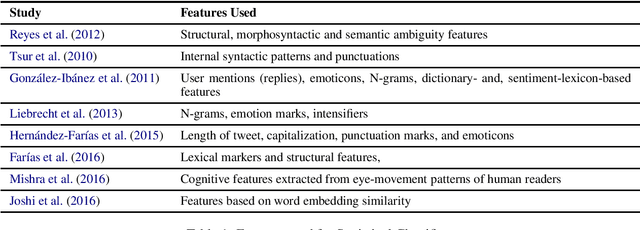
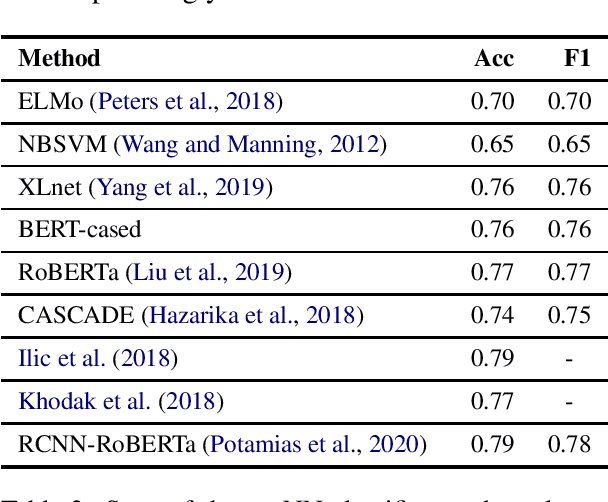
Sarcasm detection is the task of identifying irony containing utterances in sentiment-bearing text. However, the figurative and creative nature of sarcasm poses a great challenge for affective computing systems performing sentiment analysis. This article compiles and reviews the salient work in the literature of automatic sarcasm detection. Thus far, three main paradigm shifts have occurred in the way researchers have approached this task: 1) semi-supervised pattern extraction to identify implicit sentiment, 2) use of hashtag-based supervision, and 3) incorporation of context beyond target text. In this article, we provide a comprehensive review of the datasets, approaches, trends, and issues in sarcasm and irony detection.