 Add to Chrome
 Add to Firefox
 Add to Edge
Progressive Self-Supervised Learning with Individualized Community Assignment for Brain Network Analysis
Jun 29, 2026
Brain networks exhibit a modular community structure that varies across individuals and neurological conditions. However, existing self-supervised learning (SSL) methods often overlook this heterogeneity, relying on generic masking strategies that fail to capture subject-specific functional organization. We propose BrainPICM, a self-supervised framework for brain network analysis via progressive individualized community aware masking. BrainPICM formulates ROI-to-community mapping as a progressive unbalanced optimal transport process, yielding soft assignments and per-ROI confidence scores. Guided by these confidence estimates, a curriculum-style masking strategy gradually incorporates low-confidence, potentially pathological regions into training, enabling the model to learn both stable modular structures and individual variations. Additionally, a deviation-aware aggregation module quantifies functional reorganization by measuring mass redistribution relative to a population template, enhancing interpretability and downstream prediction. Experiments on three fMRI datasets (ABIDE-I, ADHD-200, ADNI) show that BrainPICM consistently outperforms state-of-the-art supervised and SSL methods in diagnostic accuracy, indicating that explicitly injecting modular community structure into masked modeling yields more functionally consistent and generalizable representations. The source code for this approach will be released at https://github.com/Hrychen7/BrainPICM.

Advancing Brain Imaging Analysis Step-by-step via Progressive Self-paced Learning
Jul 23, 2024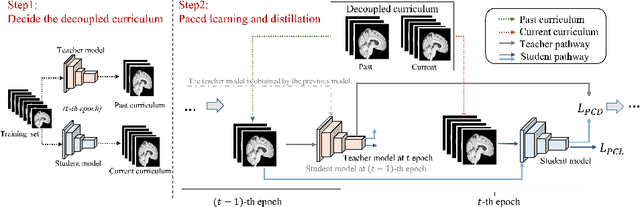
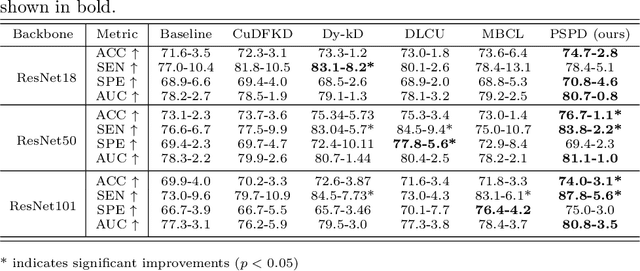
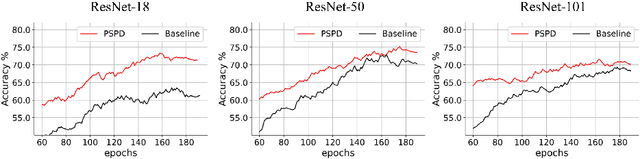
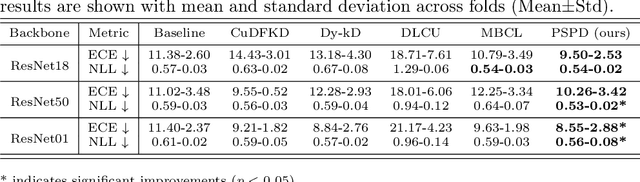
Recent advancements in deep learning have shifted the development of brain imaging analysis. However, several challenges remain, such as heterogeneity, individual variations, and the contradiction between the high dimensionality and small size of brain imaging datasets. These issues complicate the learning process, preventing models from capturing intrinsic, meaningful patterns and potentially leading to suboptimal performance due to biases and overfitting. Curriculum learning (CL) presents a promising solution by organizing training examples from simple to complex, mimicking the human learning process, and potentially fostering the development of more robust and accurate models. Despite its potential, the inherent limitations posed by small initial training datasets present significant challenges, including overfitting and poor generalization. In this paper, we introduce the Progressive Self-Paced Distillation (PSPD) framework, employing an adaptive and progressive pacing and distillation mechanism. This allows for dynamic curriculum adjustments based on the states of both past and present models. The past model serves as a teacher, guiding the current model with gradually refined curriculum knowledge and helping prevent the loss of previously acquired knowledge. We validate PSPD's efficacy and adaptability across various convolutional neural networks using the Alzheimer's Disease Neuroimaging Initiative (ADNI) dataset, underscoring its superiority in enhancing model performance and generalization capabilities. The source code for this approach will be released at https://github.com/Hrychen7/PSPD.