 Add to Chrome
 Add to Firefox
 Add to Edge
Conditional Neural Bayes Ratio Estimation for Experimental Design Optimisation
Mar 27, 2026
For frontier experiments operating at the edge of detectability, instrument design directly determines the probability of discovery. We introduce Conditional Neural Bayes Ratio Estimation (cNBRE), which extends neural Bayes ratio estimation by conditioning on design parameters, enabling a single trained network to estimate Bayes factors across a continuous design space. Applied to 21-cm radio cosmology with simulations representative of the REACH experiment, the amortised nature of cNBRE enables systematic design space exploration that would be intractable with traditional point-wise methods, while recovering established physical relationships. The analysis demonstrates a ~20 percentage point variation in detection probability with antenna orientation for a single night of observation, a design decision that would be trivial to implement if determined prior to antenna construction. This framework enables efficient, globally-informed experimental design optimisation for a wide range of scientific applications.

Radiometer Calibration using Machine Learning
Apr 23, 2025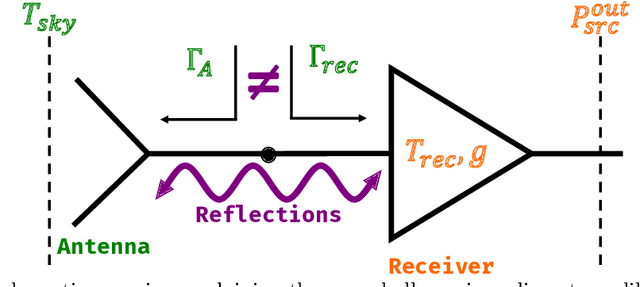
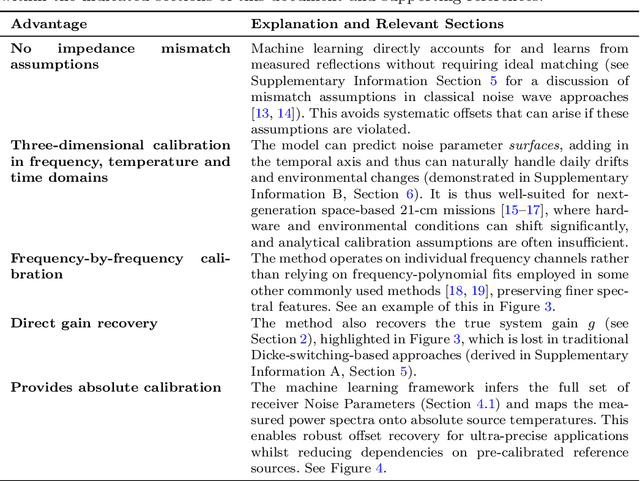
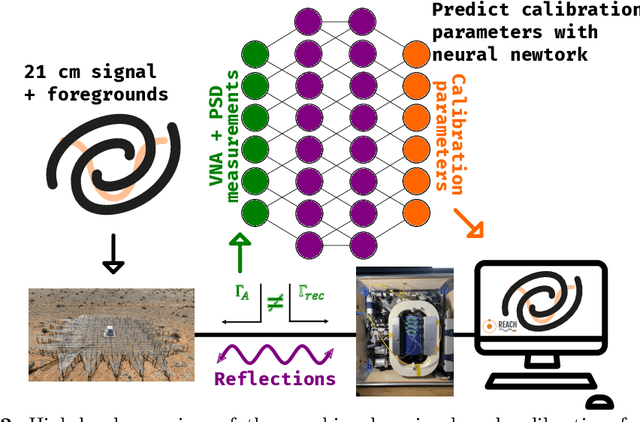
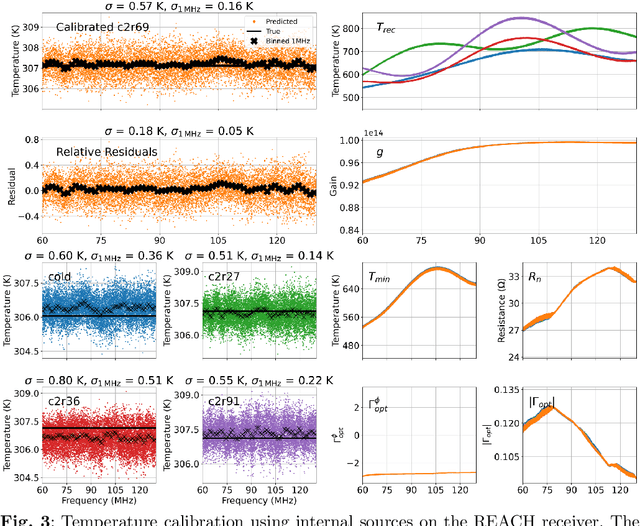
Radiometers are crucial instruments in radio astronomy, forming the primary component of nearly all radio telescopes. They measure the intensity of electromagnetic radiation, converting this radiation into electrical signals. A radiometer's primary components are an antenna and a Low Noise Amplifier (LNA), which is the core of the ``receiver'' chain. Instrumental effects introduced by the receiver are typically corrected or removed during calibration. However, impedance mismatches between the antenna and receiver can introduce unwanted signal reflections and distortions. Traditional calibration methods, such as Dicke switching, alternate the receiver input between the antenna and a well-characterised reference source to mitigate errors by comparison. Recent advances in Machine Learning (ML) offer promising alternatives. Neural networks, which are trained using known signal sources, provide a powerful means to model and calibrate complex systems where traditional analytical approaches struggle. These methods are especially relevant for detecting the faint sky-averaged 21-cm signal from atomic hydrogen at high redshifts. This is one of the main challenges in observational Cosmology today. Here, for the first time, we introduce and test a machine learning-based calibration framework capable of achieving the precision required for radiometric experiments aiming to detect the 21-cm line.