 Add to Chrome
 Add to Firefox
 Add to Edge
Missing Pattern Recognized Diffusion Imputation Model for Missing Not At Random
May 25, 2026
Missing data frequently arises across diverse domains, including time-series and image domains. In the real world, missing occurrences often depend on the unobservable values themselves, which are referred to as Missing Not at Random (MNAR). In this work, we introduce the Missing Pattern Recognized Diffusion Imputation Model (PRDIM), a novel framework that explicitly captures the missing pattern and precisely imputes unobserved values. PRDIM iteratively maximizes the likelihood of the joint distribution for observed values and missing mask under an Expectation-Maximization (EM) algorithm. In this sense, we first employ a pattern recognizer, which approximates the underlying missing pattern and provides guidance during every inference toward more plausible imputations with respect to the missing information. Through extensive experiments, we demonstrate that PRDIM consistently achieves strong imputation performance under MNAR settings across multiple data modalities.

Distilling Dataset into Neural Field
Mar 05, 2025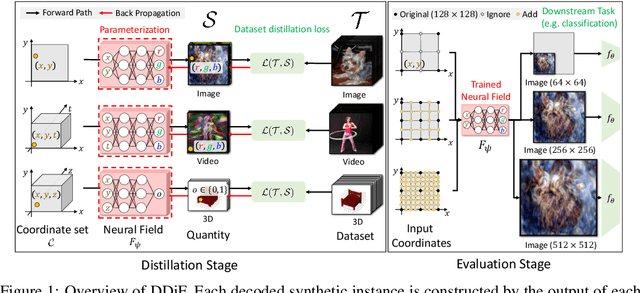
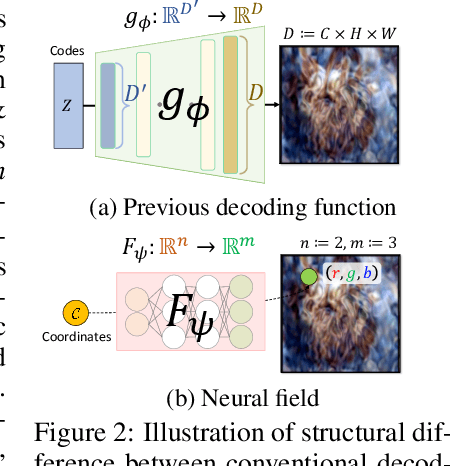
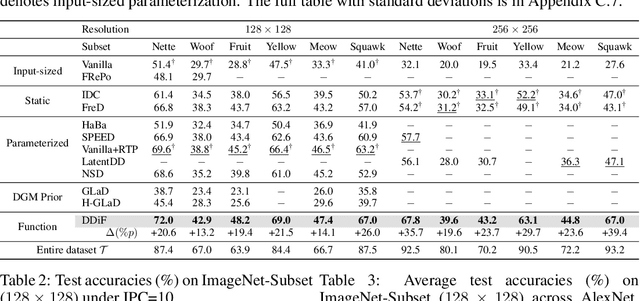
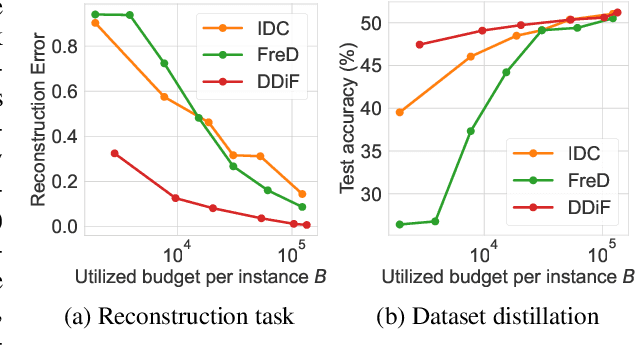
Utilizing a large-scale dataset is essential for training high-performance deep learning models, but it also comes with substantial computation and storage costs. To overcome these challenges, dataset distillation has emerged as a promising solution by compressing the large-scale dataset into a smaller synthetic dataset that retains the essential information needed for training. This paper proposes a novel parameterization framework for dataset distillation, coined Distilling Dataset into Neural Field (DDiF), which leverages the neural field to store the necessary information of the large-scale dataset. Due to the unique nature of the neural field, which takes coordinates as input and output quantity, DDiF effectively preserves the information and easily generates various shapes of data. We theoretically confirm that DDiF exhibits greater expressiveness than some previous literature when the utilized budget for a single synthetic instance is the same. Through extensive experiments, we demonstrate that DDiF achieves superior performance on several benchmark datasets, extending beyond the image domain to include video, audio, and 3D voxel. We release the code at https://github.com/aailab-kaist/DDiF.