 Add to Chrome
 Add to Firefox
 Add to Edge
IPv2: An Improved Image Purification Strategy for Real-World Ultra-Low-Dose Lung CT Denoising
Feb 22, 2026
The image purification strategy constructs an intermediate distribution with aligned anatomical structures, which effectively corrects the spatial misalignment between real-world ultra-low-dose CT and normal-dose CT images and significantly enhances the structural preservation ability of denoising models. However, this strategy exhibits two inherent limitations. First, it suppresses noise only in the chest wall and bone regions while leaving the image background untreated. Second, it lacks a dedicated mechanism for denoising the lung parenchyma. To address these issues, we systematically redesign the original image purification strategy and propose an improved version termed IPv2. The proposed strategy introduces three core modules, namely Remove Background, Add noise, and Remove noise. These modules endow the model with denoising capability in both background and lung tissue regions during training data construction and provide a more reasonable evaluation protocol through refined label construction at the testing stage. Extensive experiments on our previously established real-world patient lung CT dataset acquired at 2% radiation dose demonstrate that IPv2 consistently improves background suppression and lung parenchyma restoration across multiple mainstream denoising models. The code is publicly available at https://github.com/MonkeyDadLufy/Image-Purification-Strategy-v2.

ACQ: Improving Generative Data-free Quantization Via Attention Correction
Jan 18, 2023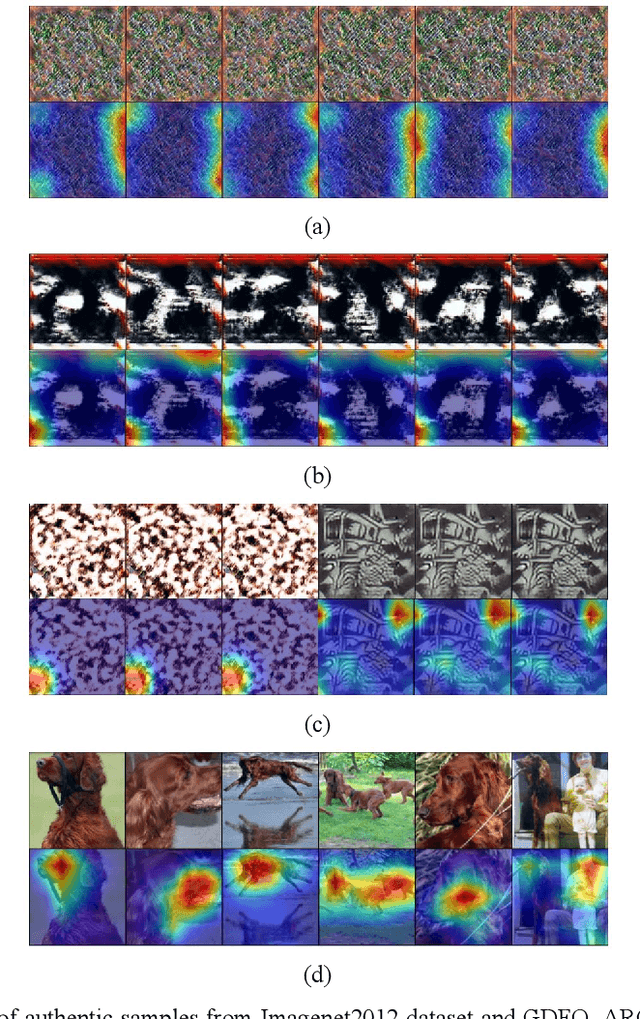

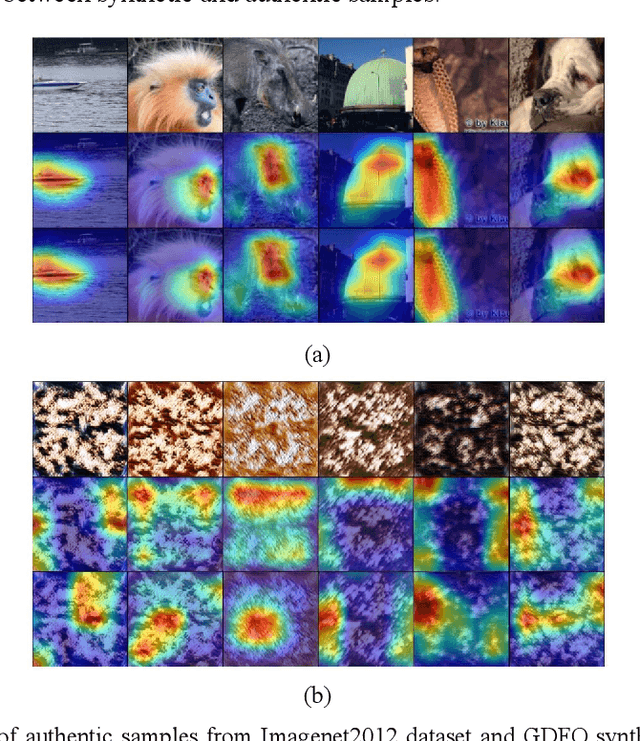
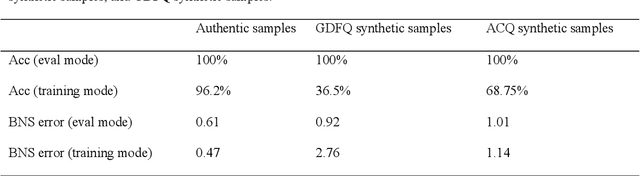
Data-free quantization aims to achieve model quantization without accessing any authentic sample. It is significant in an application-oriented context involving data privacy. Converting noise vectors into synthetic samples through a generator is a popular data-free quantization method, which is called generative data-free quantization. However, there is a difference in attention between synthetic samples and authentic samples. This is always ignored and restricts the quantization performance. First, since synthetic samples of the same class are prone to have homogenous attention, the quantized network can only learn limited modes of attention. Second, synthetic samples in eval mode and training mode exhibit different attention. Hence, the batch-normalization statistics matching tends to be inaccurate. ACQ is proposed in this paper to fix the attention of synthetic samples. An attention center position-condition generator is established regarding the homogenization of intra-class attention. Restricted by the attention center matching loss, the attention center position is treated as the generator's condition input to guide synthetic samples in obtaining diverse attention. Moreover, we design adversarial loss of paired synthetic samples under the same condition to prevent the generator from paying overmuch attention to the condition, which may result in mode collapse. To improve the attention similarity of synthetic samples in different network modes, we introduce a consistency penalty to guarantee accurate BN statistics matching. The experimental results demonstrate that ACQ effectively improves the attention problems of synthetic samples. Under various training settings, ACQ achieves the best quantization performance. For the 4-bit quantization of Resnet18 and Resnet50, ACQ reaches 67.55% and 72.23% accuracy, respectively.