 Add to Chrome
 Add to Firefox
 Add to Edge
Thermodynamic Isomorphism of Transformers: A Lagrangian Approach to Attention Dynamics
Feb 09, 2026
Although the Transformer architecture has revolutionized artificial intelligence, its underlying mechanisms remain largely heuristic and lack a unified physical theory. In this work, we propose a first-principles framework for information dynamics, treating the attention mechanism as a physical system governed by the principle of least action rather than as an algorithmic optimization. By mapping information states to a Riemannian manifold with the Fisher information metric, we derive the intelligence Lagrangian. We show that the softmax function corresponds to the unique thermodynamic equilibrium state that minimizes the Helmholtz free energy of the information gas. In addition, we identify the query-key interaction as an electrodynamic coupling between an external field and an intrinsic dipole moment. This theory establishes the first law of information thermodynamics, unifying inference (mechanical work) and learning (chemical evolution). It also explains emergent phenomena, such as scaling laws and grokking, as phase transitions characterized by the divergence of specific heat. Finally, we discuss how rotational symmetry breaking in the attention manifold generates massless Goldstone bosons, providing a field-theoretic perspective on rotary positional embeddings (RoPE). Our work connects Statistical Physics and Deep Learning, laying the groundwork for a general theory of physics-based intelligence.

CNN-based TEM image denoising from first principles
Jan 20, 2025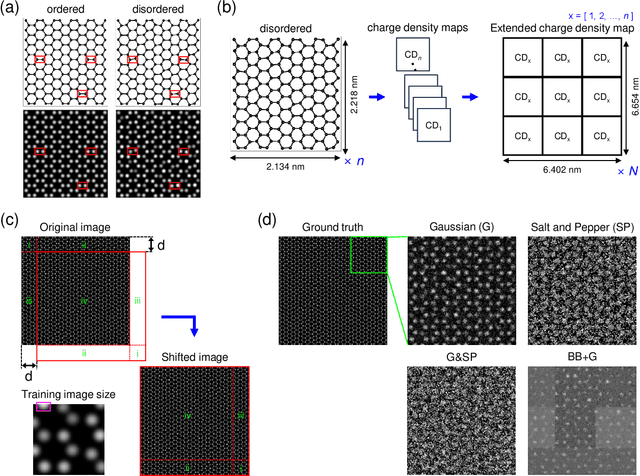
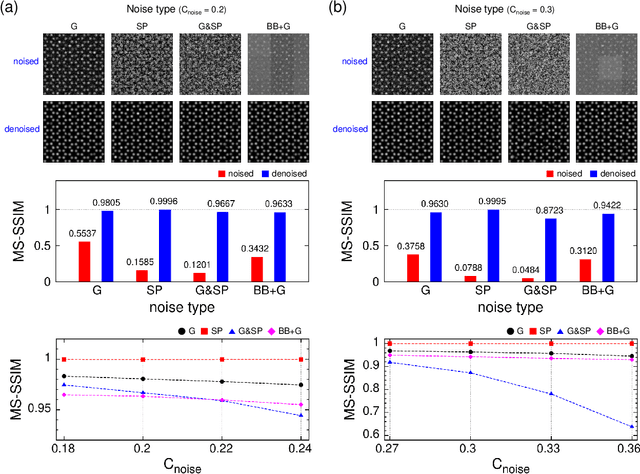


Transmission electron microscope (TEM) images are often corrupted by noise, hindering their interpretation. To address this issue, we propose a deep learning-based approach using simulated images. Using density functional theory calculations with a set of pseudo-atomic orbital basis sets, we generate highly accurate ground truth images. We introduce four types of noise into these simulations to create realistic training datasets. Each type of noise is then used to train a separate convolutional neural network (CNN) model. Our results show that these CNNs are effective in reducing noise, even when applied to images with different noise levels than those used during training. However, we observe limitations in some cases, particularly in preserving the integrity of circular shapes and avoiding visible artifacts between image patches. To overcome these challenges, we propose alternative training strategies and future research directions. This study provides a valuable framework for training deep learning models for TEM image denoising.