 Add to Chrome
 Add to Firefox
 Add to Edge
ChildSafeAds Shared Task 2026: Commercial Content in Child-Facing YouTube Videos
Aug 19, 2026
ChildSafeAds is a shared task on commercial content in YouTube videos likely to reach children and teenagers. It contains 3,360 videos from 939 channels. Each instance begins with a segment submitted to SponsorBlock, an open-source crowdsourced browser extension whose users mark sponsor segments so that others can skip them. We pair the segment with its available transcript, video and channel information, and a sales or service page linked from the video description. Systems determine what kind of offer is being promoted (ST1), assign product categories (ST2), and identify legal risk flags (ST3). The evidence is divided into four cumulative access levels, from the transcript to the linked page, so results can be compared against the cost of collecting the data. 45.5\% of videos in our data failed to properly use the in-platform ad disclosure method (the ``Includes paid promotion'' label). GPT-5.4 produced the labels after the expert organiser team reviewed samples and iterated on the taxonomy, prompts and model choices. GPT-5.6-luna independently labelled the development set. This report describes the task, data and evaluation. An updated version will add participating systems and shared-task results.

Targeted and Troublesome: Tracking and Advertising on Children's Websites
Aug 09, 2023
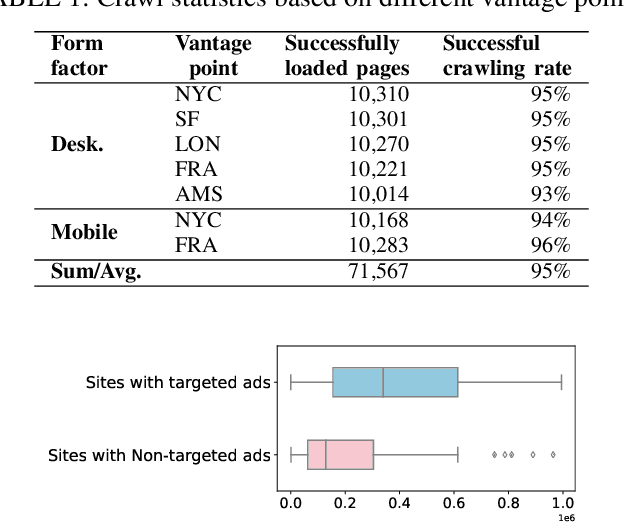

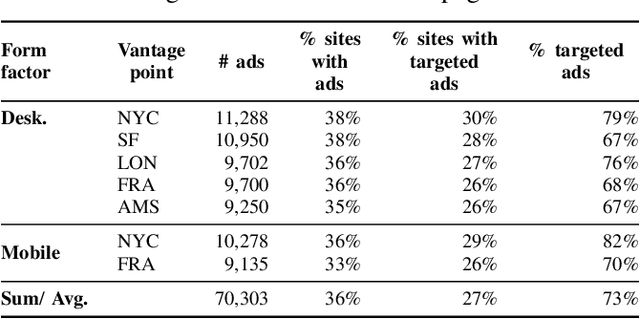
On the modern web, trackers and advertisers frequently construct and monetize users' detailed behavioral profiles without consent. Despite various studies on web tracking mechanisms and advertisements, there has been no rigorous study focusing on websites targeted at children. To address this gap, we present a measurement of tracking and (targeted) advertising on websites directed at children. Motivated by lacking a comprehensive list of child-directed (i.e., targeted at children) websites, we first build a multilingual classifier based on web page titles and descriptions. Applying this classifier to over two million pages, we compile a list of two thousand child-directed websites. Crawling these sites from five vantage points, we measure the prevalence of trackers, fingerprinting scripts, and advertisements. Our crawler detects ads displayed on child-directed websites and determines if ad targeting is enabled by scraping ad disclosure pages whenever available. Our results show that around 90% of child-directed websites embed one or more trackers, and about 27% contain targeted advertisements--a practice that should require verifiable parental consent. Next, we identify improper ads on child-directed websites by developing an ML pipeline that processes both images and text extracted from ads. The pipeline allows us to run semantic similarity queries for arbitrary search terms, revealing ads that promote services related to dating, weight loss, and mental health; as well as ads for sex toys and flirting chat services. Some of these ads feature repulsive and sexually explicit imagery. In summary, our findings indicate a trend of non-compliance with privacy regulations and troubling ad safety practices among many advertisers and child-directed websites. To protect children and create a safer online environment, regulators and stakeholders must adopt and enforce more stringent measures.