 Add to Chrome
 Add to Firefox
 Add to Edge
REDACT: A Systematically Controlled Multilingual Benchmark for Personal Information Detection
Jun 18, 2026
Benchmark infrastructure for personally identifiable information (PII) detection remains limited: existing corpora cover few entity types, use ad hoc generation conditions, and do not show which surface conditions cause detector failures. We present REDACT, a systematically controlled multilingual PII benchmark with 13,427 records, 324,078 entity annotations, 51 entity types, 4,127 surface-form patterns, and 25 languages across 9 scripts. A strength-2 covering-array sampler controls nine generation axes: domain, format, difficulty, length, density, code-switching, language, adjacency, and co-occurrence. Three entity-level metadata fields (disclosure status, disclosure form, and a GDPR-aligned sensitivity tier) enable stratified evaluation beyond aggregate or per-type F1. From the full benchmark, we evaluate five detectors (Presidio, GLiNER, the OpenAI Privacy Filter, GPT-4.1, and Claude Sonnet 4.6) on a locked, language-stratified sample of 1,000 records. Aggregate F1 masks an architecture-dependent failure structure: the rule-based detector performs poorly on the highest-stakes data, including HIGH-sensitivity categories (recall 0.07) and non-verbatim disclosure forms, while the LLM detectors remain more robust, with the HIGH tier as their strongest sensitivity slice. A three-model reference-free LLM-as-judge assessment corroborates that sensitivity-tier assignment is the task's hardest axis. We release the benchmark, schema, prompts, and stratified evaluation harness.

Decoding Emotion: Speech Perception Patterns in Individuals with Self-reported Depression
Dec 28, 2024
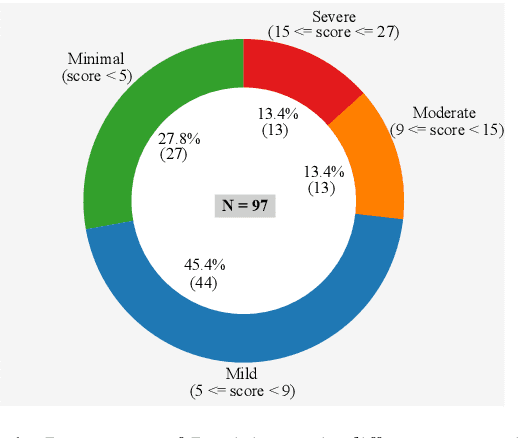

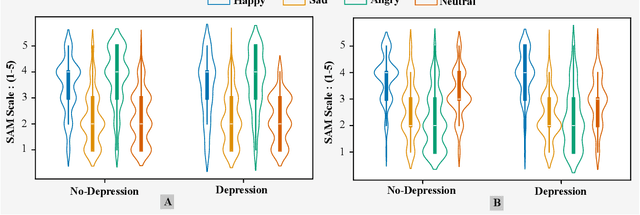
The current study examines the relationship between self-reported depression and the perception of affective speech within the Indian population. PANAS and PHQ-9 were used to assess current mood and depression, respectively. Participants' emotional reactivity was recorded on a valence and arousal scale against the affective speech audio presented in a sequence. No significant differences between the depression and no-depression groups were observed for any of the emotional stimuli, except the audio file depicting neutral emotion. Significantly higher PANAS scores by the depression than the no-depression group indicate the impact of pre-disposed mood on the current mood status. Contrary to previous findings, this study did not observe reduced positive emotional reactivity by the depression group. However, the results demonstrated consistency in emotional reactivity for speech stimuli depicting sadness and anger across all measures of emotion perception.