 Add to Chrome
 Add to Firefox
 Add to Edge
Compiler-Assisted Speculative Sampling for Accelerated LLM Inference on Heterogeneous Edge Devices
Feb 08, 2026
LLM deployment on resource-constrained edge devices faces severe latency constraints, particularly in real-time applications where delayed responses can compromise safety or usability. Among many approaches to mitigate the inefficiencies of sequential token-by-token generation, Speculative Decoding (SD) has emerged as a promising technique. However, SD at the edge is hindered by two major challenges: (1) integrating SD into a compiler-based workflow without sacrificing performance or programmability, and (2) exploiting the heterogeneous compute resources of modern SoCs through carefully designed partitioning strategies. This work addresses these challenges by using an analytical cost model that explores heterogeneous hardware configurations and guides coarse-grained partitioning of LLM subgraphs, particularly with edge-typical short input sequence lengths. The cost model predicts when speculative sampling and heterogeneous execution are jointly beneficial and is validated on an edge device featuring a hexacore Cortex-A CPU and a Mali GPU, revealing up to 1.68$\times$ speedup for translation tasks, closely matching analytic expectations.

Leveraging Stochastic Depth Training for Adaptive Inference
May 23, 2025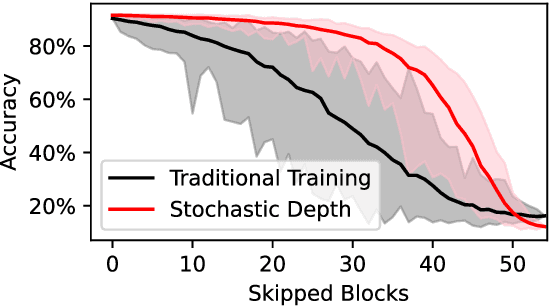
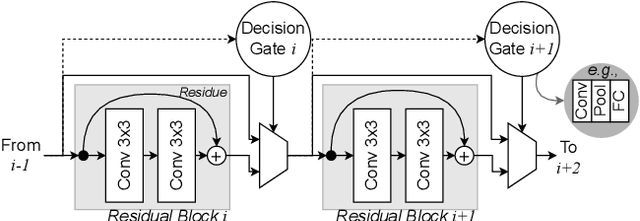
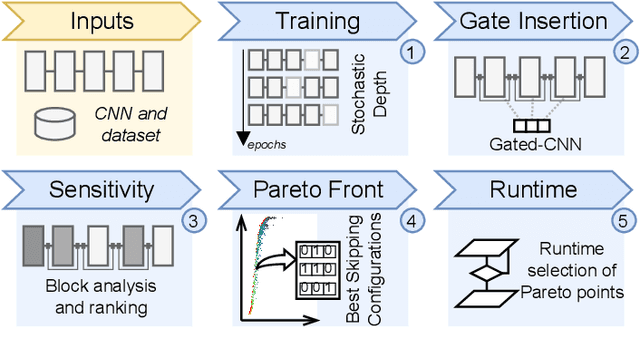
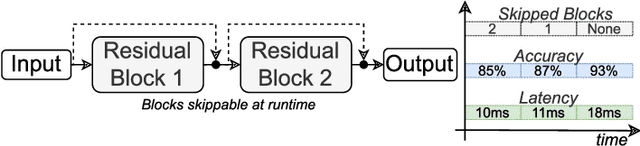
Dynamic DNN optimization techniques such as layer-skipping offer increased adaptability and efficiency gains but can lead to i) a larger memory footprint as in decision gates, ii) increased training complexity (e.g., with non-differentiable operations), and iii) less control over performance-quality trade-offs due to its inherent input-dependent execution. To approach these issues, we propose a simpler yet effective alternative for adaptive inference with a zero-overhead, single-model, and time-predictable inference. Central to our approach is the observation that models trained with Stochastic Depth -- a method for faster training of residual networks -- become more resilient to arbitrary layer-skipping at inference time. We propose a method to first select near Pareto-optimal skipping configurations from a stochastically-trained model to adapt the inference at runtime later. Compared to original ResNets, our method shows improvements of up to 2X in power efficiency at accuracy drops as low as 0.71%.