 Add to Chrome
 Add to Firefox
 Add to Edge
ADaFuSE: Adaptive Diffusion-generated Image and Text Fusion for Interactive Text-to-Image Retrieval
Mar 23, 2026
Recent advances in interactive text-to-image retrieval (I-TIR) use diffusion models to bridge the modality gap between the textual information need and the images to be searched, resulting in increased effectiveness. However, existing frameworks fuse multi-modal views of user feedback by simple embedding addition. In this work, we show that this static and undifferentiated fusion indiscriminately incorporates generative noise produced by the diffusion model, leading to performance degradation for up to 55.62% samples. We further propose ADaFuSE (Adaptive Diffusion-Text Fusion with Semantic-aware Experts), a lightweight fusion model designed to align and calibrate multi-modal views for diffusion-augmented I-TIR, which can be plugged into existing frameworks without modifying the backbone encoder. Specifically, we introduce a dual-branch fusion mechanism that employs an adaptive gating branch to dynamically balance modality reliability, alongside a semantic-aware mixture-of-experts branch to capture fine-grained cross-modal nuances. Via thorough evaluation over four standard I-TIR benchmarks, ADaFuSE achieves state-of-the-art performance, surpassing DAR by up to 3.49% in Hits@10 with only a 5.29% parameter increase, while exhibiting stronger robustness to noisy and longer interactive queries. These results show that generative augmentation coupled with principled fusion provides a simple, generalizable alternative to fine-tuning for interactive retrieval.

Is Training Necessary for Anomaly Detection?
Jan 30, 2026Current state-of-the-art multi-class unsupervised anomaly detection (MUAD) methods rely on training encoder-decoder models to reconstruct anomaly-free features. We first show these approaches have an inherent fidelity-stability dilemma in how they detect anomalies via reconstruction residuals. We then abandon the reconstruction paradigm entirely and propose Retrieval-based Anomaly Detection (RAD). RAD is a training-free approach that stores anomaly-free features in a memory and detects anomalies through multi-level retrieval, matching test patches against the memory. Experiments demonstrate that RAD achieves state-of-the-art performance across four established benchmarks (MVTec-AD, VisA, Real-IAD, 3D-ADAM) under both standard and few-shot settings. On MVTec-AD, RAD reaches 96.7\% Pixel AUROC with just a single anomaly-free image compared to 98.5\% of RAD's full-data performance. We further prove that retrieval-based scores theoretically upper-bound reconstruction-residual scores. Collectively, these findings overturn the assumption that MUAD requires task-specific training, showing that state-of-the-art anomaly detection is feasible with memory-based retrieval. Our code is available at https://github.com/longkukuhi/RAD.
Eliminating Hallucination in Diffusion-Augmented Interactive Text-to-Image Retrieval
Jan 28, 2026Diffusion-Augmented Interactive Text-to-Image Retrieval (DAI-TIR) is a promising paradigm that improves retrieval performance by generating query images via diffusion models and using them as additional ``views'' of the user's intent. However, these generative views can be incorrect because diffusion generation may introduce hallucinated visual cues that conflict with the original query text. Indeed, we empirically demonstrate that these hallucinated cues can substantially degrade DAI-TIR performance. To address this, we propose Diffusion-aware Multi-view Contrastive Learning (DMCL), a hallucination-robust training framework that casts DAI-TIR as joint optimization over representations of query intent and the target image. DMCL introduces semantic-consistency and diffusion-aware contrastive objectives to align textual and diffusion-generated query views while suppressing hallucinated query signals. This yields an encoder that acts as a semantic filter, effectively mapping hallucinated cues into a null space, improving robustness to spurious cues and better representing the user's intent. Attention visualization and geometric embedding-space analyses corroborate this filtering behavior. Across five standard benchmarks, DMCL delivers consistent improvements in multi-round Hits@10, reaching as high as 7.37\% over prior fine-tuned and zero-shot baselines, which indicates it is a general and robust training framework for DAI-TIR.
RoboEye: Enhancing 2D Robotic Object Identification with Selective 3D Geometric Keypoint Matching
Sep 18, 2025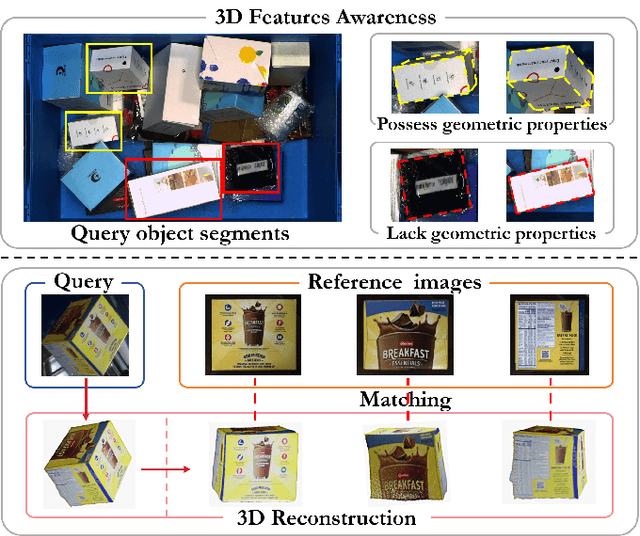
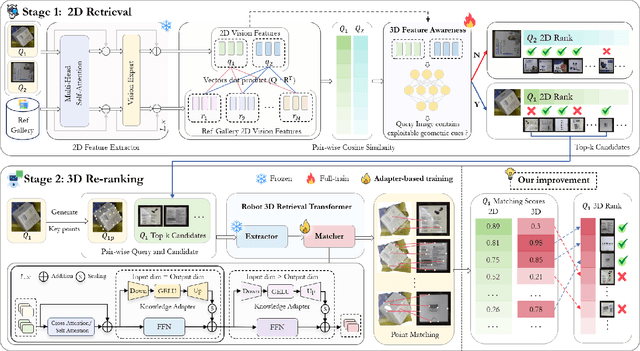
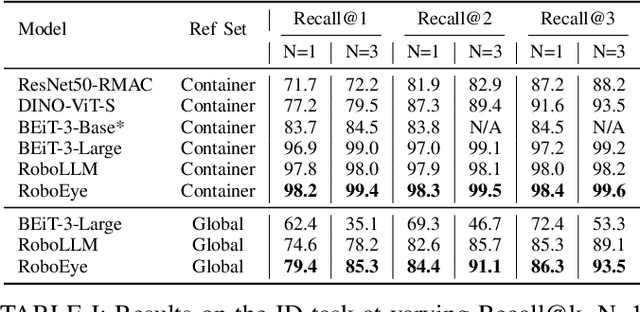
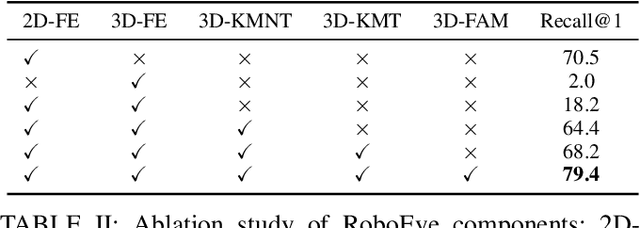
The rapidly growing number of product categories in large-scale e-commerce makes accurate object identification for automated packing in warehouses substantially more difficult. As the catalog grows, intra-class variability and a long tail of rare or visually similar items increase, and when combined with diverse packaging, cluttered containers, frequent occlusion, and large viewpoint changes-these factors amplify discrepancies between query and reference images, causing sharp performance drops for methods that rely solely on 2D appearance features. Thus, we propose RoboEye, a two-stage identification framework that dynamically augments 2D semantic features with domain-adapted 3D reasoning and lightweight adapters to bridge training deployment gaps. In the first stage, we train a large vision model to extract 2D features for generating candidate rankings. A lightweight 3D-feature-awareness module then estimates 3D feature quality and predicts whether 3D re-ranking is necessary, preventing performance degradation and avoiding unnecessary computation. When invoked, the second stage uses our robot 3D retrieval transformer, comprising a 3D feature extractor that produces geometry-aware dense features and a keypoint-based matcher that computes keypoint-correspondence confidences between query and reference images instead of conventional cosine-similarity scoring. Experiments show that RoboEye improves Recall@1 by 7.1% over the prior state of the art (RoboLLM). Moreover, RoboEye operates using only RGB images, avoiding reliance on explicit 3D inputs and reducing deployment costs. The code used in this paper is publicly available at: https://github.com/longkukuhi/RoboEye.