 Add to Chrome
 Add to Firefox
 Add to Edge
Moving Target SAR Imaging Using Planar Arrays And Multidimensional Chinese Remainder Theorem (MD-CRT)--Part II: Two Subarray Designs
Jun 12, 2026
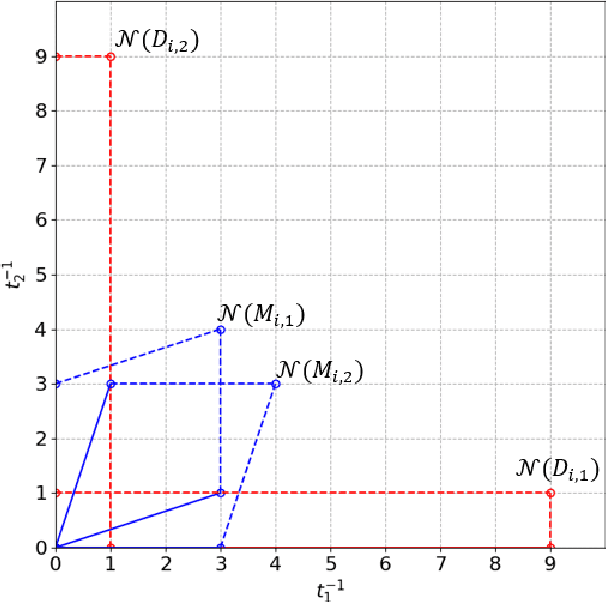
Based on the framework proposed in Part I, the Part II of this two-part paper investigates two-subarray designs for moving target SAR imaging using planar antenna arrays and the multidimensional Chinese remainder theorem (MD-CRT). In this Part II, we focus on the performance analysis and the detailed two planar subarray designs. In particular, we study a common-scaling two-subarray design, under which the two subarrays share the same scaling factor in the MD-CRT formulation. Under this design, ambiguity resolution can be performed on a common integer frequency vector. As a result, the same unambiguous range as in the general two-subarray framework in Part~I is preserved, while the sufficient conditions for robust recovery become weaker and the corresponding reconstruction error bounds become tighter. Within this common-scaling design, we compare the proposed planar array framework with a conventional separated scheme, in which the motion-induced cross-range shift is recovered by a one-dimensional CRT-based method and the target height is estimated by cross-track interferometric processing. Under the same platform size and minimum antenna spacing constraints, the proposed planar array framework can realize the common-scaling design, whereas the corresponding one-dimensional non-uniform linear array scheme does not admit such a design. With this design, the planar array framework leads to a weaker sufficient condition for robust recovery and thus performs better in moving target imaging. We also compare several planar array designs under fixed platform size and minimum antenna spacing. The analysis shows that recovery performance depends not only on the number of antennas but also on the array geometry. In particular, non-separable planar array geometries can provide better robustness than separable ones when their antenna numbers are comparable.

Robust Multidimensional Chinese Remainder Theorem (MD-CRT) with Non-Diagonal Moduli and Multi-Stage Framework
Apr 01, 2026The Chinese remainder theorem (CRT) provides an efficient way to reconstruct an integer from its remainders modulo several integer moduli, and has been widely applied in signal processing and information theory. Its multidimensional extension (MD-CRT) generalizes this principle to integer vectors and integer matrix moduli, enabling reconstruction in multidimensional signal processing scenarios. However, since matrices are generally non-commutative, the multidimensional extension introduces new theoretical and algorithmic challenges. When all matrix moduli are diagonal, the system is equivalent to applying the one-dimensional CRT independently along each dimension. This work first investigates whether non-diagonal (non-separable) moduli offer fundamental advantages over traditional diagonal ones. We show that under the same determinant constraint, non-diagonal matrices do not increase the dynamic range but yield more balanced and better-conditioned sampling patterns. More importantly, they generate lattices with longer shortest vectors, leading to higher robustness to vector remainder errors, compared to diagonal ones. To further improve the robustness, we develop a multi-stage robust MD-CRT framework that improves the robustness level without reducing the dynamic range. Due to the multidimensional nature and modulo matrix forms, it is challenging and not straightforward to extend the existing one-dimensional multi-stage robust CRT. In this paper, we obtain a new condition for matrix moduli, which can be easily checked, such that a multi-stage robust MD-CRT can be implemented. Both theoretical analysis and simulation results demonstrate that the proposed multi-stage robust MD-CRT achieves stronger error tolerance and more reliable reconstruction under erroneous vector remainders than that of single-stage robust MD-CRT.
Prime Integer Matrices
May 01, 2025This paper introduces prime integer matrices and its properties. It provides a simple way to construct families of pairwise co-prime integer matrices, that may have applications in multidimensional co-prime sensing and multidimensional Chinese remainder theorem.
A Construction of Pairwise Co-prime Integer Matrices of Any Dimension and Their Least Common Right Multiple
Apr 10, 2025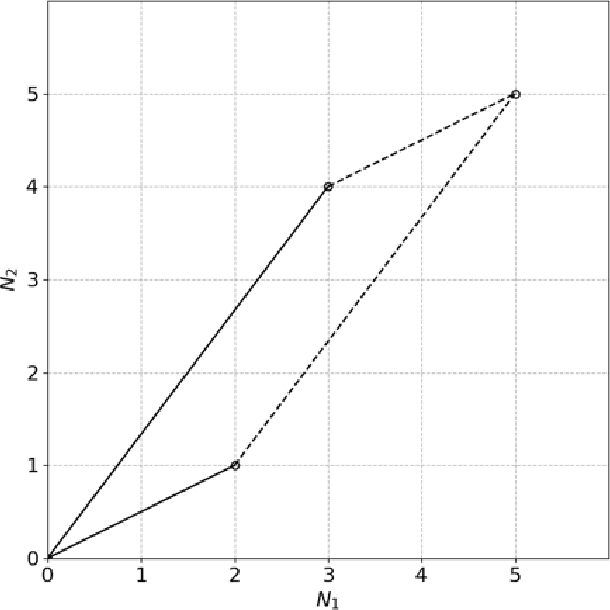
Compared with co-prime integers, co-prime integer matrices are more challenging due to the non-commutativity. In this paper, we present a new family of pairwise co-prime integer matrices of any dimension and large size. These matrices are non-commutative and have low spread, i.e., their ratios of peak absolute values to mean absolute values (or the smallest non-zero absolute values) of their components are low. When matrix dimension is larger than $2$, this family of matrices differs from the existing families, such as circulant, Toeplitz matrices, or triangular matrices, and therefore, offers more varieties in applications. In this paper, we first prove the pairwise coprimality of the constructed matrices, then determine their determinant absolute values, and their least common right multiple (lcrm) with a closed and simple form. We also analyze their sampling rates when these matrices are used as sampling matrices for a multi-dimensional signal. The proposed family of pairwise co-prime integer matrices may have applications in multi-dimensional Chinese remainder theorem (MD-CRT) that can be used to determine integer vectors from their integer vector remainders modulo a set of integer matrix moduli, and also in multi-dimensional sparse sensing and multirate systems.