 Add to Chrome
 Add to Firefox
 Add to Edge
Revisiting the Shape Convention of Transformer Language Models
Feb 06, 2026
Dense Transformer language models have largely adhered to one consistent architectural shape: each layer consists of an attention module followed by a feed-forward network (FFN) with a narrow-wide-narrow MLP, allocating most parameters to the MLP at expansion ratios between 2 and 4. Motivated by recent results that residual wide-narrow-wide (hourglass) MLPs offer superior function approximation capabilities, we revisit the long-standing MLP shape convention in Transformer, challenging the necessity of the narrow-wide-narrow design. To study this, we develop a Transformer variant that replaces the conventional FFN with a deeper hourglass-shaped FFN, comprising a stack of hourglass sub-MLPs connected by residual pathways. We posit that a deeper but lighter hourglass FFN can serve as a competitive alternative to the conventional FFN, and that parameters saved by using a lighter hourglass FFN can be more effectively utilized, such as by enlarging model hidden dimensions under fixed budgets. We confirm these through empirical validations across model scales: hourglass FFNs outperform conventional FFNs up to 400M and achieve comparable performance at larger scales to 1B parameters; hourglass FFN variants with reduced FFN and increased attention parameters show consistent improvements over conventional configurations at matched budgets. Together, these findings shed new light on recent work and prompt a rethinking of the narrow-wide-narrow MLP convention and the balance between attention and FFN towards efficient and expressive modern language models.

Compound AI Systems Optimization: A Survey of Methods, Challenges, and Future Directions
Jun 09, 2025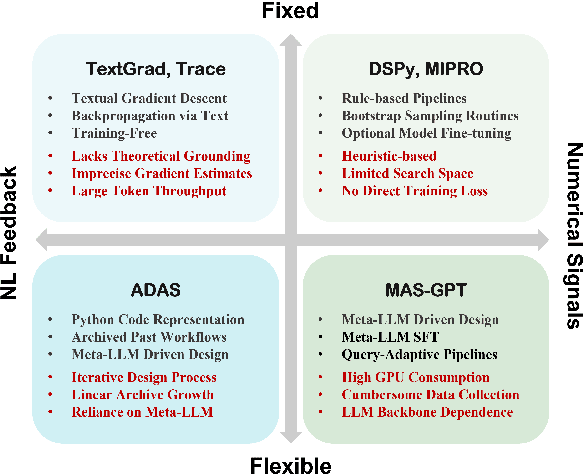
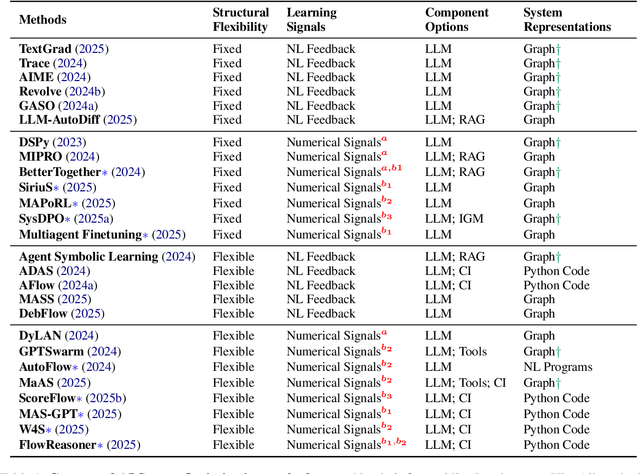
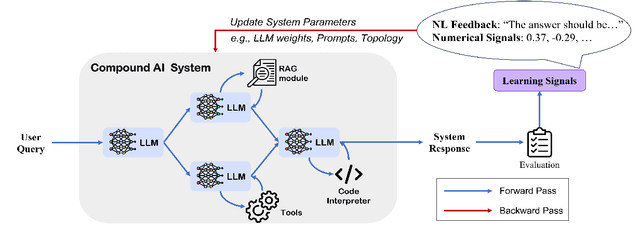
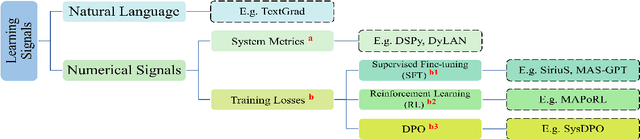
Recent advancements in large language models (LLMs) and AI systems have led to a paradigm shift in the design and optimization of complex AI workflows. By integrating multiple components, compound AI systems have become increasingly adept at performing sophisticated tasks. However, as these systems grow in complexity, new challenges arise in optimizing not only individual components but also their interactions. While traditional optimization methods such as supervised fine-tuning (SFT) and reinforcement learning (RL) remain foundational, the rise of natural language feedback introduces promising new approaches, especially for optimizing non-differentiable systems. This paper provides a systematic review of recent progress in optimizing compound AI systems, encompassing both numerical and language-based techniques. We formalize the notion of compound AI system optimization, classify existing methods along several key dimensions, and highlight open research challenges and future directions in this rapidly evolving field. A list of surveyed papers is publicly available at https://github.com/MiuLab/AISysOpt-Survey.