 Add to Chrome
 Add to Firefox
 Add to Edge
Conditions for well-posed color recovery in scattering media
May 05, 2026
Recovering scene color from images captured in scattering media is a fundamental inverse problem in optical imaging. Yet the problem is intrinsically ill-posed as multiple solutions can explain the same observation, and prediction error cannot be controlled without understanding the space of candidate solutions. Here, we present sufficient conditions under which color recovery in a scattering medium becomes well-posed. Observing that ill-posedness stems from (i) projection of spectral signals onto pixel intensities, and (ii) unknown medium parameters, we demonstrate that sensor improvements alone cannot resolve medium-induced distortions without additional constraints. We identify recovery patterns, cross-pixel relationships that naturally occur in images, and prove, for an ideal hyperspectral camera, that they restrict the solution to a unique candidate. This opens the door to a new class of vision algorithms grounded in first principles, enabling quantitative analysis of images in scattering environments.

Spectral Sensitivity Estimation Without a Camera
Apr 23, 2023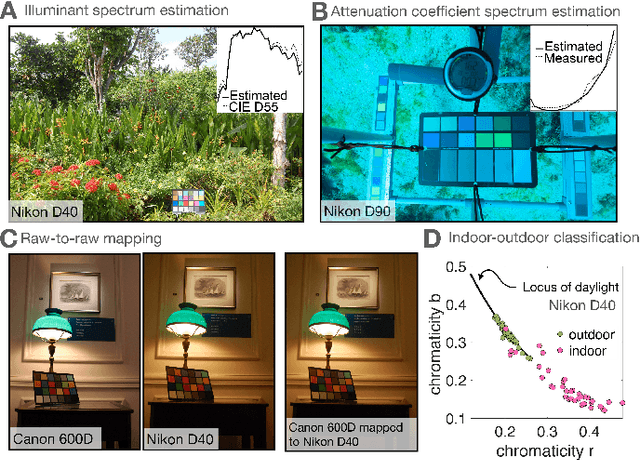
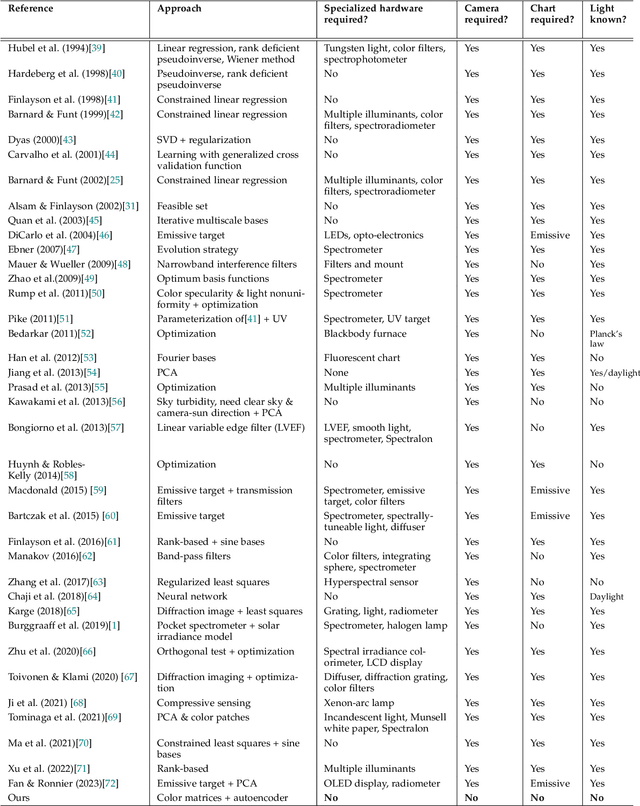
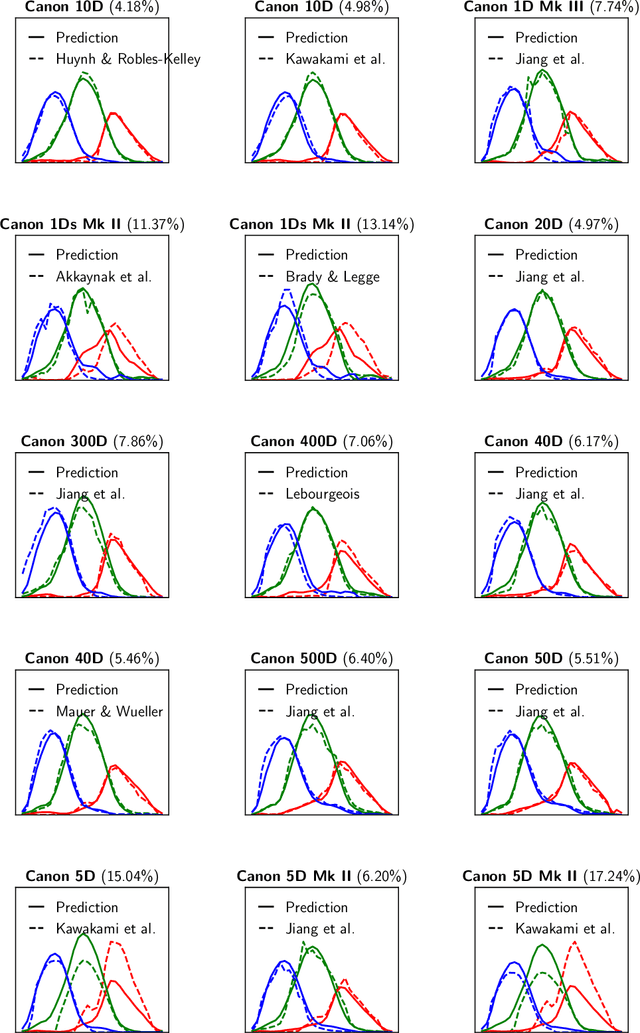
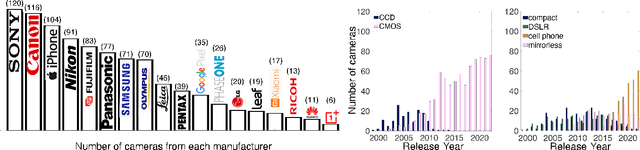
A number of problems in computer vision and related fields would be mitigated if camera spectral sensitivities were known. As consumer cameras are not designed for high-precision visual tasks, manufacturers do not disclose spectral sensitivities. Their estimation requires a costly optical setup, which triggered researchers to come up with numerous indirect methods that aim to lower cost and complexity by using color targets. However, the use of color targets gives rise to new complications that make the estimation more difficult, and consequently, there currently exists no simple, low-cost, robust go-to method for spectral sensitivity estimation. Furthermore, even if not limited by hardware or cost, researchers frequently work with imagery from multiple cameras that they do not have in their possession. To provide a practical solution to this problem, we propose a framework for spectral sensitivity estimation that not only does not require any hardware, but also does not require physical access to the camera itself. Similar to other work, we formulate an optimization problem that minimizes a two-term objective function: a camera-specific term from a system of equations, and a universal term that bounds the solution space. Different than other work, we use publicly available high-quality calibration data to construct both terms. We use the colorimetric mapping matrices provided by the Adobe DNG Converter to formulate the camera-specific system of equations, and constrain the solutions using an autoencoder trained on a database of ground-truth curves. On average, we achieve reconstruction errors as low as those that can arise due to manufacturing imperfections between two copies of the same camera. We provide predicted sensitivities for more than 1,000 cameras that the Adobe DNG Converter currently supports, and discuss which tasks can become trivial when camera responses are available.