 Add to Chrome
 Add to Firefox
 Add to Edge
Understanding Domain-Aware Distribution Alignment in Budgeted Entity Matching
Jun 25, 2026
Entity Matching (EM) is a core operation in the data integration pipeline, where records from different sources are compared to determine whether they refer to the same real-world entity. Recent work has incorporated domain information and low-resource learning techniques to better adapt EM systems to realistic settings. While these approaches have demonstrated strong performance, it remains unclear how they behave under varying data constraints and levels of supervision in practice. In this paper, we investigate a state-of-the-art method for low-resource, domain-aware EM--BEACON--and study how its performance is affected by different algorithmic choices and data availability conditions. We conduct a series of targeted experiments to evaluate these variations, providing deeper insight into the role of distribution alignment and the behavior of the BEACON framework.

Driving the Herd: Search Engines as Content Influencers
Oct 21, 2021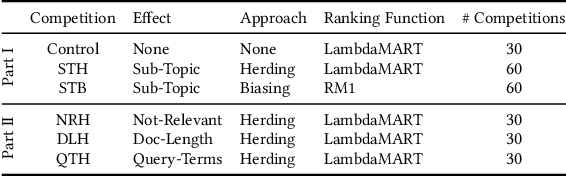
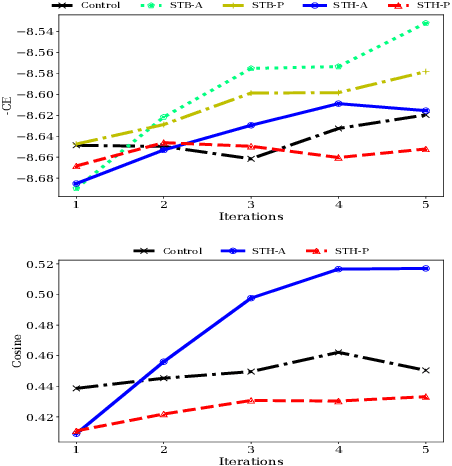
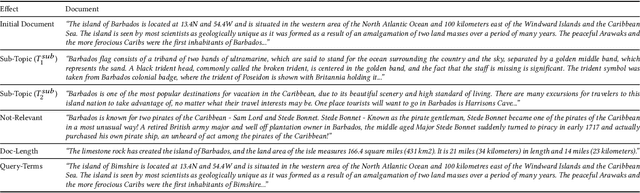
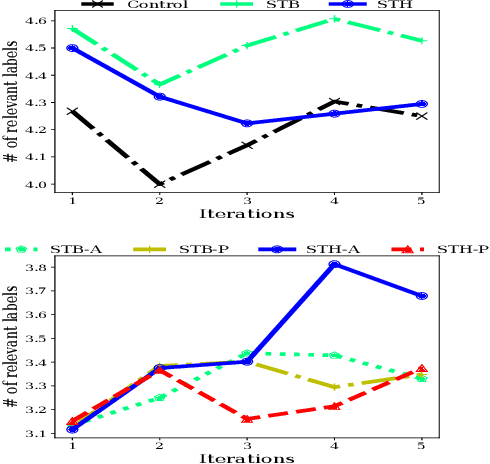
In competitive search settings such as the Web, many documents' authors (publishers) opt to have their documents highly ranked for some queries. To this end, they modify the documents - specifically, their content - in response to induced rankings. Thus, the search engine affects the content in the corpus via its ranking decisions. We present a first study of the ability of search engines to drive pre-defined, targeted, content effects in the corpus using simple techniques. The first is based on the herding phenomenon - a celebrated result from the economics literature - and the second is based on biasing the relevance ranking function. The types of content effects we study are either topical or touch on specific document properties - length and inclusion of query terms. Analysis of ranking competitions we organized between incentivized publishers shows that the types of content effects we target can indeed be attained by applying our suggested techniques. These findings have important implications with regard to the role of search engines in shaping the corpus.