 Add to Chrome
 Add to Firefox
 Add to Edge
On solving symmetric multi-type orthogonal non-negative matrix tri-factorization problem
Jun 06, 2026
We study the symmetric multi-type orthogonal non-negative matrix tri-factorization problem, where several symmetric non-negative matrices are simultaneously approximated by factors of the form $GS_{i}G^{\top}$, with a shared non-negative and orthogonal factor $G$. This model is motivated by clustering and network analysis, where non-negativity improves interpretability and orthogonality gives a natural assignment-type structure to the latent factor. Since the resulting optimization problem is highly non-convex, we develop two heuristic algorithms for computing high-quality local solutions. The first one is a fixed point method derived from the Karush-Kuhn-Tucker conditions after adding a penalty term for the orthogonality constraint. The second one is a three-stage ADAM-based method that combines non-negativity-preserving optimization, orthogonalization, and restricted ADAM refinement on the feasible set. We evaluate both methods on synthetic data, including noisy instances, and on citation network benchmarks. The synthetic experiments show that both algorithms recover factorizations close to the optimum and remain stable under noise. On real networks, the learned embeddings are competitive with or better than standard baselines such as SVD, node2vec, and classical link prediction heuristics in link prediction, node clustering, and node classification tasks.

Dealing with zero-inflated data: achieving SOTA with a two-fold machine learning approach
Oct 12, 2023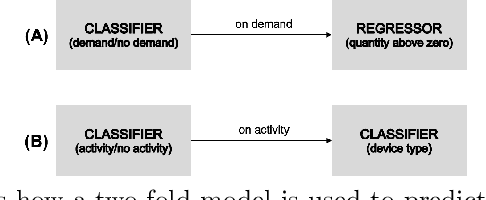
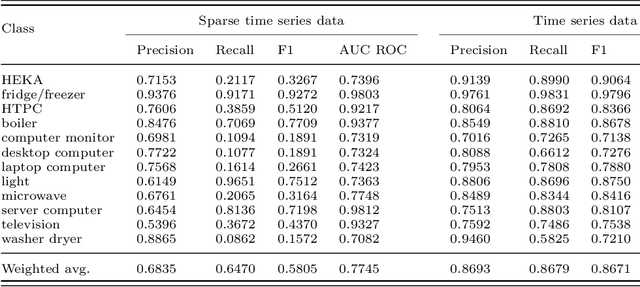
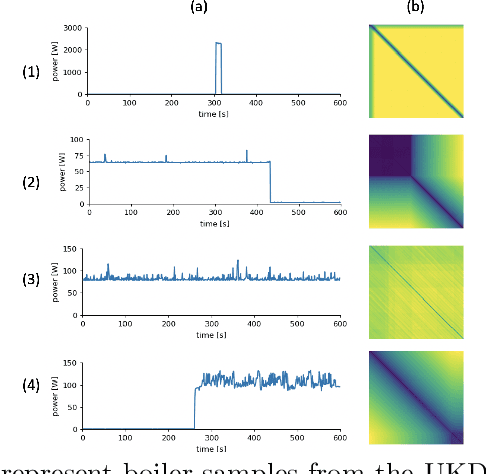
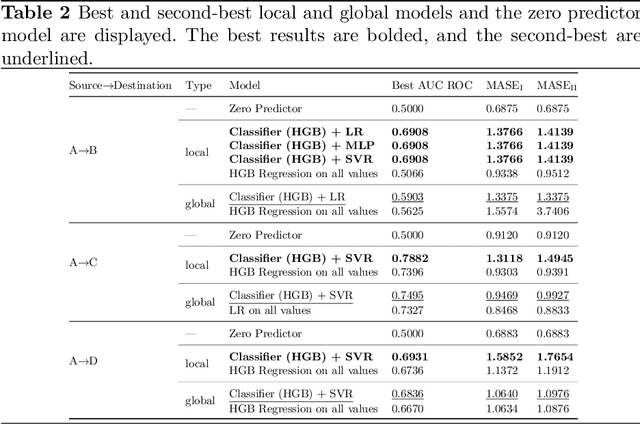
In many cases, a machine learning model must learn to correctly predict a few data points with particular values of interest in a broader range of data where many target values are zero. Zero-inflated data can be found in diverse scenarios, such as lumpy and intermittent demands, power consumption for home appliances being turned on and off, impurities measurement in distillation processes, and even airport shuttle demand prediction. The presence of zeroes affects the models' learning and may result in poor performance. Furthermore, zeroes also distort the metrics used to compute the model's prediction quality. This paper showcases two real-world use cases (home appliances classification and airport shuttle demand prediction) where a hierarchical model applied in the context of zero-inflated data leads to excellent results. In particular, for home appliances classification, the weighted average of Precision, Recall, F1, and AUC ROC was increased by 27%, 34%, 49%, and 27%, respectively. Furthermore, it is estimated that the proposed approach is also four times more energy efficient than the SOTA approach against which it was compared to. Two-fold models performed best in all cases when predicting airport shuttle demand, and the difference against other models has been proven to be statistically significant.