 Add to Chrome
 Add to Firefox
 Add to Edge
Beyond One-shot: AI Agents for Learning in Field Experiments
Jun 01, 2026
Organizations routinely run experiments for A/B testing, yet the data generated from one experiment is underutilized to inform subsequent intervention design. Significant barriers exist to extracting actionable knowledge from prior experimental data to inform new interventions. We study whether tool-augmented agentic AI can automatically learn from experimental data to generate new interventions in subsequent experiments. Through two-stage field experiments in healthcare prescription messaging (693,139 patient visits), we compare a Human + Chatbot method (Stage 1: behavioral experts with conversational AI co-designing 13 message variants, 444,691 patient visits) against a Tool-Augmented Agentic AI method (Stage 2: AI autonomously extracting principles from Stage 1 data to generate 17 new variants, 248,448 patient visits). The Agentic AI method, equipped with analytical tools, structured Data-Information-Knowledge-Wisdom (DIKW) reasoning agents, and transparent evidence chains, produces superior interventions: the best AI-generated message achieved a 69.8% CTR (+6.5 percentage points over baseline). Critically, our results suggest that the value comes from domain-specific experimental data, not from general reasoning ability: frontier LLMs operating without experimental data failed to predict which interventions would succeed. The field experiments also revealed that general-purpose behavioral theories used for intervention design do not extend uniformly to specific healthcare contexts, motivating an agentic AI approach to theory audits at field-experiment scale. Our research shows that tool-augmented AI can learn from experimental data and generate improved domain-relevant interventions, transforming behavioral experimentation from one-shot evaluation into a scalable system for cumulative design learning.

Let Curves Speak: A Continuous Glucose Monitor based Large Sensor Foundation Model for Diabetes Management
Dec 12, 2024

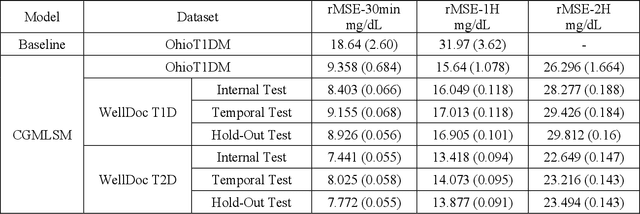

While previous studies of AI in diabetes management focus on long-term risk, research on near-future glucose prediction remains limited but important as it enables timely diabetes self-management. Integrating AI with continuous glucose monitoring (CGM) holds promise for near-future glucose prediction. However, existing models have limitations in capturing patterns of blood glucose fluctuations and demonstrate poor generalizability. A robust approach is needed to leverage massive CGM data for near-future glucose prediction. We propose large sensor models (LSMs) to capture knowledge in CGM data by modeling patients as sequences of glucose. CGM-LSM is pretrained on 15.96 million glucose records from 592 diabetes patients for near-future glucose prediction. We evaluated CGM-LSM against state-of-the-art methods using the OhioT1DM dataset across various metrics, prediction horizons, and unseen patients. Additionally, we assessed its generalizability across factors like diabetes type, age, gender, and hour of day. CGM-LSM achieved exceptional performance, with an rMSE of 29.81 mg/dL for type 1 diabetes patients and 23.49 mg/dL for type 2 diabetes patients in a two-hour prediction horizon. For the OhioT1DM dataset, CGM-LSM achieved a one-hour rMSE of 15.64 mg/dL, halving the previous best of 31.97 mg/dL. Robustness analyses revealed consistent performance not only for unseen patients and future periods, but also across diabetes type, age, and gender. The model demonstrated adaptability to different hours of day, maintaining accuracy across periods of various activity intensity levels. CGM-LSM represents a transformative step in diabetes management by leveraging pretraining to uncover latent glucose generation patterns in sensor data. Our findings also underscore the broader potential of LSMs to drive innovation across domains involving complex sensor data.