 Add to Chrome
 Add to Firefox
 Add to Edge
A Unified Approach to Human-Scale Blockage and Scattering Analysis in Sub-THz Propagation With Application to RF Sensing
Apr 13, 2026
RF sensing exploits phase-sensitive measurements of stray electromagnetic (EM) fields from wireless devices across various frequency bands to detect EM blockage and to reconstruct and map the surrounding environment in 2D/3D. Although blockage effects caused by objects or human motion are well-studied in ISM bands and frequencies up to 60~GHz, there is a significant lack of research for frequencies above 100~GHz. The paper proposes a unified signal processing framework for RF sensing in the sub-THz D-band (105--175~GHz), explicitly integrating EM blockage and scattering as a single process through the birth-death dynamics of multipath components (MPCs). The framework extracts, associates, and classifies MPCs from angle-delay measurements using statistically grounded detection and classification, enabling human-scale sensing from a single radio link. The modeling and classification of MPCs, along with large-scale EM parameters, are demonstrated through an indoor measurement campaign using multiple test targets. Experimental results show that newly formed, attenuated, and suppressed MPCs can be reliably identified with millimeter-scale delay resolution. Static object localization achieves average positioning errors of $8-20$~cm depending on range and material, while passive human localization yields errors of 12-17cm at 0.5m and 26-30cm at 2m, respectively. The proposed framework demonstrates that accurate sensing and localization are feasible at sub-THz frequencies using a single link.

IRS Configuration Techniques for Ultra Wideband Signals and THz Communications
Jan 10, 2024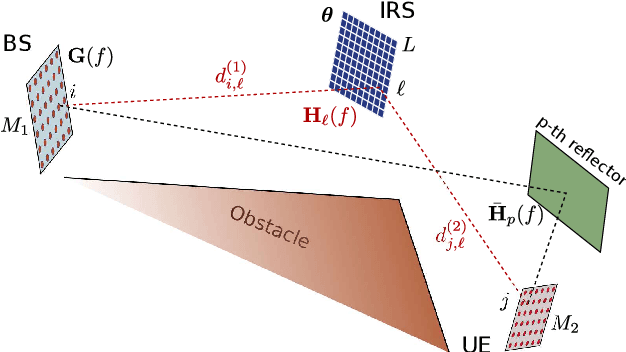
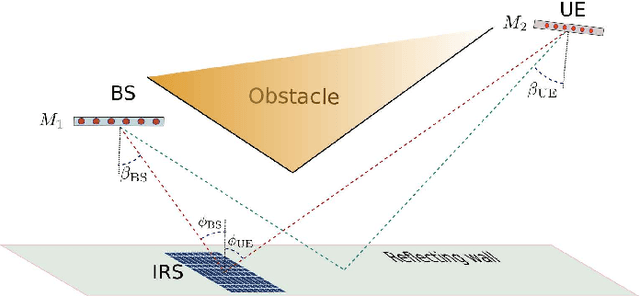
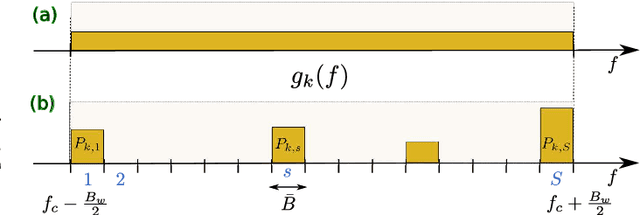
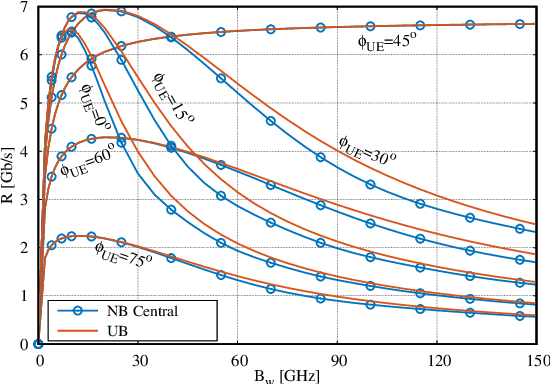
Motivated by the challenges of future 6G communications where terahertz (THz) frequencies, intelligent reflective surfaces (IRSs) and ultra-wideband (UWB) signals coexist, we analyse and propose a set of efficient techniques for configuring the IRS when the signal bandwidth is a significant fraction of the central frequency (up to 50%). To the best of our knowledge this is the first time that IRS configuration techniques are analyzed for such huge bandwidths. In our work we take into account for the channel model, the power spectral density of the signal reflected by the IRS and the network geometry. We evaluate the proposed solutions in terms of achievable rate and compare it against an upper bound we derived. Our results hint rules for designing IRS-aided communication systems and allow to draw conclusions on the trade-off between performance and complexity required for configuring the IRS.