 Add to Chrome
 Add to Firefox
 Add to Edge
High-quality data augmentation for code comment classification
Jan 27, 2026
Code comments serve a crucial role in software development for documenting functionality, clarifying design choices, and assisting with issue tracking. They capture developers' insights about the surrounding source code, serving as an essential resource for both human comprehension and automated analysis. Nevertheless, since comments are in natural language, they present challenges for machine-based code understanding. To address this, recent studies have applied natural language processing (NLP) and deep learning techniques to classify comments according to developers' intentions. However, existing datasets for this task suffer from size limitations and class imbalance, as they rely on manual annotations and may not accurately represent the distribution of comments in real-world codebases. To overcome this issue, we introduce new synthetic oversampling and augmentation techniques based on high-quality data generation to enhance the NLBSE'26 challenge datasets. Our Synthetic Quality Oversampling Technique and Augmentation Technique (Q-SYNTH) yield promising results, improving the base classifier by $2.56\%$.

Operator-Based Generalization Bound for Deep Learning: Insights on Multi-Task Learning
Dec 22, 2025This paper presents novel generalization bounds for vector-valued neural networks and deep kernel methods, focusing on multi-task learning through an operator-theoretic framework. Our key development lies in strategically combining a Koopman based approach with existing techniques, achieving tighter generalization guarantees compared to traditional norm-based bounds. To mitigate computational challenges associated with Koopman-based methods, we introduce sketching techniques applicable to vector valued neural networks. These techniques yield excess risk bounds under generic Lipschitz losses, providing performance guarantees for applications including robust and multiple quantile regression. Furthermore, we propose a novel deep learning framework, deep vector-valued reproducing kernel Hilbert spaces (vvRKHS), leveraging Perron Frobenius (PF) operators to enhance deep kernel methods. We derive a new Rademacher generalization bound for this framework, explicitly addressing underfitting and overfitting through kernel refinement strategies. This work offers novel insights into the generalization properties of multitask learning with deep learning architectures, an area that has been relatively unexplored until recent developments.
On the Koopman-Based Generalization Bounds for Multi-Task Deep Learning
Dec 22, 2025The paper establishes generalization bounds for multitask deep neural networks using operator-theoretic techniques. The authors propose a tighter bound than those derived from conventional norm based methods by leveraging small condition numbers in the weight matrices and introducing a tailored Sobolev space as an expanded hypothesis space. This enhanced bound remains valid even in single output settings, outperforming existing Koopman based bounds. The resulting framework maintains key advantages such as flexibility and independence from network width, offering a more precise theoretical understanding of multitask deep learning in the context of kernel methods.
Gradient Similarity Surgery in Multi-Task Deep Learning
Jun 06, 2025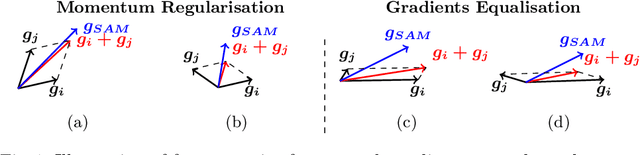
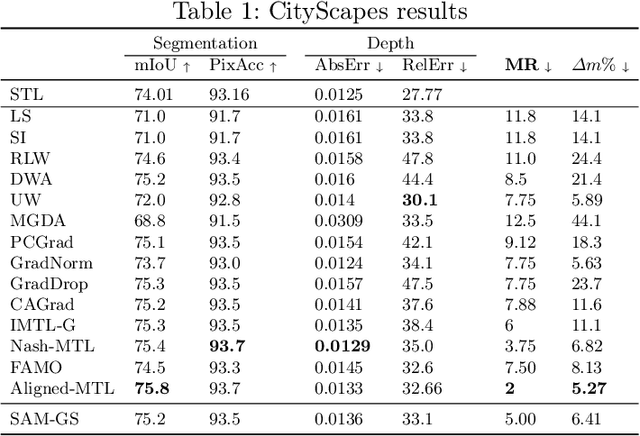
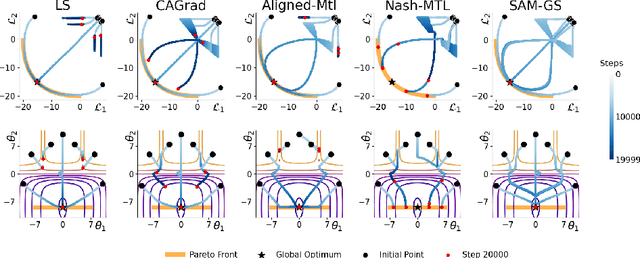
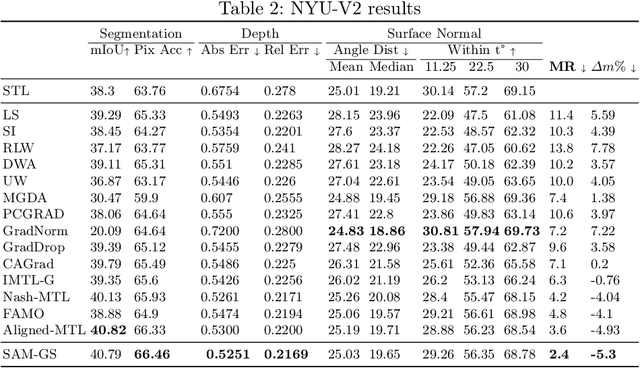
The multi-task learning ($MTL$) paradigm aims to simultaneously learn multiple tasks within a single model capturing higher-level, more general hidden patterns that are shared by the tasks. In deep learning, a significant challenge in the backpropagation training process is the design of advanced optimisers to improve the convergence speed and stability of the gradient descent learning rule. In particular, in multi-task deep learning ($MTDL$) the multitude of tasks may generate potentially conflicting gradients that would hinder the concurrent convergence of the diverse loss functions. This challenge arises when the gradients of the task objectives have either different magnitudes or opposite directions, causing one or a few to dominate or to interfere with each other, thus degrading the training process. Gradient surgery methods address the problem explicitly dealing with conflicting gradients by adjusting the overall gradient trajectory. This work introduces a novel gradient surgery method, the Similarity-Aware Momentum Gradient Surgery (SAM-GS), which provides an effective and scalable approach based on a gradient magnitude similarity measure to guide the optimisation process. The SAM-GS surgery adopts gradient equalisation and modulation of the first-order momentum. A series of experimental tests have shown the effectiveness of SAM-GS on synthetic problems and $MTL$ benchmarks. Gradient magnitude similarity plays a crucial role in regularising gradient aggregation in $MTDL$ for the optimisation of the learning process.