 Add to Chrome
 Add to Firefox
 Add to Edge
From Snow to Rain: Evaluating Robustness, Calibration, and Complexity of Model-Based Robust Training
Jan 14, 2026
Robustness to natural corruptions remains a critical challenge for reliable deep learning, particularly in safety-sensitive domains. We study a family of model-based training approaches that leverage a learned nuisance variation model to generate realistic corruptions, as well as new hybrid strategies that combine random coverage with adversarial refinement in nuisance space. Using the Challenging Unreal and Real Environments for Traffic Sign Recognition dataset (CURE-TSR), with Snow and Rain corruptions, we evaluate accuracy, calibration, and training complexity across corruption severities. Our results show that model-based methods consistently outperform baselines Vanilla, Adversarial Training, and AugMix baselines, with model-based adversarial training providing the strongest robustness under across all corruptions but at the expense of higher computation and model-based data augmentation achieving comparable robustness with $T$ less computational complexity without incurring a statistically significant drop in performance. These findings highlight the importance of learned nuisance models for capturing natural variability, and suggest a promising path toward more resilient and calibrated models under challenging conditions.

DYMOND: DYnamic MOtif-NoDes Network Generative Model
Aug 01, 2023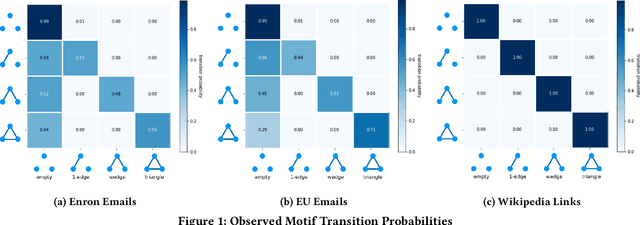
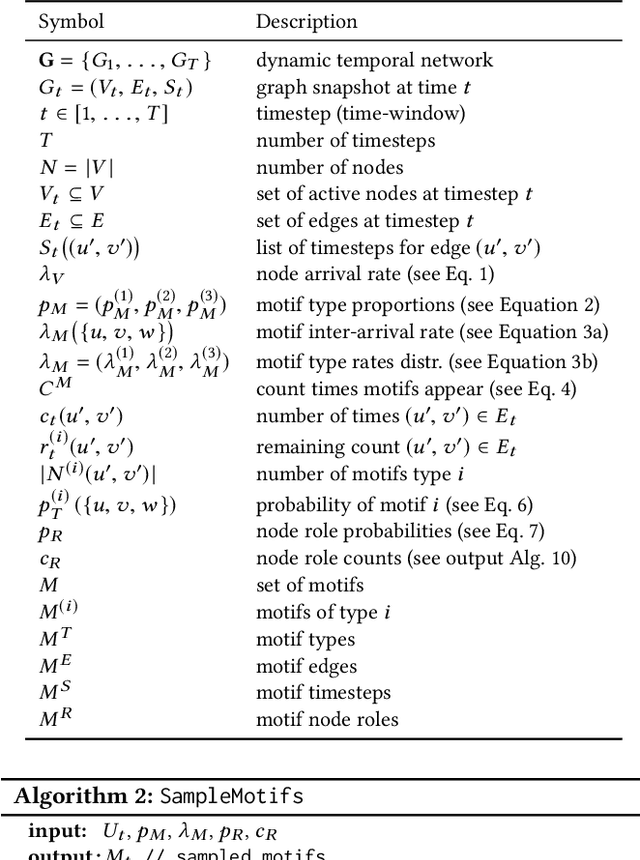
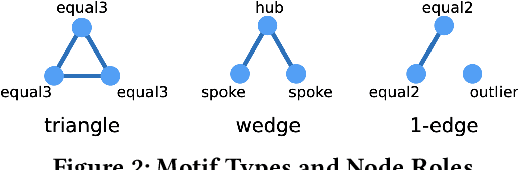
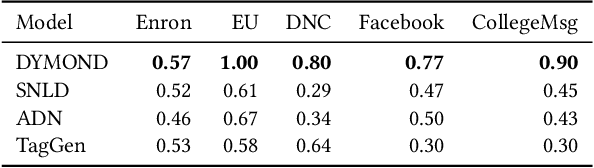
Motifs, which have been established as building blocks for network structure, move beyond pair-wise connections to capture longer-range correlations in connections and activity. In spite of this, there are few generative graph models that consider higher-order network structures and even fewer that focus on using motifs in models of dynamic graphs. Most existing generative models for temporal graphs strictly grow the networks via edge addition, and the models are evaluated using static graph structure metrics -- which do not adequately capture the temporal behavior of the network. To address these issues, in this work we propose DYnamic MOtif-NoDes (DYMOND) -- a generative model that considers (i) the dynamic changes in overall graph structure using temporal motif activity and (ii) the roles nodes play in motifs (e.g., one node plays the hub role in a wedge, while the remaining two act as spokes). We compare DYMOND to three dynamic graph generative model baselines on real-world networks and show that DYMOND performs better at generating graph structure and node behavior similar to the observed network. We also propose a new methodology to adapt graph structure metrics to better evaluate the temporal aspect of the network. These metrics take into account the changes in overall graph structure and the individual nodes' behavior over time.
* In Proceedings of the Web Conference 2021 (WWW '21)