 Add to Chrome
 Add to Firefox
 Add to Edge
Nonnegative Matrix Factorization in the Component-Wise L1 Norm for Sparse Data
Mar 31, 2026
Nonnegative matrix factorization (NMF) approximates a nonnegative matrix, $X$, by the product of two nonnegative factors, $WH$, where $W$ has $r$ columns and $H$ has $r$ rows. In this paper, we consider NMF using the component-wise L1 norm as the error measure (L1-NMF), which is suited for data corrupted by heavy-tailed noise, such as Laplace noise or salt and pepper noise, or in the presence of outliers. Our first contribution is an NP-hardness proof for L1-NMF, even when $r=1$, in contrast to the standard NMF that uses least squares. Our second contribution is to show that L1-NMF strongly enforces sparsity in the factors for sparse input matrices, thereby favoring interpretability. However, if the data is affected by false zeros, too sparse solutions might degrade the model. Our third contribution is a new, more general, L1-NMF model for sparse data, dubbed weighted L1-NMF (wL1-NMF), where the sparsity of the factorization is controlled by adding a penalization parameter to the entries of $WH$ associated with zeros in the data. The fourth contribution is a new coordinate descent (CD) approach for wL1-NMF, denoted as sparse CD (sCD), where each subproblem is solved by a weighted median algorithm. To the best of our knowledge, sCD is the first algorithm for L1-NMF whose complexity scales with the number of nonzero entries in the data, making it efficient in handling large-scale, sparse data. We perform extensive numerical experiments on synthetic and real-world data to show the effectiveness of our new proposed model (wL1-NMF) and algorithm (sCD).

An extrapolated and provably convergent algorithm for nonlinear matrix decomposition with the ReLU function
Mar 31, 2025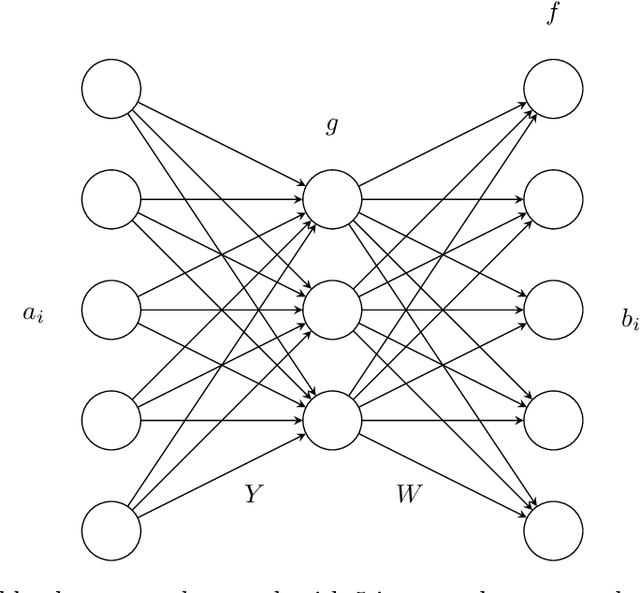
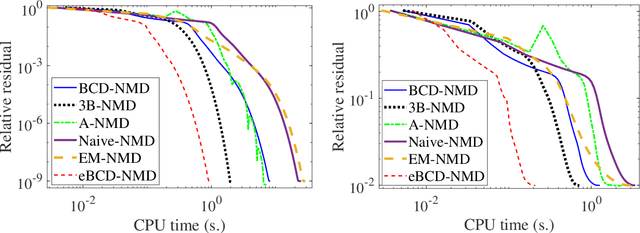
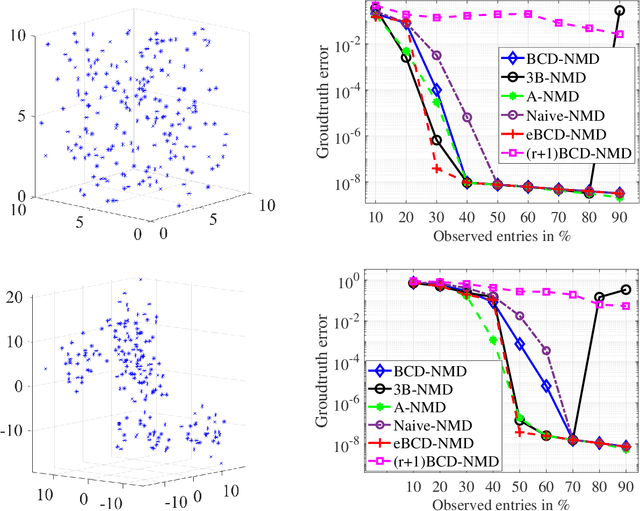

Nonlinear matrix decomposition (NMD) with the ReLU function, denoted ReLU-NMD, is the following problem: given a sparse, nonnegative matrix $X$ and a factorization rank $r$, identify a rank-$r$ matrix $\Theta$ such that $X\approx \max(0,\Theta)$. This decomposition finds application in data compression, matrix completion with entries missing not at random, and manifold learning. The standard ReLU-NMD model minimizes the least squares error, that is, $\|X - \max(0,\Theta)\|_F^2$. The corresponding optimization problem is nondifferentiable and highly nonconvex. This motivated Saul to propose an alternative model, Latent-ReLU-NMD, where a latent variable $Z$ is introduced and satisfies $\max(0,Z)=X$ while minimizing $\|Z - \Theta\|_F^2$ (``A nonlinear matrix decomposition for mining the zeros of sparse data'', SIAM J. Math. Data Sci., 2022). Our first contribution is to show that the two formulations may yield different low-rank solutions $\Theta$; in particular, we show that Latent-ReLU-NMD can be ill-posed when ReLU-NMD is not, meaning that there are instances in which the infimum of Latent-ReLU-NMD is not attained while that of ReLU-NMD is. We also consider another alternative model, called 3B-ReLU-NMD, which parameterizes $\Theta=WH$, where $W$ has $r$ columns and $H$ has $r$ rows, allowing one to get rid of the rank constraint in Latent-ReLU-NMD. Our second contribution is to prove the convergence of a block coordinate descent (BCD) applied to 3B-ReLU-NMD and referred to as BCD-NMD. Our third contribution is a novel extrapolated variant of BCD-NMD, dubbed eBCD-NMD, which we prove is also convergent under mild assumptions. We illustrate the significant acceleration effect of eBCD-NMD compared to BCD-NMD, and also show that eBCD-NMD performs well against the state of the art on synthetic and real-world data sets.
Accelerated Algorithms for Nonlinear Matrix Decomposition with the ReLU function
May 15, 2023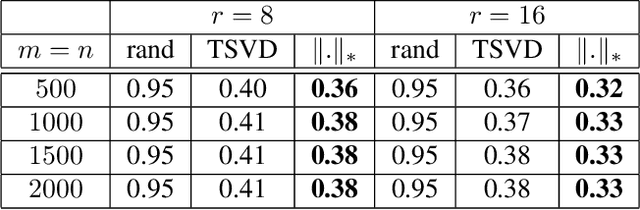
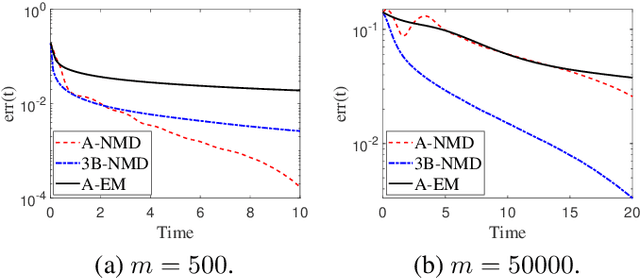
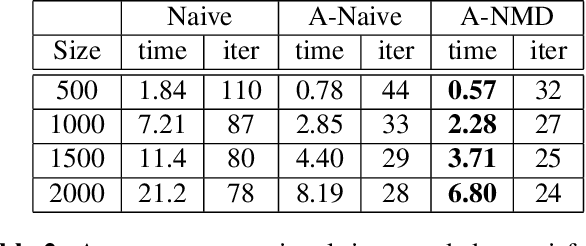
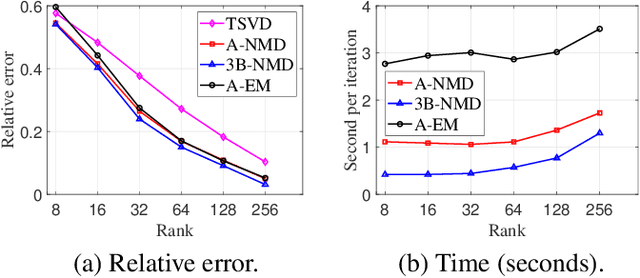
In this paper, we study the following nonlinear matrix decomposition (NMD) problem: given a sparse nonnegative matrix $X$, find a low-rank matrix $\Theta$ such that $X \approx f(\Theta)$, where $f$ is an element-wise nonlinear function. We focus on the case where $f(\cdot) = \max(0, \cdot)$, the rectified unit (ReLU) non-linear activation. We refer to the corresponding problem as ReLU-NMD. We first provide a brief overview of the existing approaches that were developed to tackle ReLU-NMD. Then we introduce two new algorithms: (1) aggressive accelerated NMD (A-NMD) which uses an adaptive Nesterov extrapolation to accelerate an existing algorithm, and (2) three-block NMD (3B-NMD) which parametrizes $\Theta = WH$ and leads to a significant reduction in the computational cost. We also propose an effective initialization strategy based on the nuclear norm as a proxy for the rank function. We illustrate the effectiveness of the proposed algorithms (available on gitlab) on synthetic and real-world data sets.