 Add to Chrome
 Add to Firefox
 Add to Edge
Are Safety Guarantees in Neural Networks Safe? How to Compute Trustworthy Robustness Certifications
Jun 22, 2026
A primary challenge in AI safety is the existence of adversarial examples -- slightly distorted inputs that cause a neural network (NN) to misclassify. To mitigate this problem, recent research focuses on the computation of robustness certifications, which, for a given input, determine the largest distortion the input may receive without breaking the network's prediction. Robustness certifications can be interpreted as an axis-aligned hyper-rectangle (multi-dimensional intervals). Most existing approaches focus on maximizing the certification's volume, but recent intractability results prohibit the computation of volume-optimal certifications in reasonable time. We introduce the apothem measure and show how to compute apothem-optimal certifications in a linear number of calls to a NN verifier (oracle) w.r.t. the input domain's diameter. Moreover, we prove that we cannot have a volume-optimal, oracle-based algorithm, even if we discard the oracle costs. Also, we introduce dual certifications -- an interval including all instances of a class -- thus providing apothem-minimum upper bounds to a robustness certification. Further, we present the ParallelepipedoNN system, which we evaluate on the standard MNIST and Fashion MNIST benchmarks. A preliminary comparison with existing work on the same datasets reveals at least two-fold improvement w.r.t. the minimum edge length.

The Cost of Relaxation: Evaluating the Error in Convex Neural Network Verification
Apr 20, 2026Many neural network (NN) verification systems represent the network's input-output relation as a constraint program. Sound and complete, representations involve integer constraints, for simulating the activations. Recent works convexly relax the integer constraints, improving performance, at the cost of soundness. Convex relaxations consider outputs that are unreachable by the original network. We study the worst case divergence between the original network and its convex relaxations; both qualitatively and quantitatively. The relaxations' space forms a lattice, where the top element corresponds to a full relaxation, with every neuron linearized. The bottom element corresponds to the original network. We provide analytical upper and lower bounds for the $\ell_\infty$-distance between the fully relaxed and original outputs. This distance grows exponentially, w.r.t. the network's depth, and linearly w.r.t. the input's radius. The misclassification probability exhibits a step-like behavior, w.r.t. input radius. Our results are supported by experiments on MNIST, Fashion MNIST and random networks.
Linguistic Cues of Deception in a Multilingual April Fools' Day Context
Nov 09, 2021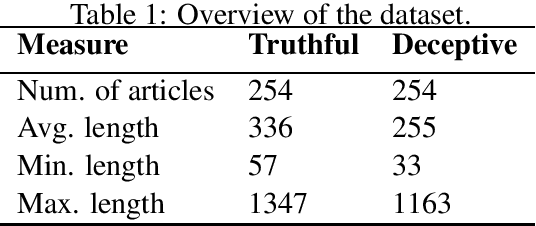
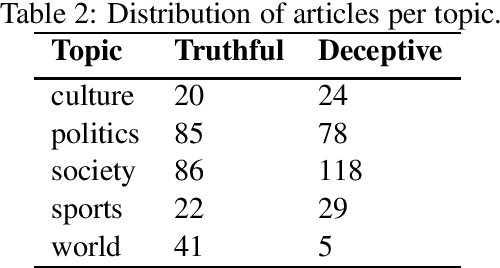
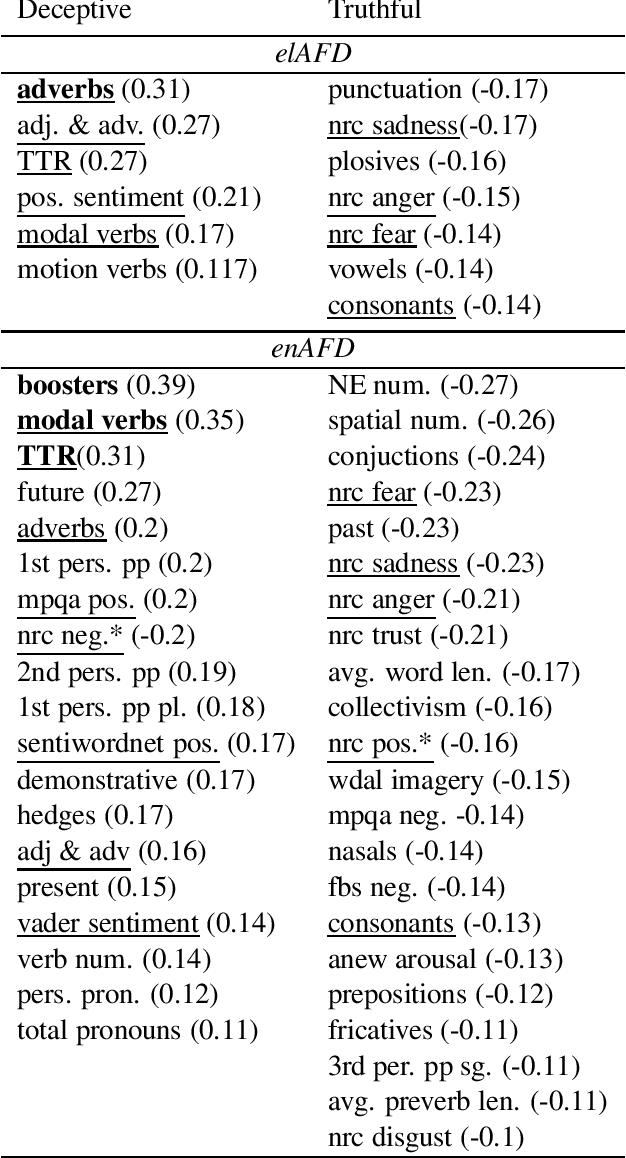
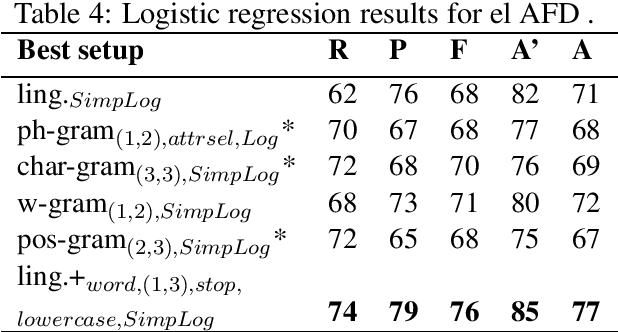
In this work we consider the collection of deceptive April Fools' Day(AFD) news articles as a useful addition in existing datasets for deception detection tasks. Such collections have an established ground truth and are relatively easy to construct across languages. As a result, we introduce a corpus that includes diachronic AFD and normal articles from Greek newspapers and news websites. On top of that, we build a rich linguistic feature set, and analyze and compare its deception cues with the only AFD collection currently available, which is in English. Following a current research thread, we also discuss the individualism/collectivism dimension in deception with respect to these two datasets. Lastly, we build classifiers by testing various monolingual and crosslingual settings. The results showcase that AFD datasets can be helpful in deception detection studies, and are in alignment with the observations of other deception detection works.
Deception detection in text and its relation to the cultural dimension of individualism/collectivism
May 26, 2021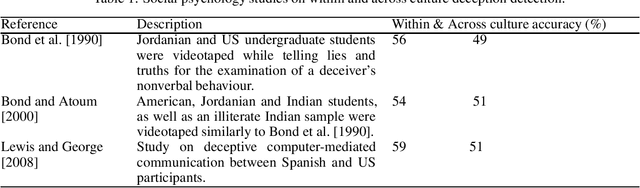
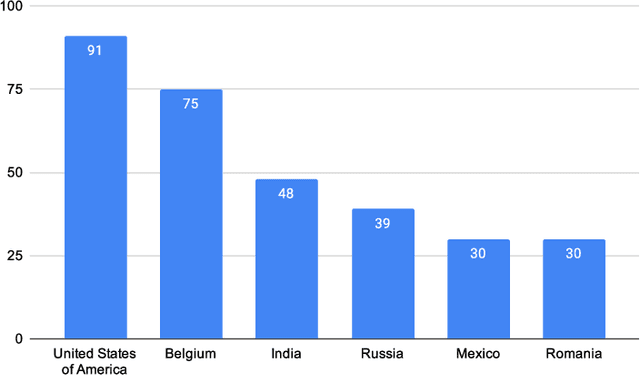
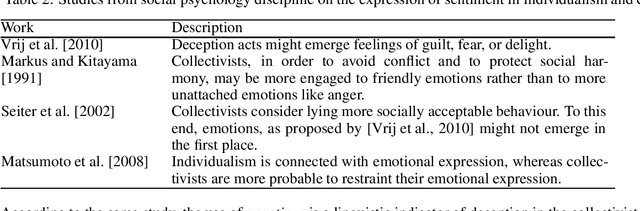
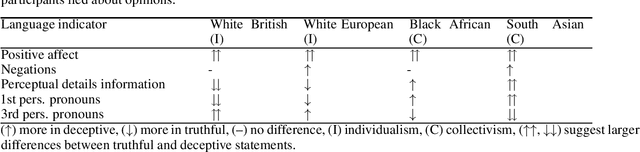
Deception detection is a task with many applications both in direct physical and in computer-mediated communication. Our focus is on automatic deception detection in text across cultures. We view culture through the prism of the individualism/collectivism dimension and we approximate culture by using country as a proxy. Having as a starting point recent conclusions drawn from the social psychology discipline, we explore if differences in the usage of specific linguistic features of deception across cultures can be confirmed and attributed to norms in respect to the individualism/collectivism divide. We also investigate if a universal feature set for cross-cultural text deception detection tasks exists. We evaluate the predictive power of different feature sets and approaches. We create culture/language-aware classifiers by experimenting with a wide range of n-gram features based on phonology, morphology and syntax, other linguistic cues like word and phoneme counts, pronouns use, etc., and token embeddings. We conducted our experiments over 11 datasets from 5 languages i.e., English, Dutch, Russian, Spanish and Romanian, from six countries (US, Belgium, India, Russia, Mexico and Romania), and we applied two classification methods i.e, logistic regression and fine-tuned BERT models. The results showed that our task is fairly complex and demanding. There are indications that some linguistic cues of deception have cultural origins, and are consistent in the context of diverse domains and dataset settings for the same language. This is more evident for the usage of pronouns and the expression of sentiment in deceptive language. The results of this work show that the automatic deception detection across cultures and languages cannot be handled in a unified manner, and that such approaches should be augmented with knowledge about cultural differences and the domains of interest.