 Add to Chrome
 Add to Firefox
 Add to Edge
FLIM Networks with Bag of Feature Points
Feb 24, 2026
Convolutional networks require extensive image annotation, which can be costly and time-consuming. Feature Learning from Image Markers (FLIM) tackles this challenge by estimating encoder filters (i.e., kernel weights) from user-drawn markers on discriminative regions of a few representative images without traditional optimization. Such an encoder combined with an adaptive decoder comprises a FLIM network fully trained without backpropagation. Prior research has demonstrated their effectiveness in Salient Object Detection (SOD), being significantly lighter than existing lightweight models. This study revisits FLIM SOD and introduces FLIM-Bag of Feature Points (FLIM-BoFP), a considerably faster filter estimation method. The previous approach, FLIM-Cluster, derives filters through patch clustering at each encoder's block, leading to computational overhead and reduced control over filter locations. FLIM-BoFP streamlines this process by performing a single clustering at the input block, creating a bag of feature points, and defining filters directly from mapped feature points across all blocks. The paper evaluates the benefits in efficiency, effectiveness, and generalization of FLIM-BoFP compared to FLIM-Cluster and other state-of-the-art baselines for parasite detection in optical microscopy images.

FLIM-based Salient Object Detection Networks with Adaptive Decoders
Apr 29, 2025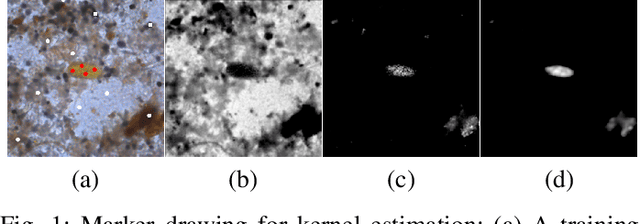
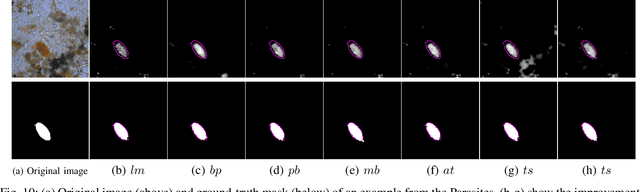
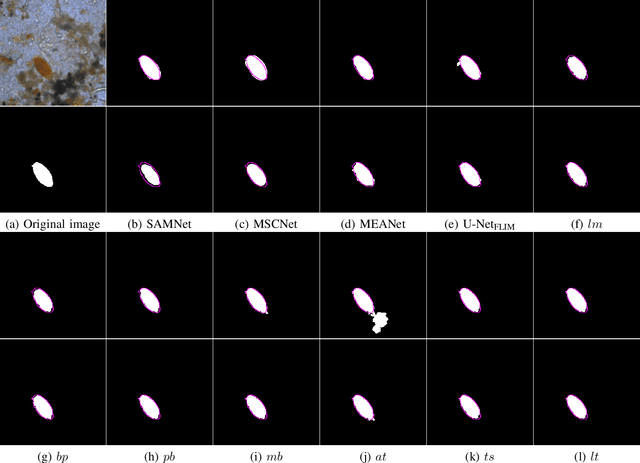
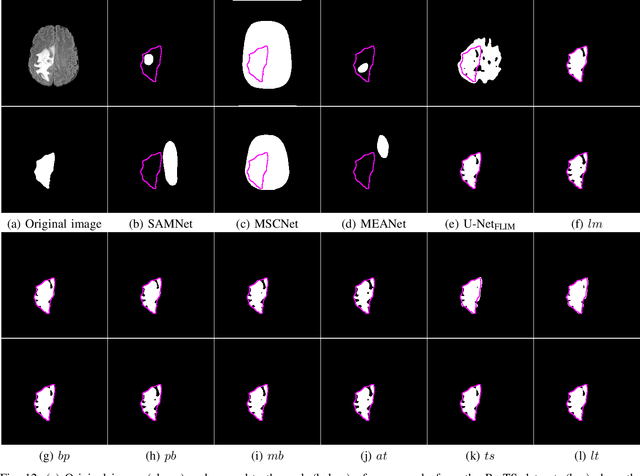
Salient Object Detection (SOD) methods can locate objects that stand out in an image, assign higher values to their pixels in a saliency map, and binarize the map outputting a predicted segmentation mask. A recent tendency is to investigate pre-trained lightweight models rather than deep neural networks in SOD tasks, coping with applications under limited computational resources. In this context, we have investigated lightweight networks using a methodology named Feature Learning from Image Markers (FLIM), which assumes that the encoder's kernels can be estimated from marker pixels on discriminative regions of a few representative images. This work proposes flyweight networks, hundreds of times lighter than lightweight models, for SOD by combining a FLIM encoder with an adaptive decoder, whose weights are estimated for each input image by a given heuristic function. Such FLIM networks are trained from three to four representative images only and without backpropagation, making the models suitable for applications under labeled data constraints as well. We study five adaptive decoders; two of them are introduced here. Differently from the previous ones that rely on one neuron per pixel with shared weights, the heuristic functions of the new adaptive decoders estimate the weights of each neuron per pixel. We compare FLIM models with adaptive decoders for two challenging SOD tasks with three lightweight networks from the state-of-the-art, two FLIM networks with decoders trained by backpropagation, and one FLIM network whose labeled markers define the decoder's weights. The experiments demonstrate the advantages of the proposed networks over the baselines, revealing the importance of further investigating such methods in new applications.