 Add to Chrome
 Add to Firefox
 Add to Edge
GemmAr: Enhancing LLMs Through Arabic Instruction-Tuning
Jul 09, 2024
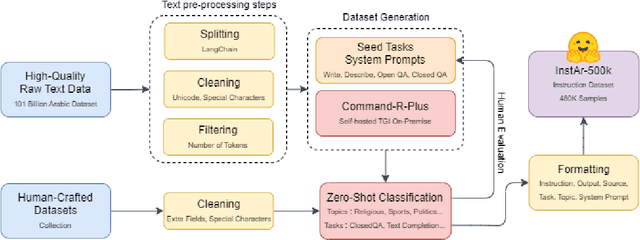
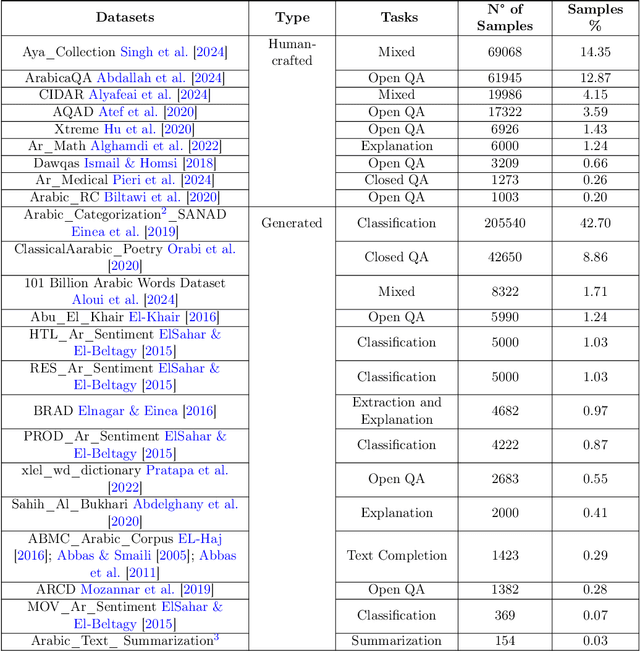
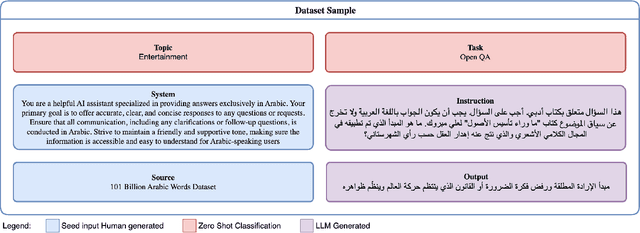

Large language models (LLMs) have greatly impacted the natural language processing (NLP) field, particularly for the English language. These models have demonstrated capabilities in understanding and generating human-like text. The success of language models largely depends on the availability of high-quality instruction datasets, which consist of detailed task descriptions and corresponding responses that are essential for training the models to address a variety of prompts accurately. However, the availability and quality of these resources vary by language. While models perform well in English, they often need help with languages like Arabic, due to the lack of datasets for fine-tuning Arabic-specific tasks. To address this issue, we introduce InstAr-500k, a new Arabic instruction dataset created by generating and collecting content that covers several domains and instruction types. We assess this dataset by fine-tuning an open-source Gemma-7B model on several downstream tasks to improve its functionality. Based on multiple evaluations, our fine-tuned model achieves excellent performance on several Arabic NLP benchmarks. These outcomes emphasize the effectiveness of our dataset in elevating the capabilities of language models for Arabic. Our instruction dataset bridges the performance gap between English and Arabic language models by providing resources that amplify Arabic NLP development. Building on this foundation, we developed a model, GemmAr-7B-V1, specifically tuned to excel at a wide range of Arabic NLP tasks.

LlamAr & GemmAr: Enhancing LLMs Through Arabic Instruction-Tuning
Jul 02, 2024Large language models (LLMs) have greatly impacted the natural language processing (NLP) field, particularly for the English language. These models have demonstrated capabilities in understanding and generating human-like text. The success of language models largely depends on the availability of high-quality instruction datasets, which consist of detailed task descriptions and corresponding responses that are essential for training the models to accurately address a variety of prompts. However, the availability and quality of these resources vary by language. While models perform well in English, they often struggle with languages like Arabic, due to the lack of datasets for fine-tuning Arabic-specific tasks. To address this issue, we introduce InstAr-500k, a new Arabic instruction dataset created by generating and collecting content that covers several domains and instruction types. We then assess this dataset by fine-tuning two open-source models, Llama-3-8B-Instruct and Gemma-7B-IT, on several downstream tasks to scale improvements in their functionality. Based on multiple evaluations, our fine-tuned models achieve state-of-the-art performance on several Arabic NLP benchmarks. These outcomes emphasize the effectiveness of our dataset in elevating the capabilities of language models for Arabic. Our instruction dataset bridges the performance gap between English and Arabic language models by providing resources that amplify Arabic NLP development. Building on this foundation, we developed two state-of-the-art models, LlamAr-8B and GemmAr-7B, which are specifically tuned to excel at a wide range of Arabic NLP tasks.
101 Billion Arabic Words Dataset
Apr 29, 2024
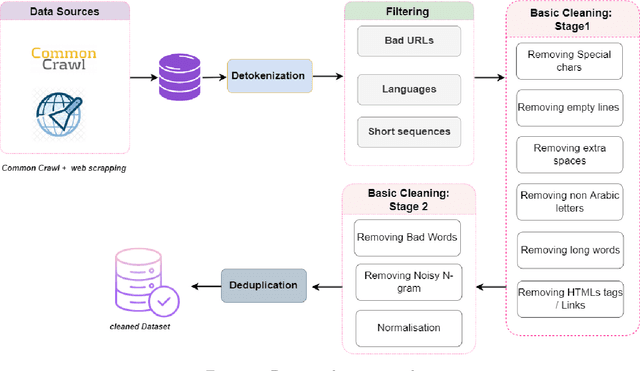


In recent years, Large Language Models have revolutionized the field of natural language processing, showcasing an impressive rise predominantly in English-centric domains. These advancements have set a global benchmark, inspiring significant efforts toward developing Arabic LLMs capable of understanding and generating the Arabic language with remarkable accuracy. Despite these advancements, a critical challenge persists: the potential bias in Arabic LLMs, primarily attributed to their reliance on datasets comprising English data that has been translated into Arabic. This reliance not only compromises the authenticity of the generated content but also reflects a broader issue -the scarcity of original quality Arabic linguistic data. This study aims to address the data scarcity in the Arab world and to encourage the development of Arabic Language Models that are true to both the linguistic and nuances of the region. We undertook a large-scale data mining project, extracting a substantial volume of text from the Common Crawl WET files, specifically targeting Arabic content. The extracted data underwent a rigorous cleaning and deduplication process, using innovative techniques to ensure the integrity and uniqueness of the dataset. The result is the 101 Billion Arabic Words Dataset, the largest Arabic dataset available to date, which can significantly contribute to the development of authentic Arabic LLMs. This study not only highlights the potential for creating linguistically and culturally accurate Arabic LLMs but also sets a precedent for future research in enhancing the authenticity of Arabic language models.