 Add to Chrome
 Add to Firefox
 Add to Edge
Belief Coevolution in a Social Network of Generalist and Specialist Large Language Models
Jul 29, 2026
Large language models (LLMs) are increasingly deployed in multi-agent environments. However, the processes by which beliefs form and propagate among interacting LLMs remain poorly understood. We introduce CoevolveSim, a framework for studying belief diffusion within networked LLM populations. CoevolveSim allows us to isolate and study three factors: domain specialization, social-role assignment, and social network structure. Within this framework, generalist and specialist LLM agents exchange and revise beliefs. In each round, an LLM agent observes a summary of its neighbors' beliefs before updating its own. We run 1,280 controlled simulations spanning four scenarios, two network structures, and 20 medical-indication statements. We find that persona-style role assignment and network structure reshape individual belief revision but have minimal effect on population-level consensus. In contrast, introducing (finetuned) specialist LLMs more than doubles the shift in consensus and gives rise to consistent asymmetries in exerted influence. We further show that simple persistence-based opinion-dynamics models reproduce collective outcomes in all-generalist LLM populations, whereas heterogeneous LLM populations require population-level belief composition to reproduce consensus and agent identity to predict individual belief transitions. Our results indicate that realistic simulation of belief diffusion in multi-agent LLM systems requires a diverse set of underlying LLMs, not persona prompting alone.

REGE: A Method for Incorporating Uncertainty in Graph Embeddings
Dec 07, 2024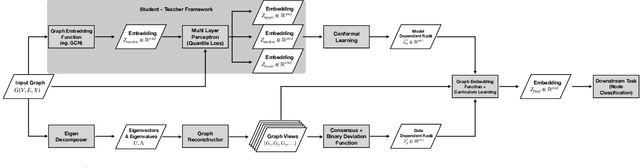
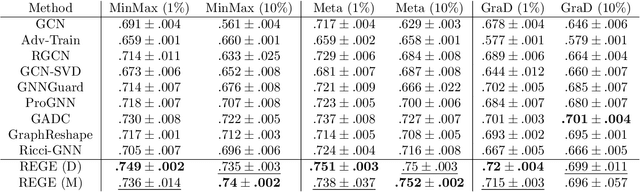
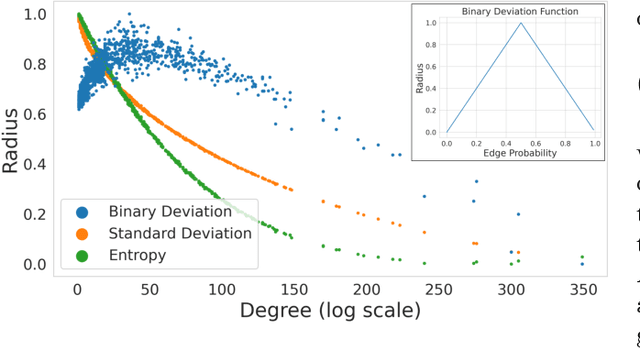
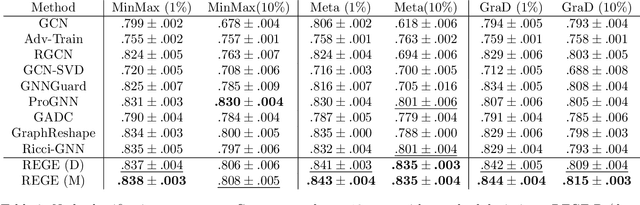
Machine learning models for graphs in real-world applications are prone to two primary types of uncertainty: (1) those that arise from incomplete and noisy data and (2) those that arise from uncertainty of the model in its output. These sources of uncertainty are not mutually exclusive. Additionally, models are susceptible to targeted adversarial attacks, which exacerbate both of these uncertainties. In this work, we introduce Radius Enhanced Graph Embeddings (REGE), an approach that measures and incorporates uncertainty in data to produce graph embeddings with radius values that represent the uncertainty of the model's output. REGE employs curriculum learning to incorporate data uncertainty and conformal learning to address the uncertainty in the model's output. In our experiments, we show that REGE's graph embeddings perform better under adversarial attacks by an average of 1.5% (accuracy) against state-of-the-art methods.
Using Sequences of Life-events to Predict Human Lives
Jun 05, 2023Over the past decade, machine learning has revolutionized computers' ability to analyze text through flexible computational models. Due to their structural similarity to written language, transformer-based architectures have also shown promise as tools to make sense of a range of multi-variate sequences from protein-structures, music, electronic health records to weather-forecasts. We can also represent human lives in a way that shares this structural similarity to language. From one perspective, lives are simply sequences of events: People are born, visit the pediatrician, start school, move to a new location, get married, and so on. Here, we exploit this similarity to adapt innovations from natural language processing to examine the evolution and predictability of human lives based on detailed event sequences. We do this by drawing on arguably the most comprehensive registry data in existence, available for an entire nation of more than six million individuals across decades. Our data include information about life-events related to health, education, occupation, income, address, and working hours, recorded with day-to-day resolution. We create embeddings of life-events in a single vector space showing that this embedding space is robust and highly structured. Our models allow us to predict diverse outcomes ranging from early mortality to personality nuances, outperforming state-of-the-art models by a wide margin. Using methods for interpreting deep learning models, we probe the algorithm to understand the factors that enable our predictions. Our framework allows researchers to identify new potential mechanisms that impact life outcomes and associated possibilities for personalized interventions.