 Add to Chrome
 Add to Firefox
 Add to Edge
Variational Quantum Conditional Boltzmann Machines for Time-Series Forecasting: Architectures, Symmetric Hyperparameter Evaluation, and a Nonlinear Benchmark
Jul 27, 2026
In this study, we developed and evaluated four conditional energy-based forecasting architectures: a classical Gaussian-Bernoulli CRBM, a hybrid quantum-classical QCRBM, a full-register QQRBM, and a lag-feature QFeatureQRBM with complete derivations of their conditional distributions, Contrastive-Divergence gradients, and hybrid training, bridging the energy-based formulation and the implementation-level quantum computation. Unlike prior comparisons, our evaluation enforces symmetric hyperparameter optimisation: classical and quantum-specific hyperparameters receive an equally thorough grid search across thirteen structured experiments. We test on two data classes, a Gaussian-process dataset (GP) generated with real financial data and the input-driven NARMA-10 nonlinear benchmark. Across both regimes we find no systematic evidence of a quantum advantage at the available sample size: no quantum architecture improves on the best classical baseline. The fully quantum QQRBM and QFeatureQRBM are significantly worse, whereas the hybrid QCRBM is statistically indistinguishable from the strongest classical CRBM on both datasets. A power analysis bounds this null result: at n = 12 only medium-to-large effects are detectable, so small advantages cannot be excluded. An iso-parameter (matched-budget) comparison reaches the same conclusion: the classical CRBM is lowest at three of the four budgets and no CRBM-vs-QCRBM difference is significant at any budget.

Early heart disease prediction using hybrid quantum classification
Aug 17, 2022
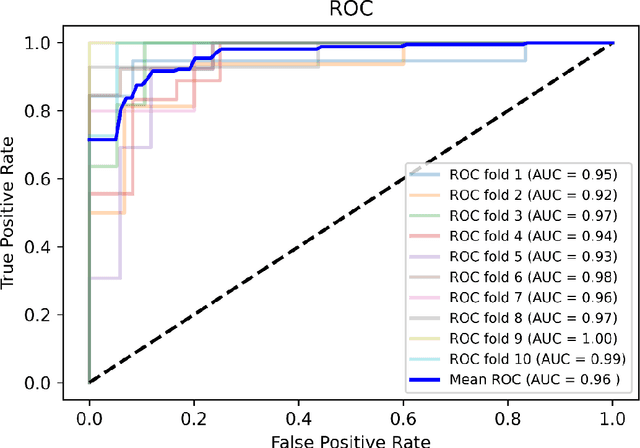
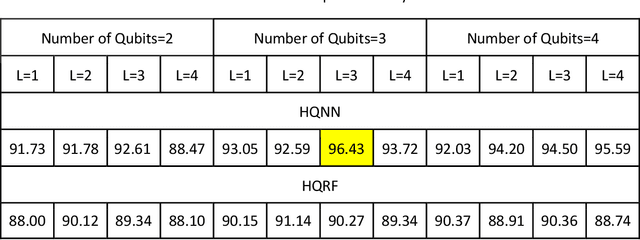
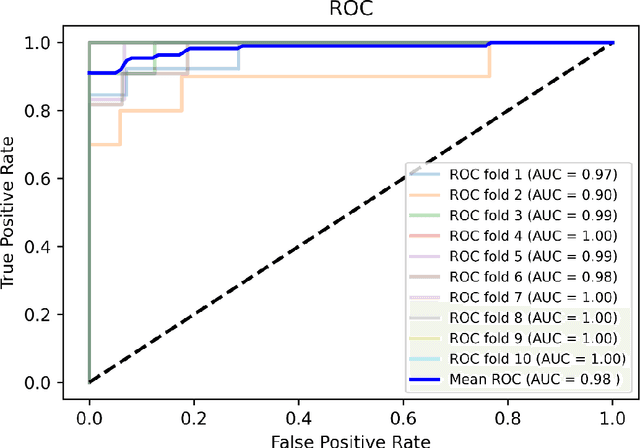
The rate of heart morbidity and heart mortality increases significantly which affect the global public health and world economy. Early prediction of heart disease is crucial for reducing heart morbidity and mortality. This paper proposes two quantum machine learning methods i.e. hybrid quantum neural network and hybrid random forest quantum neural network for early detection of heart disease. The methods are applied on the Cleveland and Statlog datasets. The results show that hybrid quantum neural network and hybrid random forest quantum neural network are suitable for high dimensional and low dimensional problems respectively. The hybrid quantum neural network is sensitive to outlier data while hybrid random forest is robust on outlier data. A comparison between different machine learning methods shows that the proposed quantum methods are more appropriate for early heart disease prediction where 96.43% and 97.78% area under curve are obtained for Cleveland and Statlog dataset respectively.