 Add to Chrome
 Add to Firefox
 Add to Edge
A Family of Quaternion-Valued Differential Evolution Algorithms for Numerical Function Optimization
May 12, 2026
The numerical optimization of continuous functions is a fundamental task in many scientific and engineering domains, ranging from mechanical design to training of artificial intelligence models. Among the most effective and widely used algorithms for this purpose is Differential Evolution (DE), known for its simplicity and strong performance. Recent research has shown that adapting AI models to operate over alternative number systems-such as complex numbers, quaternions, and geometric algebras-can improve model compactness and accuracy. However, such extensions remain underexplored in bio-inspired optimization algorithms. In particular, the use of quaternion algebra represents an emerging area in computational intelligence. This paper introduces a family of novel Quaternion-Valued Differential Evolution (QDE) algorithms that operate directly in the quaternion space. We propose several mutation strategies specifically designed to exploit the algebraic and geometric properties of quaternions. Results show that our QDE variants achieve faster convergence and superior performance on several function classes in the BBOB benchmark compared to the traditional real-valued DE algorithm.

Quaternion Convolutional Neural Networks: Current Advances and Future Directions
Jul 17, 2023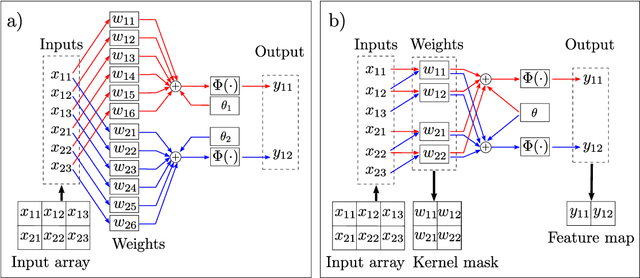
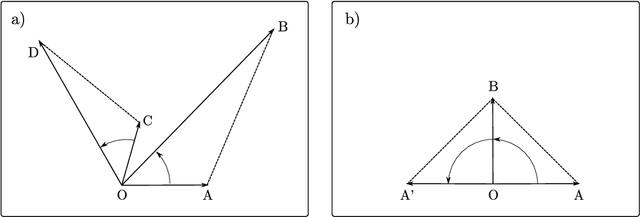
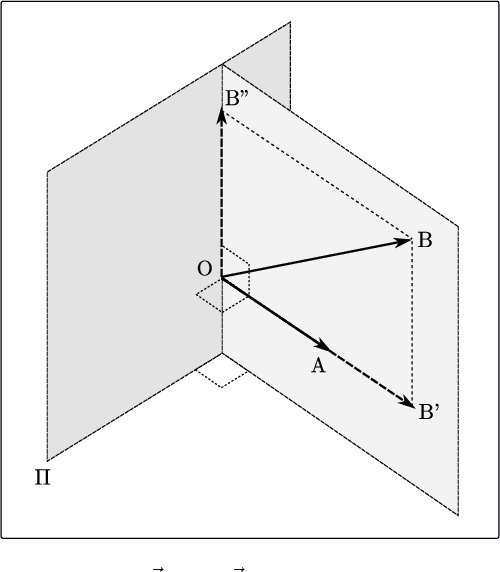
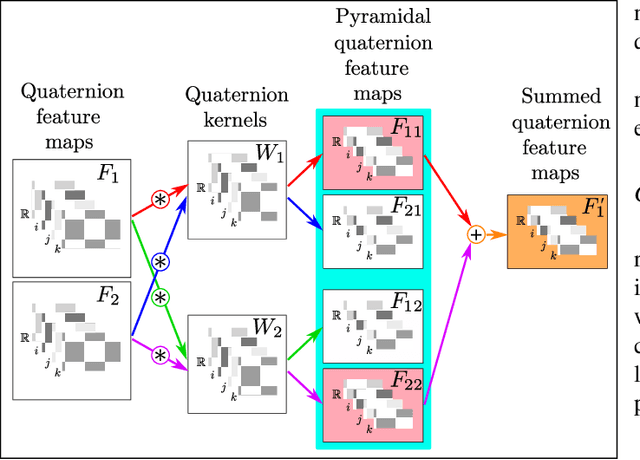
Since their first applications, Convolutional Neural Networks (CNNs) have solved problems that have advanced the state-of-the-art in several domains. CNNs represent information using real numbers. Despite encouraging results, theoretical analysis shows that representations such as hyper-complex numbers can achieve richer representational capacities than real numbers, and that Hamilton products can capture intrinsic interchannel relationships. Moreover, in the last few years, experimental research has shown that Quaternion-Valued CNNs (QCNNs) can achieve similar performance with fewer parameters than their real-valued counterparts. This paper condenses research in the development of QCNNs from its very beginnings. We propose a conceptual organization of current trends and analyze the main building blocks used in the design of QCNN models. Based on this conceptual organization, we propose future directions of research.