 Add to Chrome
 Add to Firefox
 Add to Edge
DeepStress: Stress-Testing Deep Search Agents
Jul 15, 2026
While search agents demonstrate impressive capabilities in multi-step question answering, their robustness to poor-quality evidence remains under-explored. This phenomenon occurs rarely in realistic benchmarks but can lead to dramatic failure in real life applications. Therefore in this study we propose DeepStress, a stress testing framework that controls the frequency of challenging evidence by replacing the retrieval module of search agents with a controlled synthetic environment. We use this framework to control three dimensions that can affect document reliability: trustworthiness, relevance, and factuality. Testing several search agents on HotpotQA and BrowseCompPlus, we demonstrate that agents exhibit substantial differences in their ability to handle unreliable information and propose new metrics that better document systems outcomes as well as the interactions between conflicting parametric and retrieved knowledge.

Adapting a FrameNet Semantic Parser for Spoken Language Understanding Using Adversarial Learning
Oct 07, 2019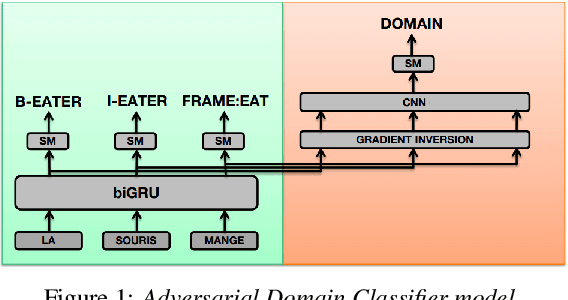
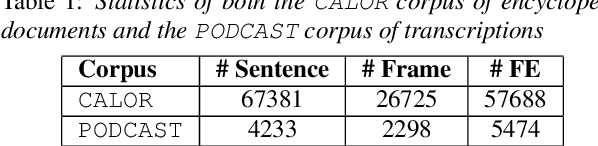
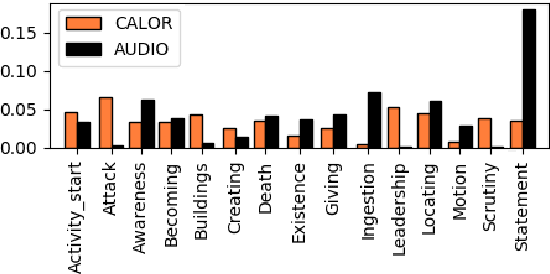
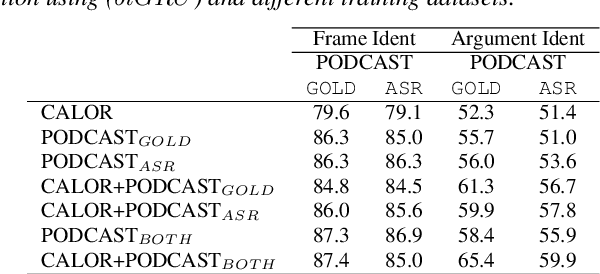
This paper presents a new semantic frame parsing model, based on Berkeley FrameNet, adapted to process spoken documents in order to perform information extraction from broadcast contents. Building upon previous work that had shown the effectiveness of adversarial learning for domain generalization in the context of semantic parsing of encyclopedic written documents, we propose to extend this approach to elocutionary style generalization. The underlying question throughout this study is whether adversarial learning can be used to combine data from different sources and train models on a higher level of abstraction in order to increase their robustness to lexical and stylistic variations as well as automatic speech recognition errors. The proposed strategy is evaluated on a French corpus of encyclopedic written documents and a smaller corpus of radio podcast transcriptions, both annotated with a FrameNet paradigm. We show that adversarial learning increases all models generalization capabilities both on manual and automatic speech transcription as well as on encyclopedic data.
MaskParse@Deskin at SemEval-2019 Task 1: Cross-lingual UCCA Semantic Parsing using Recursive Masked Sequence Tagging
Oct 07, 2019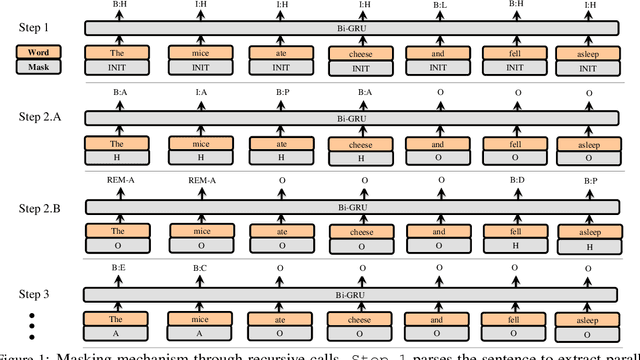
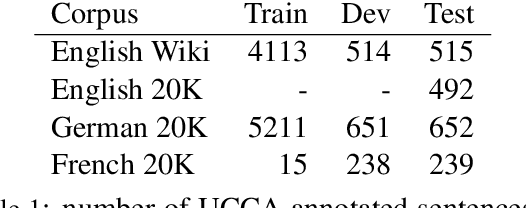
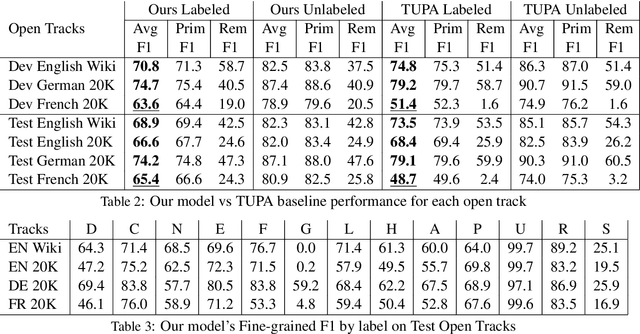
This paper describes our recursive system for SemEval-2019 \textit{ Task 1: Cross-lingual Semantic Parsing with UCCA}. Each recursive step consists of two parts. We first perform semantic parsing using a sequence tagger to estimate the probabilities of the UCCA categories in the sentence. Then, we apply a decoding policy which interprets these probabilities and builds the graph nodes. Parsing is done recursively, we perform a first inference on the sentence to extract the main scenes and links and then we recursively apply our model on the sentence using a masking feature that reflects the decisions made in previous steps. Process continues until the terminal nodes are reached. We choose a standard neural tagger and we focused on our recursive parsing strategy and on the cross lingual transfer problem to develop a robust model for the French language, using only few training samples.
Robust Semantic Parsing with Adversarial Learning for Domain Generalization
Oct 01, 2019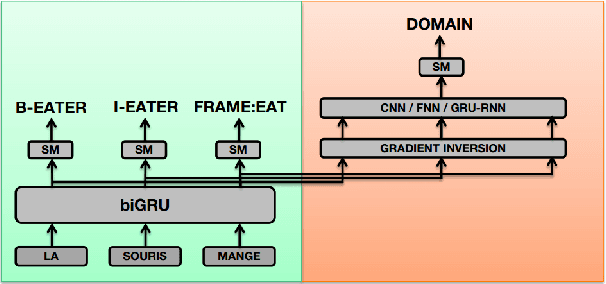

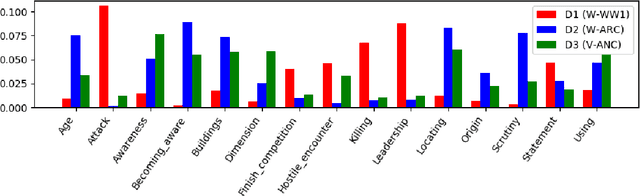

This paper addresses the issue of generalization for Semantic Parsing in an adversarial framework. Building models that are more robust to inter-document variability is crucial for the integration of Semantic Parsing technologies in real applications. The underlying question throughout this study is whether adversarial learning can be used to train models on a higher level of abstraction in order to increase their robustness to lexical and stylistic variations.We propose to perform Semantic Parsing with a domain classification adversarial task without explicit knowledge of the domain. The strategy is first evaluated on a French corpus of encyclopedic documents, annotated with FrameNet, in an information retrieval perspective, then on PropBank Semantic Role Labeling task on the CoNLL-2005 benchmark. We show that adversarial learning increases all models generalization capabilities both on in and out-of-domain data.