 Add to Chrome
 Add to Firefox
 Add to Edge
Reconfigurable Silicon Photonics Extreme Learning Machine with Random Non-linearities as Neural Processor and Physical Unclonable Function
Dec 18, 2025
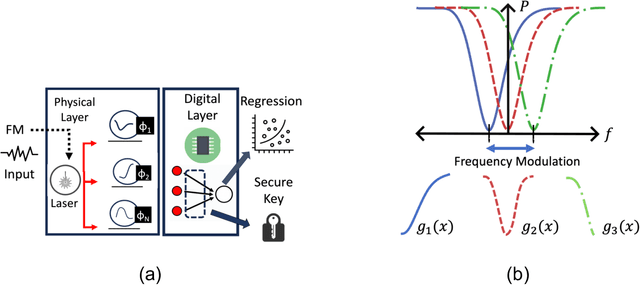
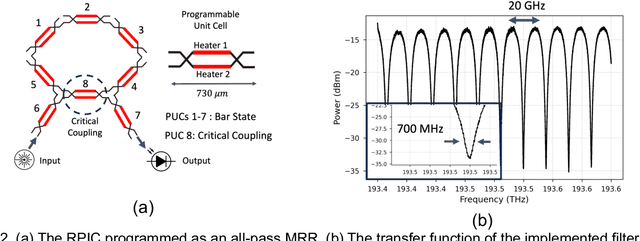
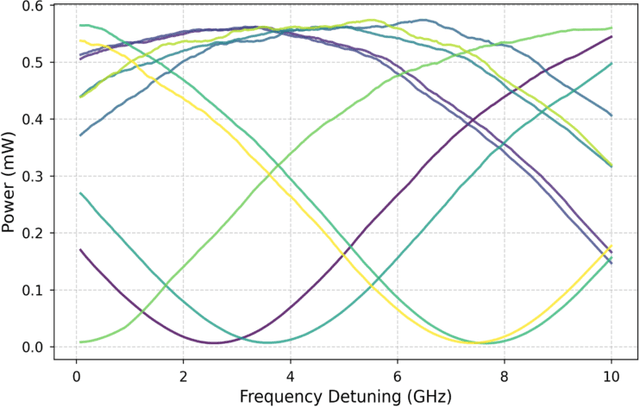
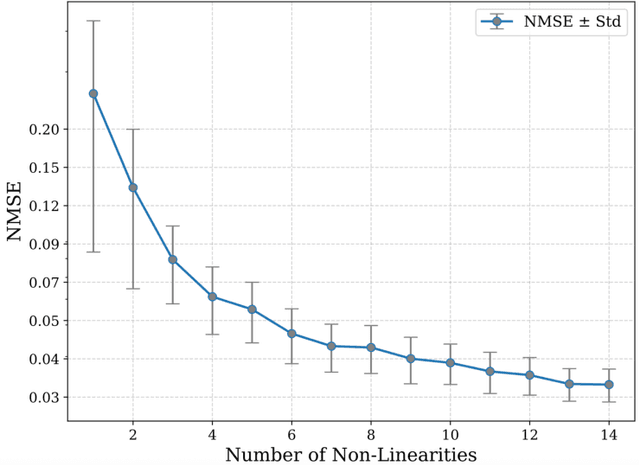
An alternative extreme learning machine -ELM- paradigm is presented exploiting random non-linearities -RN, named RN-ELM, instead of a conventional fixed node non-linearity. This method is implemented on a hybrid neural engine, with the physical layer realized by an integrated silicon photonic mesh and the digital layer by a simple regression algorithm. Non-linearities are intrinsically non-power depended and are generated through non-linear frequency to power mapping offered by optical filters. The numerical evaluation is based on an experimentally derived transfer function of an all-pass filter, implemented on a silicon reconfigurable photonic integrated chip -RPIC. RN-ELM is evaluated in a twofold manner; first as a machine learning scheme, where the expressivity offered by multiple, yet random, activation functions lead to a compact and highly simplified design with 5 optical filters, offering state-of-the-art performance in time-series prediction tasks with minimum hardware requirements. The second scenario entails its deployment as a physical unclonable function -PUF, for authentication applications directly in the physical layer. In this case, the random activation functions are associated with unavoidable, fabrication related waveguide imperfections that can act as hardware signatures. Numerical results reveal a probability of cloning as low as 10e-15, which corresponds to a highly secure authentication token.
