 Add to Chrome
 Add to Firefox
 Add to Edge
Controlled Experiments on Lane Changing by Transitional Autonomous Vehicle: Dataset and Behavioral Insights
Jul 29, 2026
This paper presents the North Carolina Transitional Autonomous Vehicle Lane-Changing (NC-tALC) dataset and uses it to characterize mandatory lane-changing behavior of transitional automated vehicles (tAVs). It quantifies the evolution of lead--lag gaps throughout the lane-change process and examines how potential collision risk develops during the maneuver. A controlled field experiment comprising 78 mandatory lane-change trials was conducted on a public roadway in Apex, North Carolina. Four instrumented vehicles created repeatable traffic conditions while varying the lane changer's initial position within the candidate target gap. High-resolution RTK-GNSS/INS trajectories were processed to identify key timestamps, calculate lead, lag, and lane-change gaps, and estimate interactions using time-gap- and speed-based surrogate safety measures. Despite substantial differences in initial conditions, lead and lag gaps consistently converged toward a relatively narrow range near lane crossing. Potential collision risk increased as the maneuver progressed, peaked near physical lane entry, and was dominated by interactions with the target-lane leader. Lane-change completion did not necessarily coincide with the disappearance of collision risk. This study provides one of the first controlled empirical characterizations of the complete mandatory lane-change process of tAVs using repeatable public-road experiments. The NC-tALC dataset supports analysis of behavioral and safety evolution throughout the maneuver rather than only at the gap-acceptance instant. The dataset and findings provide empirical benchmarks for evaluating automated lane-changing behavior, calibrating behavioral models, and validating simulation and safety assessment methods for mandatory lane-change scenarios.

Toward a Rational and Ethical Sociotechnical System of Autonomous Vehicles: A Novel Application of Multi-Criteria Decision Analysis
Feb 04, 2021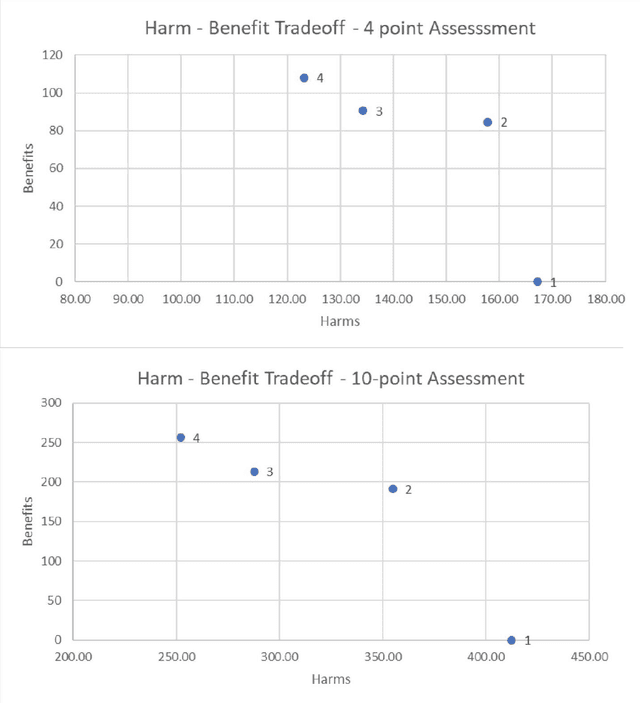
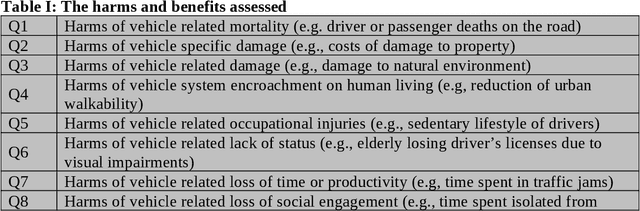
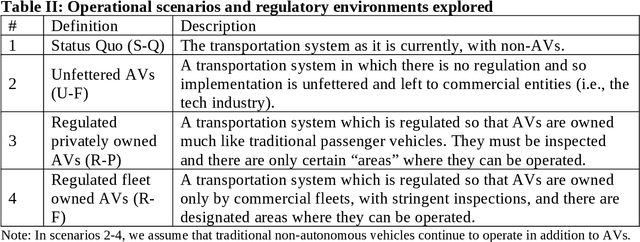
The expansion of artificial intelligence (AI) and autonomous systems has shown the potential to generate enormous social good while also raising serious ethical and safety concerns. AI technology is increasingly adopted in transportation. A survey of various in-vehicle technologies found that approximately 64% of the respondents used a smartphone application to assist with their travel. The top-used applications were navigation and real-time traffic information systems. Among those who used smartphones during their commutes, the top-used applications were navigation and entertainment. There is a pressing need to address relevant social concerns to allow for the development of systems of intelligent agents that are informed and cognizant of ethical standards. Doing so will facilitate the responsible integration of these systems in society. To this end, we have applied Multi-Criteria Decision Analysis (MCDA) to develop a formal Multi-Attribute Impact Assessment (MAIA) questionnaire for examining the social and ethical issues associated with the uptake of AI. We have focused on the domain of autonomous vehicles (AVs) because of their imminent expansion. However, AVs could serve as a stand-in for any domain where intelligent, autonomous agents interact with humans, either on an individual level (e.g., pedestrians, passengers) or a societal level.
Moral and Social Ramifications of Autonomous Vehicles
Jan 29, 2021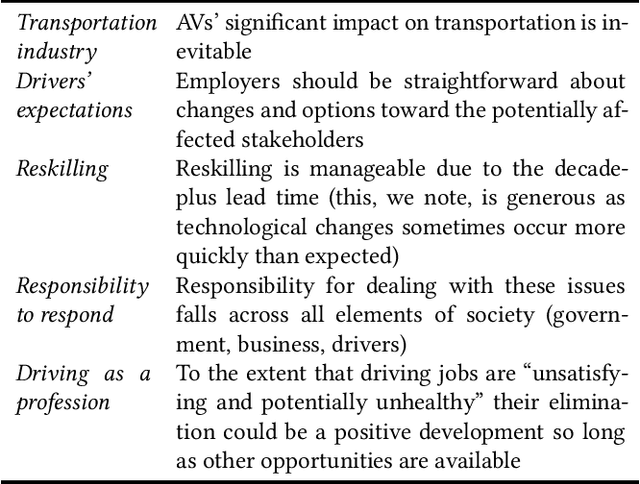
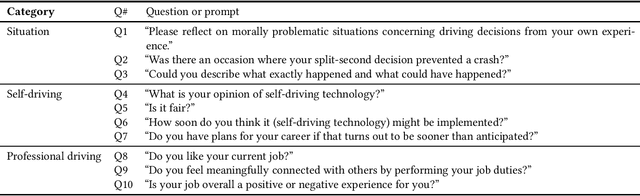
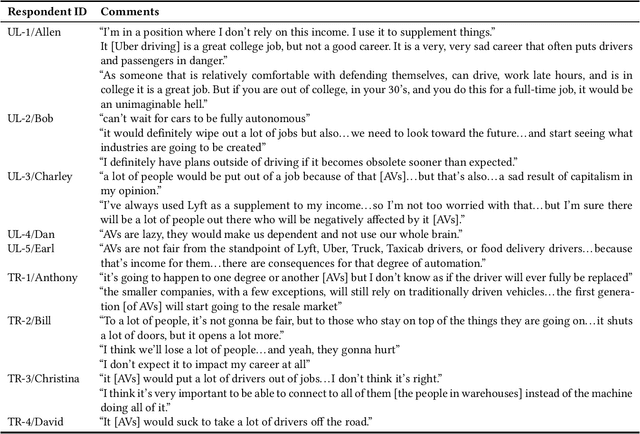
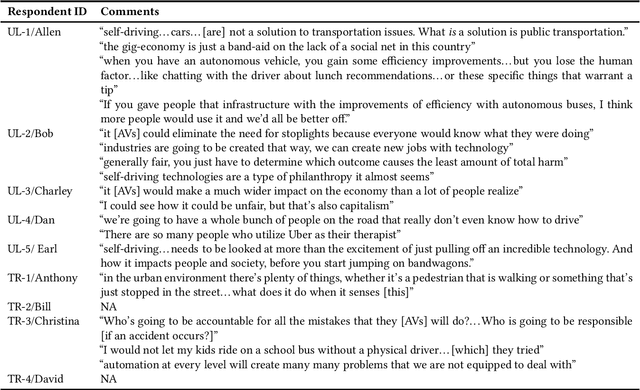
Autonomous Vehicles (AVs) raise important social and ethical concerns, especially about accountability, dignity, and justice. We focus on the specific concerns arising from how AV technology will affect the lives and livelihoods of professional and semi-professional drivers. Whereas previous studies of such concerns have focused on the opinions of experts, we seek to understand these ethical and societal challenges from the perspectives of the drivers themselves. To this end, we adopted a qualitative research methodology based on semi-structured interviews. This is an established social science methodology that helps understand the core concerns of stakeholders in depth by avoiding the biases of superficial methods such as surveys. We find that whereas drivers agree with the experts that AVs will significantly impact transportation systems, they are apprehensive about the prospects for their livelihoods and dismiss the suggestions that driving jobs are unsatisfying and their profession does not merit protection. By showing how drivers differ from the experts, our study has ramifications beyond AVs to AI and other advanced technologies. Our findings suggest that qualitative research applied to the relevant, especially disempowered, stakeholders is essential to ensuring that new technologies are introduced ethically.
Prosocial Norm Emergence in Multiagent Systems
Dec 29, 2020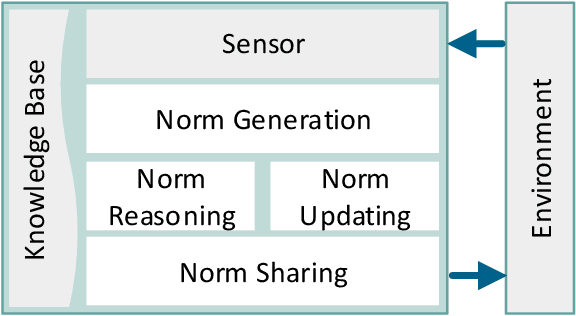
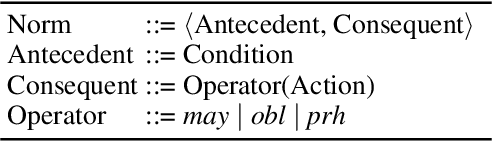

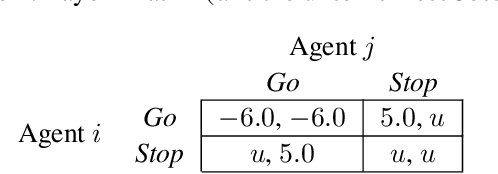
Multiagent systems provide a basis of developing systems of autonomous entities and thus find application in a variety of domains. We consider a setting where not only the member agents are adaptive but also the multiagent system itself is adaptive. Specifically, the social structure of a multiagent system can be reflected in the social norms among its members. It is well recognized that the norms that arise in society are not always beneficial to its members. We focus on prosocial norms, which help achieve positive outcomes for society and often provide guidance to agents to act in a manner that takes into account the welfare of others. Specifically, we propose Cha, a framework for the emergence of prosocial norms. Unlike previous norm emergence approaches, Cha supports continual change to a system (agents may enter and leave), and dynamism (norms may change when the environment changes). Importantly, Cha agents incorporate prosocial decision making based on inequity aversion theory, reflecting an intuition of guilt from being antisocial. In this manner, Cha brings together two important themes in prosociality: decision making by individuals and fairness of system-level outcomes. We demonstrate via simulation that Cha can improve aggregate societal gains and fairness of outcomes.