 Add to Chrome
 Add to Firefox
 Add to Edge
A Security-Oriented Lifecycle Model for Large Language Model Systems
Aug 04, 2026
Large language models are being integrated into critical infrastructure and enterprise workflows at unprecedented scale,yet the lifecycle frameworks governing their development and operations were designed for operational efficiency rather than security analysis. As a result, security-relevant activities such as data provenance verification, artifact signing, agentic permission control, and decommissioning are often left implicit or assumed to receive due care. Governance frameworks, in turn, organise requirements around risk levels or management processes without clearly linking them to the lifecycle stages where they apply. This paper addresses both deficiencies. We propose a lifecycle model for LLM systems that supports security analysis by structuring it around security-relevant boundaries rather than workflow optimisation. The model comprises 32 stages across four core pipeline layers (Data, Model, Distribution, Application), supported by a 12-stage LLMOps pillar and a 9-category governance pillar. Thirteen stages are introduced here as separate units because they expose distinct security concerns that existing frameworks do not clearly distinguish. A governance mapping synthesising the NIST AI RMF, the EU AI Act, and ISO/IEC 42001 reveals a structural property of the current regulatory landscape: governance evidence concentrates at deployment-facing stages, where systems are visible to regulators, while the most consequential decisions, data selection, alignment strategy, and capability boundaries, are made at development-facing stages, where regulatory visibility is lowest.

Predicting Early Dropouts of an Active and Healthy Ageing App
Aug 01, 2023In this work, we present a machine learning approach for predicting early dropouts of an active and healthy ageing app. The presented algorithms have been submitted to the IFMBE Scientific Challenge 2022, part of IUPESM WC 2022. We have processed the given database and generated seven datasets. We used pre-processing techniques to construct classification models that predict the adherence of users using dynamic and static features. We submitted 11 official runs and our results show that machine learning algorithms can provide high-quality adherence predictions. Based on the results, the dynamic features positively influence a model's classification performance. Due to the imbalanced nature of the dataset, we employed oversampling methods such as SMOTE and ADASYN to improve the classification performance. The oversampling approaches led to a remarkable improvement of 10\%. Our methods won first place in the IFMBE Scientific Challenge 2022.
FedPOIRec: Privacy Preserving Federated POI Recommendation with Social Influence
Dec 21, 2021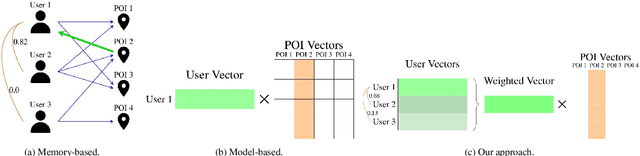
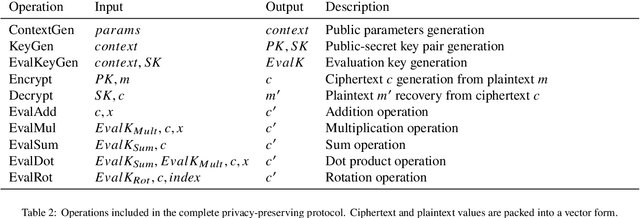
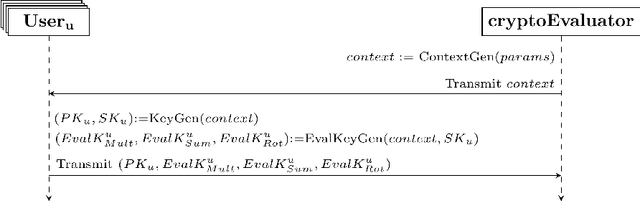
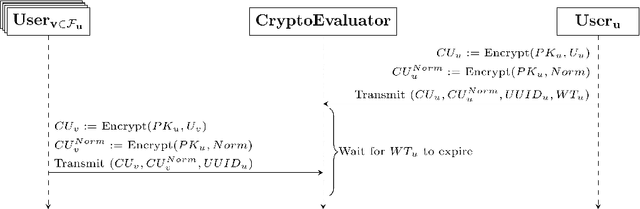
With the growing number of Location-Based Social Networks, privacy preserving location prediction has become a primary task for helping users discover new points-of-interest (POIs). Traditional systems consider a centralized approach that requires the transmission and collection of users' private data. In this work, we present FedPOIRec, a privacy preserving federated learning approach enhanced with features from users' social circles for top-$N$ POI recommendations. First, the FedPOIRec framework is built on the principle that local data never leave the owner's device, while the local updates are blindly aggregated by a parameter server. Second, the local recommenders get personalized by allowing users to exchange their learned parameters, enabling knowledge transfer among friends. To this end, we propose a privacy preserving protocol for integrating the preferences of a user's friends after the federated computation, by exploiting the properties of the CKKS fully homomorphic encryption scheme. To evaluate FedPOIRec, we apply our approach into five real-world datasets using two recommendation models. Extensive experiments demonstrate that FedPOIRec achieves comparable recommendation quality to centralized approaches, while the social integration protocol incurs low computation and communication overhead on the user side.