 Add to Chrome
 Add to Firefox
 Add to Edge
FastGFDs: Efficient Validation of Graph Functional Dependencies with Desbordante
Aug 03, 2026
Graph functional dependencies (GFD) are a recently-developed concept aimed at capturing both topological structures in graphs and functional dependencies between attributes. The process of verifying whether a given GFD holds over a particular graph is referred to as GFD validation. In this very computationally expensive problem, locating suitable subgraphs accounts for about 99% of the total run time. The concept's authors originally proposed a parallel scheme (algorithm), targeting specifically clusters of high-performance servers. The goal of this study is to open GFD validation to a broader public by making it possible to run it on a consumer class PC. Our initial experiments demonstrated that the existing algorithm may not be optimal for these purposes. Therefore, we propose FastGFDs - a GFD validation algorithm that employs a recently developed graph matching technique. In contrast to the parallel scheme, it is sequential and operates on the entire graph. Its novelty lies in the use of Core-First Decomposition and the Compact Path Index (CPI). We compare it with the naive sequential algorithm and the parallel scheme, evaluating run times and memory consumption. The current study is the first step towards designing an efficient algorithm for GFD validation in low-end single-node environments. We also provide an open-source implementation of GFD validation over large data graphs. To the best of our knowledge, this is the only publicly available implementation of an algorithm for this problem. It is developed in Desbordante - an open-source high-performance data profiler aimed at science-intensive tasks. Finally, our experiments on a real-life graph demonstrated up to three times performance (2.6x on average) improvement over the parallel scheme. Employing the new subgraph matching algorithm also reduced memory consumption by five times.
* https://fruct.org/publications/volume-33/acm33/

Fast Discovery of Inclusion Dependencies with Desbordante
Aug 03, 2026Inclusion dependency is a relation between attributes of tables that indicates possible Primary Key-Foreign Key references. Automatic discovery of inclusion dependencies is a relevant problem for both academic and industrial communities. The core concern for this problem is the efficiency of discovery process, since it is a computationally expensive task. However, existing studies only address the algorithmic side, while leaving out the implementation aspect. At the same time, engineering details are at least as important as the algorithmic ones for achieving good performance. In this paper, we describe techniques for efficient implementation of two algorithms for discovery of inclusion dependencies - Spider and Faida. The first one is a classic algorithm whose ideas lie in the foundation of many other inclusion dependency discovery algorithms. We propose an efficient parallelization technique, which greatly speeds up the algorithm while simultaneously reducing its memory consumption. The second one is the state-of-the-art approximate algorithm, which we approach by applying four types of optimizations: data buffering, SIMD-enabled execution, careful hash-table selection and parallelization. In order to experimentally evaluate our techniques, we have implemented these algorithms in Desbordante - an open-source science-intensive data profiler written in C++. For Spider, we have evaluated several different options, and in case of Faida we have demonstrated that all our optimization techniques yield results. We also compared our implementations with Metanome - a Java-based data profiler. Overall, we report up to 5x improvement in terms of run time reduction for Spider and up to 8x for Faida.
Order in Desbordante: Techniques for Efficient Implementation of Order Dependency Discovery Algorithms
Jul 26, 2026Science-intensive data profiling focuses on discovery and validation of various patterns in datasets. This study considers discovery of one such pattern - order dependency (OD). Simply put, OD states that some list of columns is ordered according to another one. It is of use for database query optimization, data cleaning and deduplication, anomaly detection, and much more. Existing discovery methods have approached this problem solely from the algorithmic standpoint, without focusing on the implementation side. At the same time, this problem is very computationally intensive, and therefore this part should not be ignored, as it brings ODs closer to industrial use. In this paper, we study two algorithms for OD discovery which target different OD axiomatizations - FASTOD and ORDER. We start by reimplementing these algorithms in C++ in order to speed them up and lower their memory consumption. We then analyze their bottlenecks and propose several techniques which improve their performance even further. To perform evaluation, we have implemented these algorithms inside Desbordante - a science-intensive, high-performance, and open-source data profiling tool developed in C++. Experiments have demonstrated a performance improvement of up to 3x obtained by reimplemented versions, and, with the application of our techniques, up to 10x. Memory consumption has been lowered by up to 2.9x.
Extending Desbordante with Probabilistic Functional Dependency Discovery Support
Jul 26, 2026Data profiling aims to extract complex patterns from data for further analysis and use that data in domains such as data cleaning, data deduplication, anomaly detection, and many more. Functional dependencies (FDs) are one of the most well-known patterns. However, they are poorly suited for these tasks, as real data is usually dirty, and the rigid definition of FDs does not allow algorithms to locate them. For this reason, there are several formulations aimed at relaxing FDs to support dirty data, with approximate functional dependency (AFD) being the most popular one. Another formulation is the Probabilistic Functional Dependency (pFD), which we aim to support inside Desbordante - a science-intensive, high-performance and open-source data profiling tool implemented in C++. However, pFDs are relatively poorly studied, compared to AFDs. In this paper we study pFDs, both analytically and empirically. We start by assessing how different pFDs and AFDs are by studying cases in which pFDs have an edge over AFDs. Then, we implement the algorithm for pFD discovery, as well as study its run time and memory consumption. We also compare it with an AFD discovery algorithm. Lastly, we study the output of both algorithms to learn whether or not it is possible to use AFD discovery algorithm to get pFDs and vice versa.
Lightning Fast Matching Dependency Discovery with Desbordante
Jul 12, 2026Matching dependency is a generalization of the functional dependency concept, which allows users to apply custom similarity functions for matching individual attributes. Matching dependencies have a wide range of applications for solving various data quality problems, such as entity resolution, data deduplication, data integration, schema matching, and many more. However, their discovery is a very computationally intensive problem, which limits their practical application. In this paper, we describe a number of optimization techniques for HyMD - currently the state-of-the-art algorithm for the discovery of matching dependencies. These optimizations belong to both technical and scientific domains. The most important of them are: 1) a new sampling technique, 2) a faster generalization lookup technique, and 3) an improved representation of a dependency. The first one aims to raise the efficiency of inference from record pairs, while the last two are designed to speed up lattice-related operations. To evaluate our optimizations, we implemented our version of HyMD in Desbordante, an open-source high-performance data profiler. Experiments demonstrated that they allow for a speedup of more than 40x over the state-of-the-art implementation on average, reaching a speedup greater than 170x in some cases. Finally, the improved version of HyMD is ready to use by anyone. It comes with bidirectional Python integration, which allows calling the C++ algorithm implementation from Python programs while allowing users to supply their custom matching functions.
Efficient Discovery of Conditional Dependencies with Desbordante
Jul 04, 2026Conditional functional dependencies (CFDs) are functional dependencies with a restricted scope: they specify the context in which a dependency holds and are useful for data-quality tasks, specifying complex integrity constraints, and extracting valuable insights from data. We study the CFD discovery problem, which is computationally demanding. We build on the state-of-the-art CFDFinder algorithm and introduce a set of algorithmic and engineering improvements, including a parallelization strategy, to produce ParCFDFinder. Our implementation is integrated into Desbordante - a high-performance open-source data profiler written in C++ that exposes a Python interface, enabling CFD discovery to be invoked from any Python program. Experimental results show that our enhancements speed up the algorithm by up to $318\times$ ($118\times$ on average) and reduce memory usage by up to $23\times$ ($14\times$ on average) compared with the existing Java-based implementation of Metanome. Integrating ParCFDFinder into Desbordante makes it possible, for the first time, to conveniently discover CFDs on datasets with hundreds of thousands of rows on a commodity machine within a reasonable time.
Scalable Maximal Frequent Episode Mining with Desbordante
Jul 03, 2026Episode mining aims to extract subsequences of events that possess certain distinctive properties and constitute facts valuable to the user. Maximal frequent episode mining concentrates on discovery of frequently-appearing subsequences, which are not included into any other larger frequent subsequence. The state-of-the-art for this problem is the MaxFEM algorithm which enumerates possible subsequences, while applying various pruning techniques to accelerate the search. However, this is a computationally-intensive problem: reducing the minimum number of required subsequence occurrences or increasing the length of the subsequence both substantially raise running time, which limits practical use of MaxFEM. In this paper we describe our efforts in designing a high-performing algorithm for this problem. For this we: 1) develop an efficient C++ implementation of MaxFEM, and 2) devise an efficient technique to parallelizing it. As the result, we propose an improved parallel MaxFEM variant, which we call ParMaxFEM. Additionally, we integrate the improved algorithm into Desbordante - a high-performance, open-source data profiler with deep Python integration that treats patterns as first-class entities and allows users to develop their custom programs that can include discovery and validation of patterns. To evaluate our approach we compare both C++ implementations with the original SPMF implementation. Experiments demonstrated that our reimplemented version provides up to $8\times$ speedup over the SPMF baseline, while our parallelization technique provides up to $35\times$ improvement overall (on 8 cores).
Solving Data Quality Problems with Desbordante: a Demo
Jul 28, 2023Data profiling is an essential process in modern data-driven industries. One of its critical components is the discovery and validation of complex statistics, including functional dependencies, data constraints, association rules, and others. However, most existing data profiling systems that focus on complex statistics do not provide proper integration with the tools used by contemporary data scientists. This creates a significant barrier to the adoption of these tools in the industry. Moreover, existing systems were not created with industrial-grade workloads in mind. Finally, they do not aim to provide descriptive explanations, i.e. why a given pattern is not found. It is a significant issue as it is essential to understand the underlying reasons for a specific pattern's absence to make informed decisions based on the data. Because of that, these patterns are effectively rest in thin air: their application scope is rather limited, they are rarely used by the broader public. At the same time, as we are going to demonstrate in this presentation, complex statistics can be efficiently used to solve many classic data quality problems. Desbordante is an open-source data profiler that aims to close this gap. It is built with emphasis on industrial application: it is efficient, scalable, resilient to crashes, and provides explanations. Furthermore, it provides seamless Python integration by offloading various costly operations to the C++ core, not only mining. In this demonstration, we show several scenarios that allow end users to solve different data quality problems. Namely, we showcase typo detection, data deduplication, and data anomaly detection scenarios.
Desbordante: from benchmarking suite to high-performance science-intensive data profiler (preprint)
Jan 14, 2023Pioneering data profiling systems such as Metanome and OpenClean brought public attention to science-intensive data profiling. This type of profiling aims to extract complex patterns (primitives) such as functional dependencies, data constraints, association rules, and others. However, these tools are research prototypes rather than production-ready systems. The following work presents Desbordante - a high-performance science-intensive data profiler with open source code. Unlike similar systems, it is built with emphasis on industrial application in a multi-user environment. It is efficient, resilient to crashes, and scalable. Its efficiency is ensured by implementing discovery algorithms in C++, resilience is achieved by extensive use of containerization, and scalability is based on replication of containers. Desbordante aims to open industrial-grade primitive discovery to a broader public, focusing on domain experts who are not IT professionals. Aside from the discovery of various primitives, Desbordante offers primitive validation, which not only reports whether a given instance of primitive holds or not, but also points out what prevents it from holding via the use of special screens. Next, Desbordante supports pipelines - ready-to-use functionality implemented using the discovered primitives, for example, typo detection. We provide built-in pipelines, and the users can construct their own via provided Python bindings. Unlike other profilers, Desbordante works not only with tabular data, but with graph and transactional data as well. In this paper, we present Desbordante, the vision behind it and its use-cases. To provide a more in-depth perspective, we discuss its current state, architecture, and design decisions it is built on. Additionally, we outline our future plans.
Russian Web Tables: A Public Corpus of Web Tables for Russian Language Based on Wikipedia
Oct 03, 2022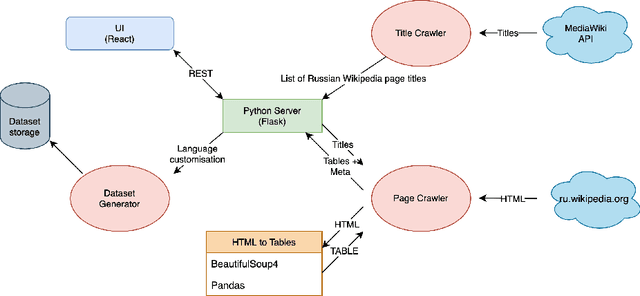
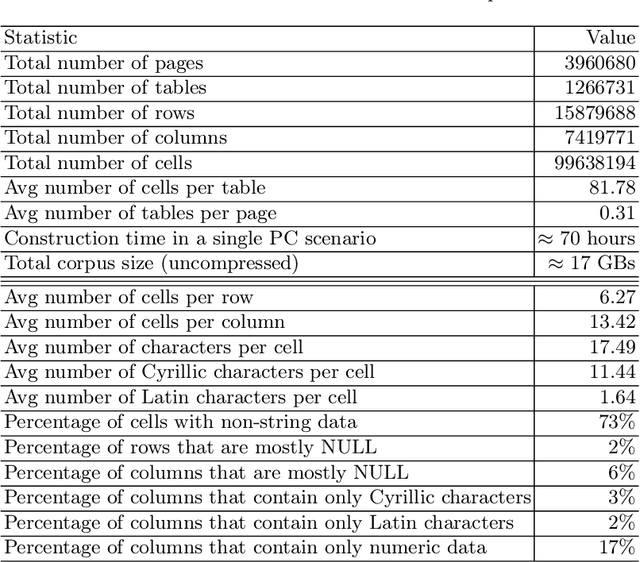
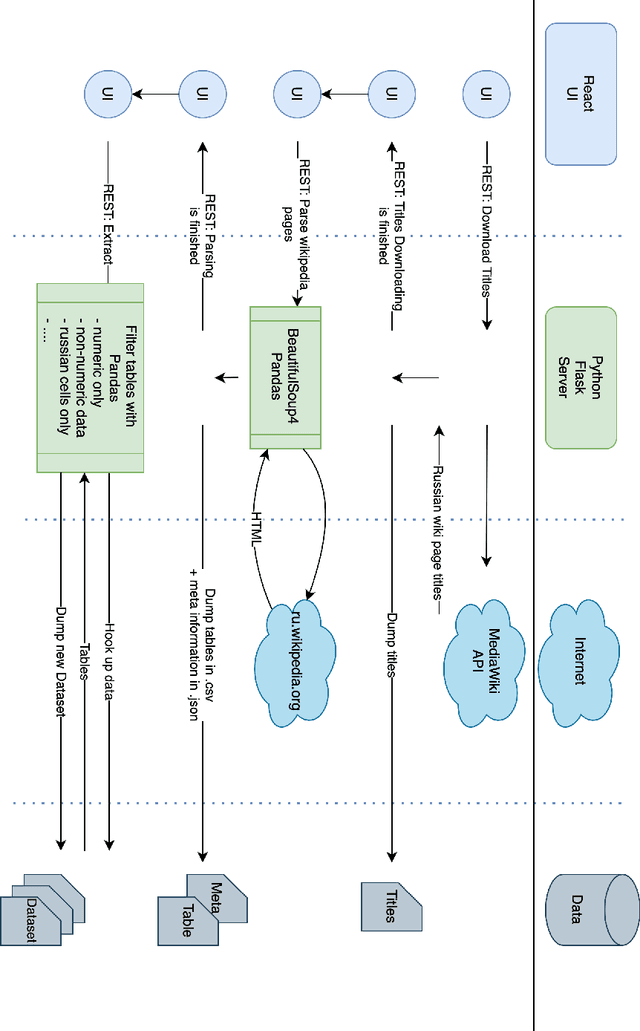

Corpora that contain tabular data such as WebTables are a vital resource for the academic community. Essentially, they are the backbone of any modern research in information management. They are used for various tasks of data extraction, knowledge base construction, question answering, column semantic type detection and many other. Such corpora are useful not only as a source of data, but also as a base for building test datasets. So far, there were no such corpora for the Russian language and this seriously hindered research in the aforementioned areas. In this paper, we present the first corpus of Web tables created specifically out of Russian language material. It was built via a special toolkit we have developed to crawl the Russian Wikipedia. Both the corpus and the toolkit are open-source and publicly available. Finally, we present a short study that describes Russian Wikipedia tables and their statistics.