 Add to Chrome
 Add to Firefox
 Add to Edge
Empowering Semantic-Sensitive Underwater Image Enhancement with VLM
Mar 13, 2026
In recent years, learning-based underwater image enhancement (UIE) techniques have rapidly evolved. However, distribution shifts between high-quality enhanced outputs and natural images can hinder semantic cue extraction for downstream vision tasks, thereby limiting the adaptability of existing enhancement models. To address this challenge, this work proposes a new learning mechanism that leverages Vision-Language Models (VLMs) to empower UIE models with semantic-sensitive capabilities. To be concrete, our strategy first generates textual descriptions of key objects from a degraded image via VLMs. Subsequently, a text-image alignment model remaps these relevant descriptions back onto the image to produce a spatial semantic guidance map. This map then steers the UIE network through a dual-guidance mechanism, which combines cross-attention and an explicit alignment loss. This forces the network to focus its restorative power on semantic-sensitive regions during image reconstruction, rather than pursuing a globally uniform improvement, thereby ensuring the faithful restoration of key object features. Experiments confirm that when our strategy is applied to different UIE baselines, significantly boosts their performance on perceptual quality metrics as well as enhances their performance on detection and segmentation tasks, validating its effectiveness and adaptability.

SFFNet: A Wavelet-Based Spatial and Frequency Domain Fusion Network for Remote Sensing Segmentation
May 03, 2024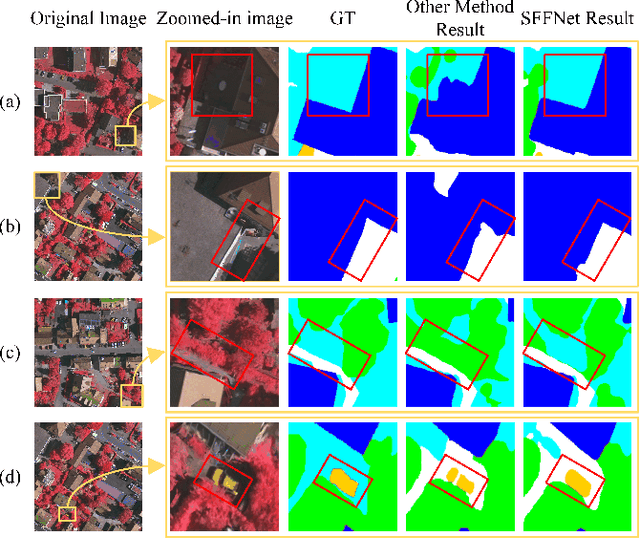
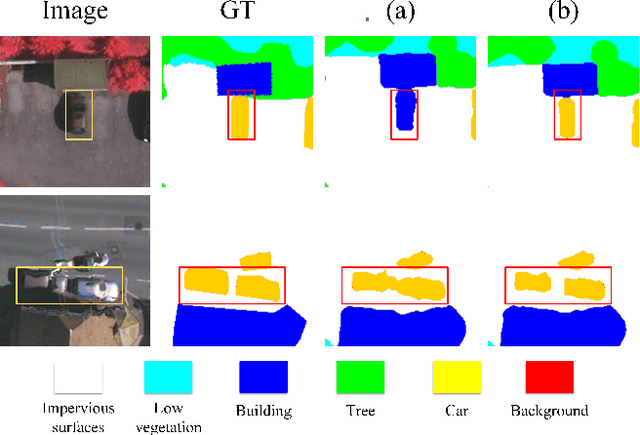
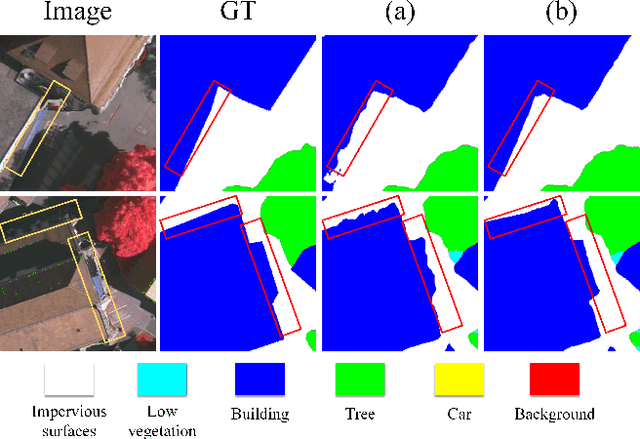
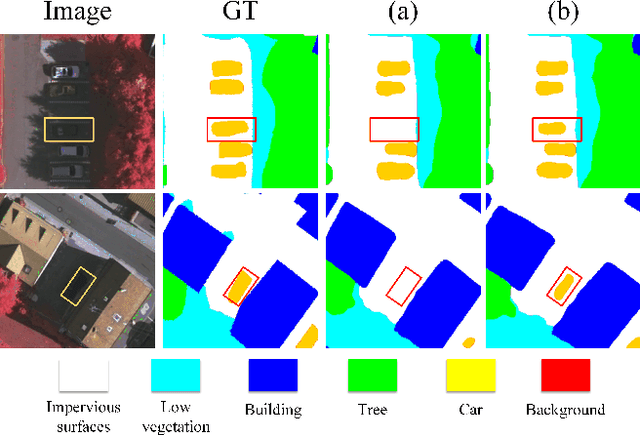
In order to fully utilize spatial information for segmentation and address the challenge of handling areas with significant grayscale variations in remote sensing segmentation, we propose the SFFNet (Spatial and Frequency Domain Fusion Network) framework. This framework employs a two-stage network design: the first stage extracts features using spatial methods to obtain features with sufficient spatial details and semantic information; the second stage maps these features in both spatial and frequency domains. In the frequency domain mapping, we introduce the Wavelet Transform Feature Decomposer (WTFD) structure, which decomposes features into low-frequency and high-frequency components using the Haar wavelet transform and integrates them with spatial features. To bridge the semantic gap between frequency and spatial features, and facilitate significant feature selection to promote the combination of features from different representation domains, we design the Multiscale Dual-Representation Alignment Filter (MDAF). This structure utilizes multiscale convolutions and dual-cross attentions. Comprehensive experimental results demonstrate that, compared to existing methods, SFFNet achieves superior performance in terms of mIoU, reaching 84.80% and 87.73% respectively.The code is located at https://github.com/yysdck/SFFNet.
MFDS-Net: Multi-Scale Feature Depth-Supervised Network for Remote Sensing Change Detection with Global Semantic and Detail Information
May 02, 2024Change detection as an interdisciplinary discipline in the field of computer vision and remote sensing at present has been receiving extensive attention and research. Due to the rapid development of society, the geographic information captured by remote sensing satellites is changing faster and more complex, which undoubtedly poses a higher challenge and highlights the value of change detection tasks. We propose MFDS-Net: Multi-Scale Feature Depth-Supervised Network for Remote Sensing Change Detection with Global Semantic and Detail Information (MFDS-Net) with the aim of achieving a more refined description of changing buildings as well as geographic information, enhancing the localisation of changing targets and the acquisition of weak features. To achieve the research objectives, we use a modified ResNet_34 as backbone network to perform feature extraction and DO-Conv as an alternative to traditional convolution to better focus on the association between feature information and to obtain better training results. We propose the Global Semantic Enhancement Module (GSEM) to enhance the processing of high-level semantic information from a global perspective. The Differential Feature Integration Module (DFIM) is proposed to strengthen the fusion of different depth feature information, achieving learning and extraction of differential features. The entire network is trained and optimized using a deep supervision mechanism. The experimental outcomes of MFDS-Net surpass those of current mainstream change detection networks. On the LEVIR dataset, it achieved an F1 score of 91.589 and IoU of 84.483, on the WHU dataset, the scores were F1: 92.384 and IoU: 86.807, and on the GZ-CD dataset, the scores were F1: 86.377 and IoU: 76.021. The code is available at https://github.com/AOZAKIiii/MFDS-Net