 Add to Chrome
 Add to Firefox
 Add to Edge
Weights or Skills? A Survey of Robot-Learning Techniques: from Action-Predicting Weights to Robots that Write their Own Skills
Aug 03, 2026
Robot learning is splitting into two bets: policies that bake competence into frozen weights (vision-language-action, or VLA, models), and agents that write and refine their own executable skills as code. This survey organises the field around that axis of weights versus skills. Its central analytical contribution is a deep-dive that arranges code-as-policy methods by their degree of self-improvement, from zero-shot program synthesis, through closed-loop self-repair and persistent skill memory, to the sparsely populated cell in which execution feedback, skill memory, and evolutionary search combine into one open-ended loop; only a few very recent systems (for example ASPIRE, ENPIRE, and RoboClaw) occupy that cell. We map the complementary "skills" pole, from unsupervised reinforcement-learning skill discovery to large-language-model skill libraries, and show that the word "skill" is used in at least five distinct senses, of which only the code sense self-improves without gradient updates. We then connect the taxonomy to the emerging skill economy: commercial robot-skill marketplaces now distribute one-tap skills across robots but ship only static playback, which surfaces open problems of adaptation, cross-embodiment portability, provenance, safety verification, composition, and standardisation. This is a deliberately focused survey. Rather than cataloguing the field exhaustively, it examines 77 representative systems across six technique families through one taxonomy and a set of contrast tables, and it supplies operational definitions of the self-improvement mechanisms together with a statement of what each family cannot do.

FactorJEPA: Factorizing Monolithic Futures into Layout-Agent-Interaction Channels for Crowded and Chaotic Global South Urban Worlds
Aug 02, 2026World models have attracted significant attention for their ability to capture and predict the structure and dynamics of the physical world. In this emerging landscape, Joint Embedding Predictive Architectures (JEPA) offer a particularly compelling direction. We study a largely unexplored regime: populous, crowded, and chaotic Global South urban environments, which we call DENSEWORLD. Unlike the lower-density, lane-structured settings that dominate existing evaluations, these scenes exhibit soft spatial boundaries, extreme agent heterogeneity, persistent occlusion, and rapid social negotiation under mixed traffic. We introduce the first large-scale dataset for this regime: 1,000 hours of drive-through, walk-through, and aerial video across 22 cities. Existing JEPA formulations struggle to preserve dense interaction dynamics under heterogeneity and partial observability. We introduce FactorJEPA, which makes world structure a first-class predictive primitive. Rather than encoding the future in a monolithic latent, it composes layout, entities, and interactions, using a visibility gate and separated subspaces to preserve partially observed agents and discourage cross-factor shortcuts. FactorJEPA improves (i) future-latent accuracy (Future-frame L1), (ii) intervention-sensitive prediction (Causal L1), and (iii) robustness to reduced visual evidence (Mask-ratio slope), while exposing (iv) a reproducible motion-information trade-off (Motion cosine). Method rankings replicate across 2B and 1B V-JEPA 2.1 backbones, with rho = 0.895 to 0.978. We publicly release the DENSEWORLD-115k dataset (https://huggingface.co/datasets/anonymousML123/denseworld-115k) and the surgery-trained FactorJEPA checkpoints (https://huggingface.co/datasets/anonymousML123/factorjepa-outputs/tree/main/outputs/full/vjepa_2_1_vitg_1B/train/m09c_surgery_3stage_DI_diheavy_encoder).
A Comprehensive Dataset for Human vs. AI Generated Text Detection
Oct 26, 2025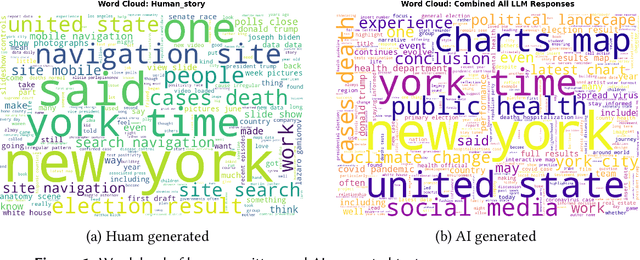
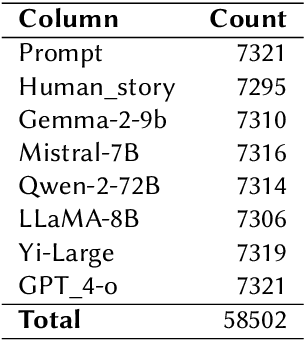

The rapid advancement of large language models (LLMs) has led to increasingly human-like AI-generated text, raising concerns about content authenticity, misinformation, and trustworthiness. Addressing the challenge of reliably detecting AI-generated text and attributing it to specific models requires large-scale, diverse, and well-annotated datasets. In this work, we present a comprehensive dataset comprising over 58,000 text samples that combine authentic New York Times articles with synthetic versions generated by multiple state-of-the-art LLMs including Gemma-2-9b, Mistral-7B, Qwen-2-72B, LLaMA-8B, Yi-Large, and GPT-4-o. The dataset provides original article abstracts as prompts, full human-authored narratives. We establish baseline results for two key tasks: distinguishing human-written from AI-generated text, achieving an accuracy of 58.35\%, and attributing AI texts to their generating models with an accuracy of 8.92\%. By bridging real-world journalistic content with modern generative models, the dataset aims to catalyze the development of robust detection and attribution methods, fostering trust and transparency in the era of generative AI. Our dataset is available at: https://huggingface.co/datasets/gsingh1-py/train.
Multimodal Benchmarking and Recommendation of Text-to-Image Generation Models
May 06, 2025This work presents an open-source unified benchmarking and evaluation framework for text-to-image generation models, with a particular focus on the impact of metadata augmented prompts. Leveraging the DeepFashion-MultiModal dataset, we assess generated outputs through a comprehensive set of quantitative metrics, including Weighted Score, CLIP (Contrastive Language Image Pre-training)-based similarity, LPIPS (Learned Perceptual Image Patch Similarity), FID (Frechet Inception Distance), and retrieval-based measures, as well as qualitative analysis. Our results demonstrate that structured metadata enrichments greatly enhance visual realism, semantic fidelity, and model robustness across diverse text-to-image architectures. While not a traditional recommender system, our framework enables task-specific recommendations for model selection and prompt design based on evaluation metrics.