 Add to Chrome
 Add to Firefox
 Add to Edge
Directed Neuro-Symbolic Stochastic Execution for Verification of Distributed Parallel AI Programs
Aug 08, 2026
Distributed parallel Artificial Intelligence (AI) programs expose reliability gaps that conventional testing cannot close: parallel executions are non-deterministic, and AI workloads bring high-dimensional inputs and non-linear operations that defeat fuzzing and symbolic execution in isolation. We present Directed Neuro-Symbolic Stochastic Execution (DNSSE), a hybrid testing framework that couples schedule prediction guided by a Large Language Model (LLM) with symbolic constraint solving and coverage-guided stochastic mutation. We model distributed AI executions as non-deterministic transition systems, specify correctness in linear temporal logic, and prove soundness, bounded completeness, and probabilistic completeness of the hybrid solver, together with an expected-cost analysis of LLM-guided schedule exploration. A scalable implementation on PyTorch and Ray detects 2.9% more concurrency bugs than the strongest baseline and raises average branch coverage from 68.6 % to 91.6 % across five realistic distributed AI benchmarks.

Single and Multi-Speaker Cloned Voice Detection: From Perceptual to Learned Features
Jul 15, 2023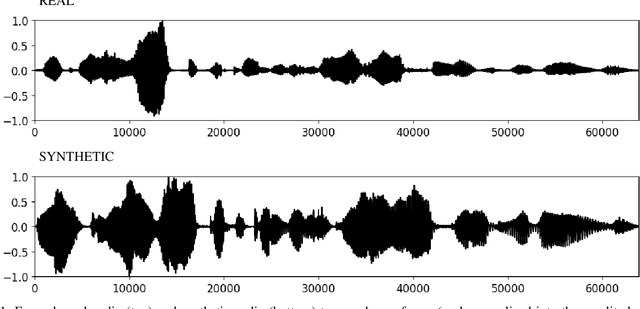
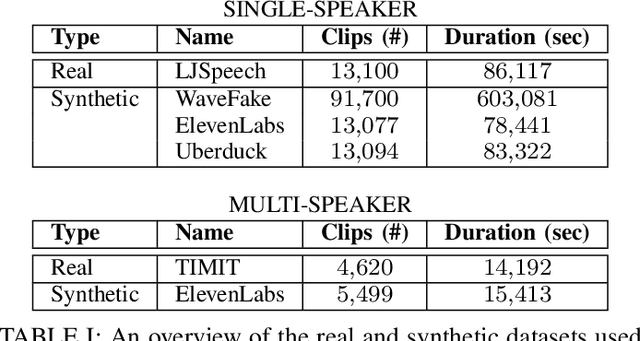
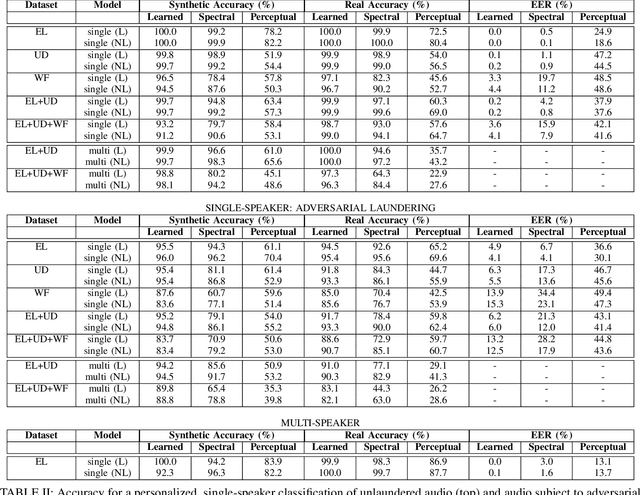
Synthetic-voice cloning technologies have seen significant advances in recent years, giving rise to a range of potential harms. From small- and large-scale financial fraud to disinformation campaigns, the need for reliable methods to differentiate real and synthesized voices is imperative. We describe three techniques for differentiating a real from a cloned voice designed to impersonate a specific person. These three approaches differ in their feature extraction stage with low-dimensional perceptual features offering high interpretability but lower accuracy, to generic spectral features, and end-to-end learned features offering less interpretability but higher accuracy. We show the efficacy of these approaches when trained on a single speaker's voice and when trained on multiple voices. The learned features consistently yield an equal error rate between $0\%$ and $4\%$, and are reasonably robust to adversarial laundering.