 Add to Chrome
 Add to Firefox
 Add to Edge
On the Internal Semantics of Time-Series Foundation Models
Nov 19, 2025
Time-series Foundation Models (TSFMs) have recently emerged as a universal paradigm for learning across diverse temporal domains. However, despite their empirical success, the internal mechanisms by which these models represent fundamental time-series concepts remain poorly understood. In this work, we undertake a systematic investigation of concept interpretability in TSFMs. Specifically, we examine: (i) which layers encode which concepts, (ii) whether concept parameters are linearly recoverable, (iii) how representations evolve in terms of concept disentanglement and abstraction across model depth, and (iv) how models process compositions of concepts. We systematically probe these questions using layer-wise analyses, linear recoverability tests, and representation similarity measures, providing a structured account of TSFM semantics. The resulting insights show that early layers mainly capture local, time-domain patterns (e.g., AR(1), level shifts, trends), while deeper layers encode dispersion and change-time signals, with spectral and warping factors remaining the hardest to recover linearly. In compositional settings, however, probe performance degrades, revealing interference between concepts. This highlights that while atomic concepts are reliably localized, composition remains a challenge, underscoring a key limitation in current TSFMs' ability to represent interacting temporal phenomena.

MASCA: LLM based-Multi Agents System for Credit Assessment
Jul 30, 2025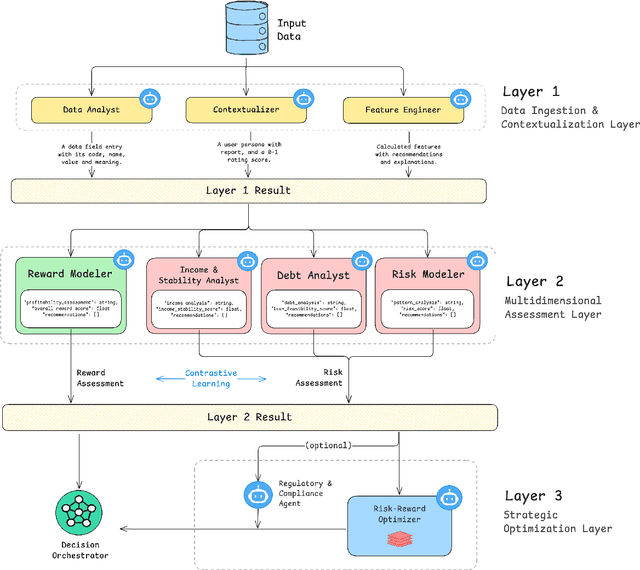
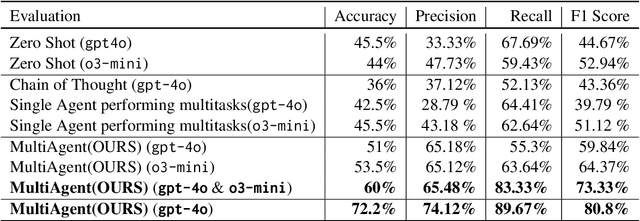

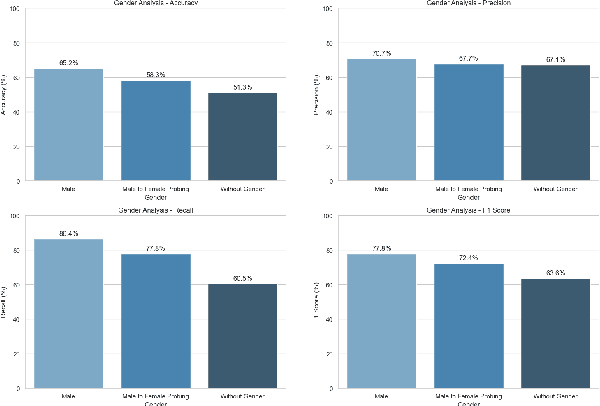
Recent advancements in financial problem-solving have leveraged LLMs and agent-based systems, with a primary focus on trading and financial modeling. However, credit assessment remains an underexplored challenge, traditionally dependent on rule-based methods and statistical models. In this paper, we introduce MASCA, an LLM-driven multi-agent system designed to enhance credit evaluation by mirroring real-world decision-making processes. The framework employs a layered architecture where specialized LLM-based agents collaboratively tackle sub-tasks. Additionally, we integrate contrastive learning for risk and reward assessment to optimize decision-making. We further present a signaling game theory perspective on hierarchical multi-agent systems, offering theoretical insights into their structure and interactions. Our paper also includes a detailed bias analysis in credit assessment, addressing fairness concerns. Experimental results demonstrate that MASCA outperforms baseline approaches, highlighting the effectiveness of hierarchical LLM-based multi-agent systems in financial applications, particularly in credit scoring.