 Add to Chrome
 Add to Firefox
 Add to Edge
Sketch2Motion: Text-driven 2D Sketch to 3D Animation via Diffusion-guided Skeleton Optimization
May 27, 2026
Animation of 2D hand-drawn sketches provides an effective medium for visual communication. However, these sketches pose challenges, particularly in handling occlusions and accurately mapping motion. While 3D animation naturally addresses these challenges, estimating 3D motion remains a very complex task. Recent approaches to converting 2D sketches to 3D animations have mainly focused on specific types of motion, such as bipedal movements and facial expressions. We propose Sketch2Motion, a diffusion-guided framework for skeleton-based motion synthesis that combines classical character animation pipelines with deep generative priors. Our method represents motion using skeletal transformations, which are propagated to mesh deformations via linear blend skinning. To guide the resulting animation toward realistic and semantically meaningful motion, we integrate a text-to-video diffusion model via motion-aware score-distillation sampling (MoSDS), enabling optimization without paired motion data. Additionally, we apply physics-inspired smoothness, topological, and contact constraints to stabilize optimization and preserve motion plausibility. Further, we integrate a spring-mass simulator to introduce secondary motion effects. The proposed framework is generalized, fully differentiable, modular, and compatible with biped, quadruped, and non-living articulated characters. Experiments demonstrate that our approach produces temporally coherent, text-aligned animations that outperform baseline motion transfer methods that lack generative priors or explicit physical constraints. We will make our code and dataset publicly available.

Enhancing Sketch Animation: Text-to-Video Diffusion Models with Temporal Consistency and Rigidity Constraints
Nov 28, 2024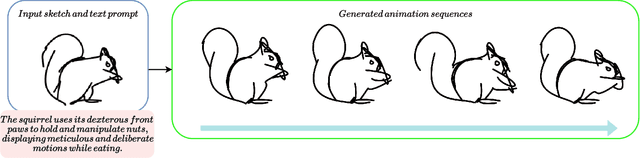
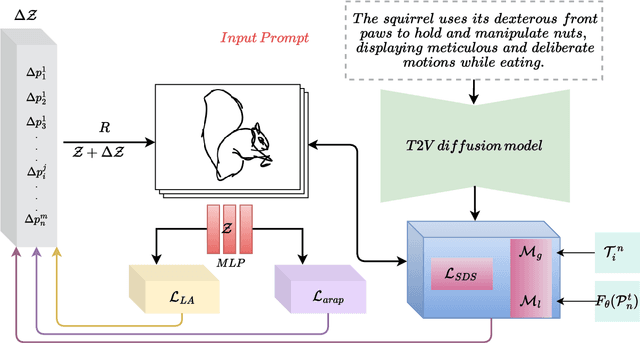
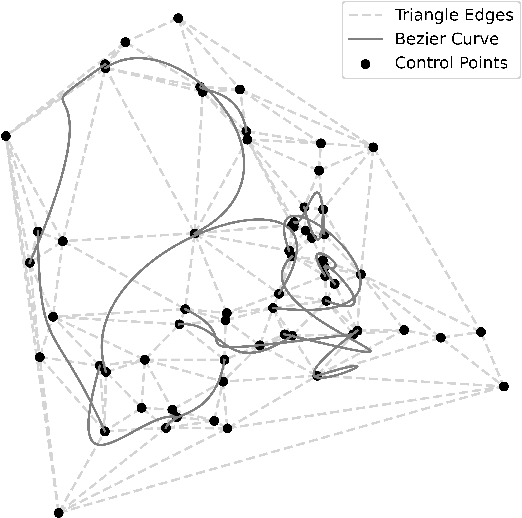
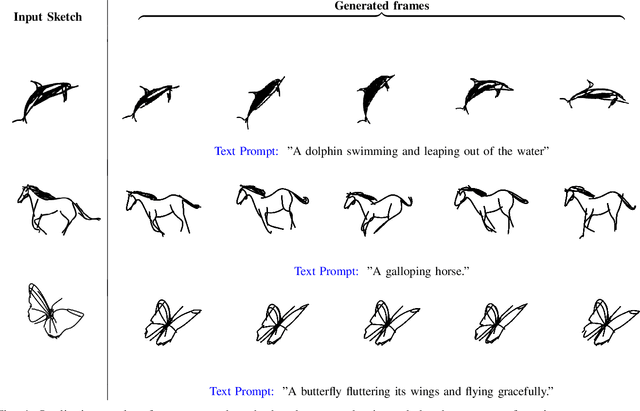
Animating hand-drawn sketches using traditional tools is challenging and complex. Sketches provide a visual basis for explanations, and animating these sketches offers an experience of real-time scenarios. We propose an approach for animating a given input sketch based on a descriptive text prompt. Our method utilizes a parametric representation of the sketch's strokes. Unlike previous methods, which struggle to estimate smooth and accurate motion and often fail to preserve the sketch's topology, we leverage a pre-trained text-to-video diffusion model with SDS loss to guide the motion of the sketch's strokes. We introduce length-area (LA) regularization to ensure temporal consistency by accurately estimating the smooth displacement of control points across the frame sequence. Additionally, to preserve shape and avoid topology changes, we apply a shape-preserving As-Rigid-As-Possible (ARAP) loss to maintain sketch rigidity. Our method surpasses state-of-the-art performance in both quantitative and qualitative evaluations.