 Add to Chrome
 Add to Firefox
 Add to Edge
Brain Tumor Classifiers Under Attack: Robustness of ResNet Variants Against Transferable FGSM and PGD Attacks
Feb 12, 2026
Adversarial robustness in deep learning models for brain tumor classification remains an underexplored yet critical challenge, particularly for clinical deployment scenarios involving MRI data. In this work, we investigate the susceptibility and resilience of several ResNet-based architectures, referred to as BrainNet, BrainNeXt and DilationNet, against gradient-based adversarial attacks, namely FGSM and PGD. These models, based on ResNet, ResNeXt, and dilated ResNet variants respectively, are evaluated across three preprocessing configurations (i) full-sized augmented, (ii) shrunk augmented and (iii) shrunk non-augmented MRI datasets. Our experiments reveal that BrainNeXt models exhibit the highest robustness to black-box attacks, likely due to their increased cardinality, though they produce weaker transferable adversarial samples. In contrast, BrainNet and Dilation models are more vulnerable to attacks from each other, especially under PGD with higher iteration steps and $α$ values. Notably, shrunk and non-augmented data significantly reduce model resilience, even when the untampered test accuracy remains high, highlighting a key trade-off between input resolution and adversarial vulnerability. These results underscore the importance of jointly evaluating classification performance and adversarial robustness for reliable real-world deployment in brain MRI analysis.

Toward Sensor-based Sleep Monitoring with Electrodermal Activity Measures
Jan 31, 2019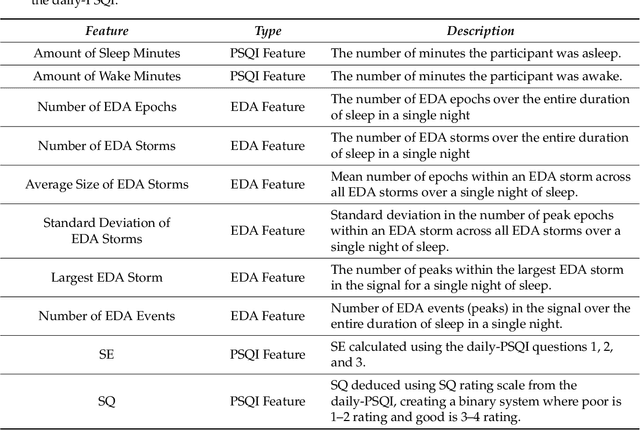
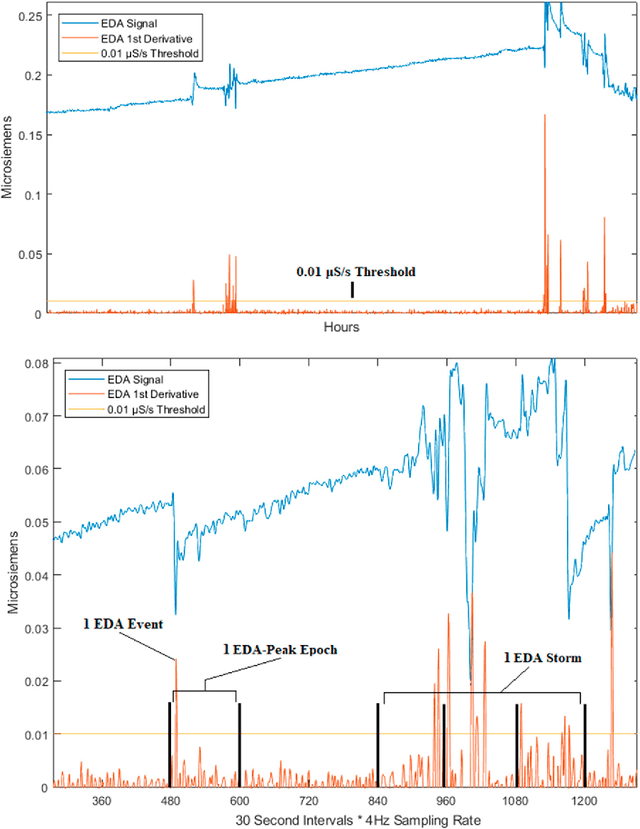
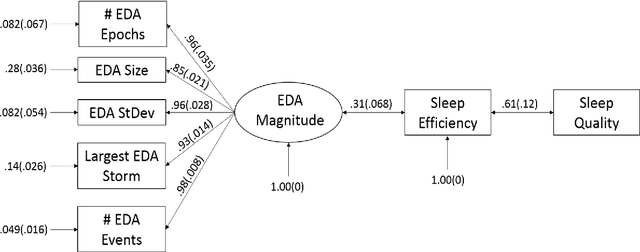
We use self-report and electrodermal activity (EDA) wearable sensor data from 77 nights of sleep on six participants to test the efficacy of EDA data for sleep monitoring. We used factor analysis to find latent factors in the EDA data, and causal model search to find the most probable graphical model accounting for self-reported sleep efficiency (SE), sleep quality (SQ), and the latent EDA factors. Structural equation modeling was used to confirm fit of the extracted graph. Based on the generated graph, logistic regression and naive Bayes models were used to test the efficacy of the EDA data in predicting SE and SQ. Six EDA features extracted from the total signal over a night's sleep could be explained by two latent factors, EDA Magnitude and EDA Storms. EDA Magnitude performed as a strong predictor for SE to aid detection of substantial changes in time asleep. The performance of EDA Magnitured and SE in classifying SQ showed promise for wearable sleep monitoring applications. However, our data suggest that obtaining a more accurate sensor-based measure of SE will be necessary before smaller changes in SQ can be detected from EDA sensor data alone.