 Add to Chrome
 Add to Firefox
 Add to Edge
Prototype-Based Low Altitude UAV Semantic Segmentation
Apr 02, 2026
Semantic segmentation of low-altitude UAV imagery presents unique challenges due to extreme scale variations, complex object boundaries, and limited computational resources on edge devices. Existing transformer-based segmentation methods achieve remarkable performance but incur high computational overhead, while lightweight approaches struggle to capture fine-grained details in high-resolution aerial scenes. To address these limitations, we propose PBSeg, an efficient prototype-based segmentation framework tailored for UAV applications. PBSeg introduces a novel prototype-based cross-attention (PBCA) that exploits feature redundancy to reduce computational complexity while maintaining segmentation quality. The framework incorporates an efficient multi-scale feature extraction module that combines deformable convolutions (DConv) with context-aware modulation (CAM) to capture both local details and global semantics. Experiments on two challenging UAV datasets demonstrate the effectiveness of the proposed approach. PBSeg achieves 71.86\% mIoU on UAVid and 80.92\% mIoU on UDD6, establishing competitive performance while maintaining computational efficiency. Code is available at https://github.com/zhangda1018/PBSeg.

Cross-Modal Dual-Causal Learning for Long-Term Action Recognition
Jul 09, 2025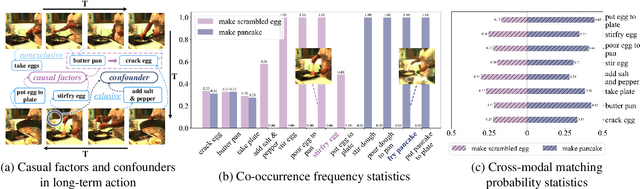
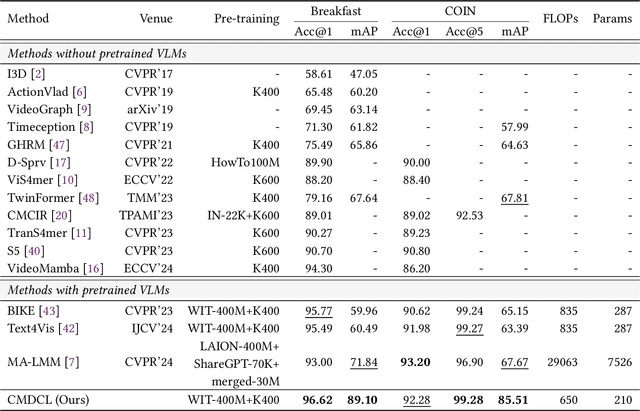
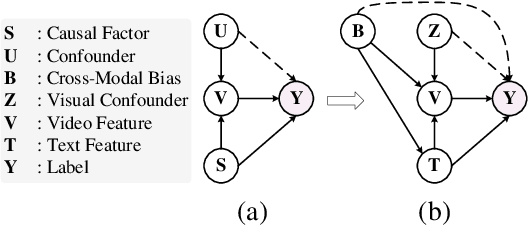
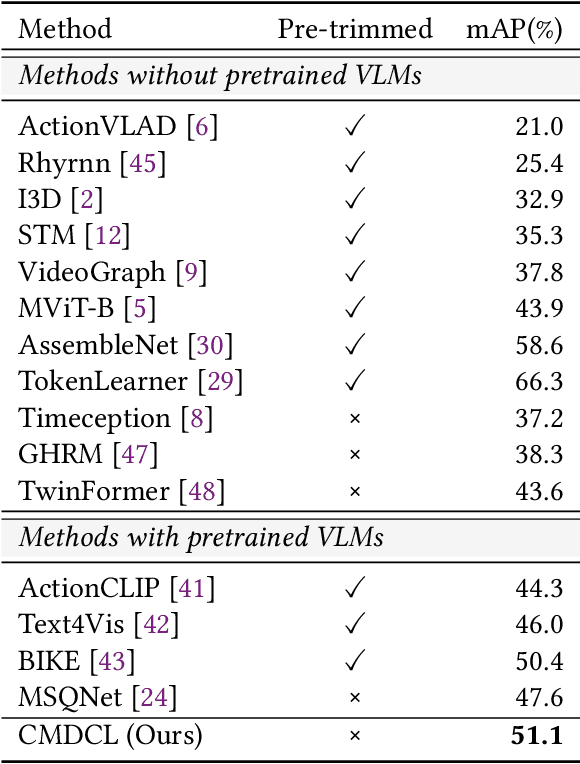
Long-term action recognition (LTAR) is challenging due to extended temporal spans with complex atomic action correlations and visual confounders. Although vision-language models (VLMs) have shown promise, they often rely on statistical correlations instead of causal mechanisms. Moreover, existing causality-based methods address modal-specific biases but lack cross-modal causal modeling, limiting their utility in VLM-based LTAR. This paper proposes \textbf{C}ross-\textbf{M}odal \textbf{D}ual-\textbf{C}ausal \textbf{L}earning (CMDCL), which introduces a structural causal model to uncover causal relationships between videos and label texts. CMDCL addresses cross-modal biases in text embeddings via textual causal intervention and removes confounders inherent in the visual modality through visual causal intervention guided by the debiased text. These dual-causal interventions enable robust action representations to address LTAR challenges. Experimental results on three benchmarks including Charades, Breakfast and COIN, demonstrate the effectiveness of the proposed model. Our code is available at https://github.com/xushaowu/CMDCL.