 Add to Chrome
 Add to Firefox
 Add to Edge
Data-Centric Benchmarking of Exploit Generation in LLMs: Understanding the Impact of Fine-Tuning
Jun 13, 2026
We study the task of CVE-conditioned exploit generation, where a model drafts proof-of-concept (PoC) exploits given software vulnerability context. We adopt a data-centric approach, constructing a high-quality dataset via multi-stage preprocessing and introducing a scalable evaluation framework with LLM-as-judge and fine-grained rubrics. Under this unified setup, we benchmark 17 large language models across 8 evaluation criteria, providing systematic insights into their zero-shot capabilities. We further show that a compact 8B open-weight model, when fine-tuned on curated data, achieves over 42.5% improvement in exploit quality and rivals some proprietary models when combined with simple test-time rejection strategies. Our results highlight the importance of data quality, structured supervision, and evaluation design for reliable exploit generation, suggesting that these factors can be as critical as model scale in adapting LLMs to cybersecurity tasks.

kRAIG: A Natural Language-Driven Agent for Automated DataOps Pipeline Generation
Mar 19, 2026Modern machine learning systems rely on complex data engineering workflows to extract, transform, and load (ELT) data into production pipelines. However, constructing these pipelines remains time-consuming and requires substantial expertise in data infrastructure and orchestration frameworks. Recent advances in large language model (LLM) agents offer a potential path toward automating these workflows, but existing approaches struggle with under-specified user intent, unreliable tool generation, and limited guarantees of executable outputs. We introduce kRAIG, an AI agent that translates natural language specifications into production-ready Kubeflow Pipelines (KFP). To resolve ambiguity in user intent, we propose ReQuesAct (Reason, Question, Act), an interaction framework that explicitly clarifies intent prior to pipeline synthesis. The system orchestrates end-to-end data movement from diverse sources and generates task-specific transformation components through a retrieval-augmented tool synthesis process. To ensure data quality and safety, kRAIG incorporates LLM-based validation stages that verify pipeline integrity prior to execution. Our framework achieves a 3x improvement in extraction and loading success and a 25 percent increase in transformation accuracy compared to state-of-the-art agentic baselines. These improvements demonstrate that structured agent workflows with explicit intent clarification and validation significantly enhance the reliability and executability of automated data engineering pipelines.
Component-Aware Pruning Framework for Neural Network Controllers via Gradient-Based Importance Estimation
Jan 27, 2026The transition from monolithic to multi-component neural architectures in advanced neural network controllers poses substantial challenges due to the high computational complexity of the latter. Conventional model compression techniques for complexity reduction, such as structured pruning based on norm-based metrics to estimate the relative importance of distinct parameter groups, often fail to capture functional significance. This paper introduces a component-aware pruning framework that utilizes gradient information to compute three distinct importance metrics during training: Gradient Accumulation, Fisher Information, and Bayesian Uncertainty. Experimental results with an autoencoder and a TD-MPC agent demonstrate that the proposed framework reveals critical structural dependencies and dynamic shifts in importance that static heuristics often miss, supporting more informed compression decisions.
COMponent-Aware Pruning for Accelerated Control Tasks in Latent Space Models
Aug 11, 2025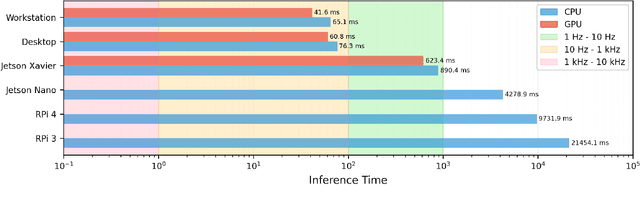
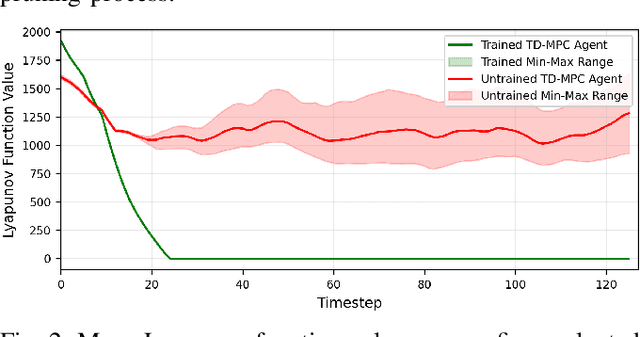
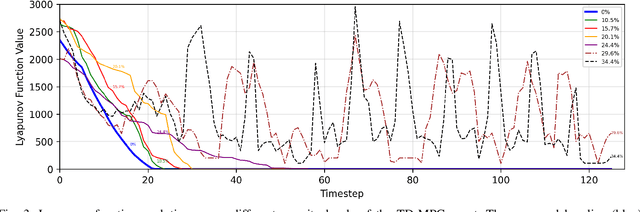
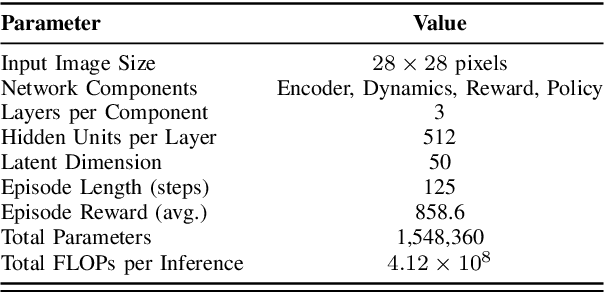
The rapid growth of resource-constrained mobile platforms, including mobile robots, wearable systems, and Internet-of-Things devices, has increased the demand for computationally efficient neural network controllers (NNCs) that can operate within strict hardware limitations. While deep neural networks (DNNs) demonstrate superior performance in control applications, their substantial computational complexity and memory requirements present significant barriers to practical deployment on edge devices. This paper introduces a comprehensive model compression methodology that leverages component-aware structured pruning to determine the optimal pruning magnitude for each pruning group, ensuring a balance between compression and stability for NNC deployment. Our approach is rigorously evaluated on Temporal Difference Model Predictive Control (TD-MPC), a state-of-the-art model-based reinforcement learning algorithm, with a systematic integration of mathematical stability guarantee properties, specifically Lyapunov criteria. The key contribution of this work lies in providing a principled framework for determining the theoretical limits of model compression while preserving controller stability. Experimental validation demonstrates that our methodology successfully reduces model complexity while maintaining requisite control performance and stability characteristics. Furthermore, our approach establishes a quantitative boundary for safe compression ratios, enabling practitioners to systematically determine the maximum permissible model reduction before violating critical stability properties, thereby facilitating the confident deployment of compressed NNCs in resource-limited environments.
Enhanced Pruning Strategy for Multi-Component Neural Architectures Using Component-Aware Graph Analysis
Apr 17, 2025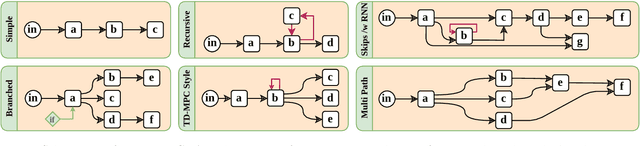
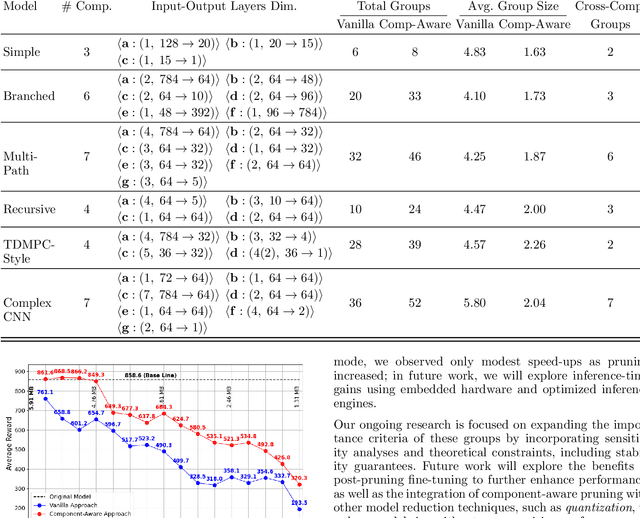
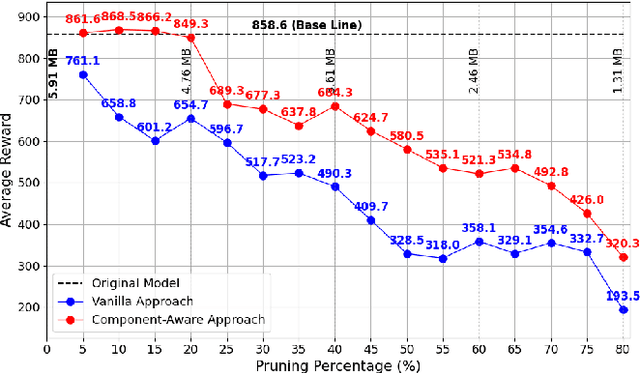
Deep neural networks (DNNs) deliver outstanding performance, but their complexity often prohibits deployment in resource-constrained settings. Comprehensive structured pruning frameworks based on parameter dependency analysis reduce model size with specific regard to computational performance. When applying them to Multi-Component Neural Architectures (MCNAs), they risk network integrity by removing large parameter groups. We introduce a component-aware pruning strategy, extending dependency graphs to isolate individual components and inter-component flows. This creates smaller, targeted pruning groups that conserve functional integrity. Demonstrated effectively on a control task, our approach achieves greater sparsity and reduced performance degradation, opening a path for optimizing complex, multi-component DNNs efficiently.