 Add to Chrome
 Add to Firefox
 Add to Edge
Convergence Analysis of Randomized Subspace Normalized SGD under Heavy-Tailed Noise
Jan 29, 2026
Randomized subspace methods reduce per-iteration cost; however, in nonconvex optimization, most analyses are expectation-based, and high-probability bounds remain scarce even under sub-Gaussian noise. We first prove that randomized subspace SGD (RS-SGD) admits a high-probability convergence bound under sub-Gaussian noise, achieving the same order of oracle complexity as prior in-expectation results. Motivated by the prevalence of heavy-tailed gradients in modern machine learning, we then propose randomized subspace normalized SGD (RS-NSGD), which integrates direction normalization into subspace updates. Assuming the noise has bounded $p$-th moments, we establish both in-expectation and high-probability convergence guarantees, and show that RS-NSGD can achieve better oracle complexity than full-dimensional normalized SGD.

Minimization of Functions on Dually Flat Spaces Using Geodesic Descent Based on Dual Connections
Dec 10, 2025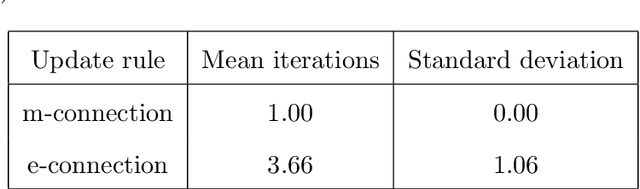
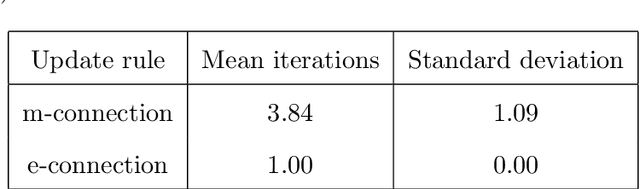
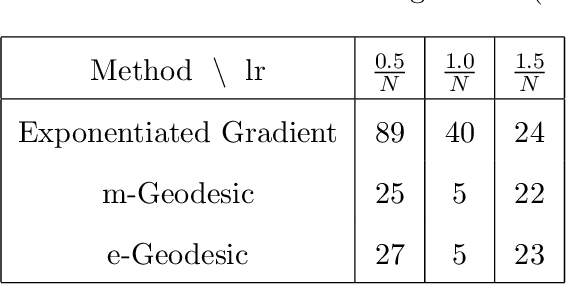
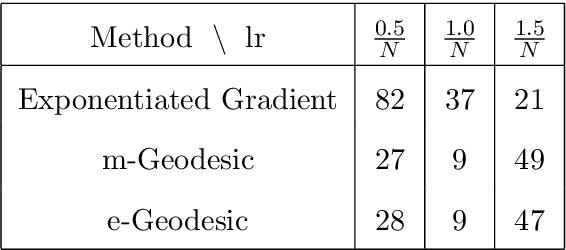
We propose geodesic-based optimization methods on dually flat spaces, where the geometric structure of the parameter manifold is closely related to the form of the objective function. A primary application is maximum likelihood estimation in statistical models, especially exponential families, whose model manifolds are dually flat. We show that an m-geodesic update, which directly optimizes the log-likelihood, can theoretically reach the maximum likelihood estimator in a single step. In contrast, an e-geodesic update has a practical advantage in cases where the parameter space is geodesically complete, allowing optimization without explicitly handling parameter constraints. We establish the theoretical properties of the proposed methods and validate their effectiveness through numerical experiments.