 Add to Chrome
 Add to Firefox
 Add to Edge
Machine-Learning-Enhanced Non-Invasive Testing for MASLD Fibrosis: Shallow-Deep Neural Networks Versus FIB-4, Tabular Foundation Models, and Large Language Models
May 19, 2026
Advanced fibrosis is a major determinant of liver-related morbidity in metabolic dysfunction-associated steatotic liver disease (MASLD). FIB-4 is widely used as a first-line non-invasive test, but its fixed formula may underuse diagnostic information contained in age, aspartate aminotransferase, alanine aminotransferase, and platelet count. We evaluated whether machine-learning-enhanced non-invasive testing (MLE-NIT) can improve advanced fibrosis detection while preserving this FIB-4 variable space. We used three biopsy-confirmed MASLD cohorts from China, Malaysia, and India (n=784). The Chinese cohort was split into 486 training and 54 internal validation/tuning patients; final performance was reported only on the Malaysian and Indian external cohorts. Models used five variables: age, FIB-4, aspartate aminotransferase, platelet count, and alanine aminotransferase. We compared FIB-4 with a shallow-deep neural network (s-DNN), TabPFN, and gpt-4o-2024-08-06. FIB-4 achieved external ROC-AUCs of 0.75 and 0.60 in Malaysia and India, respectively. TabPFN achieved 0.69 and 0.66, fine-tuned GPT-4o achieved 0.75 and 0.63, and the s-DNN achieved 0.77 and 0.67, respectively. The s-DNN contained only 354 trainable parameters, compared with 7,244,554 for TabPFN, yet provided a more balanced external operating profile. Calibration showed s-DNN Brier scores of 0.18 and 0.22, and permutation importance identified AST and FIB-4 as dominant variables. Compact non-linear MLE-NITs may enhance FIB-4-based fibrosis assessment without increasing clinical data requirements.

LLMs for Drug-Drug Interaction Prediction: A Comprehensive Comparison
Feb 09, 2025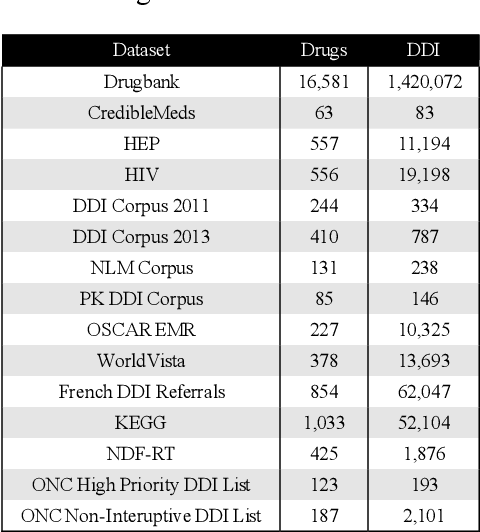

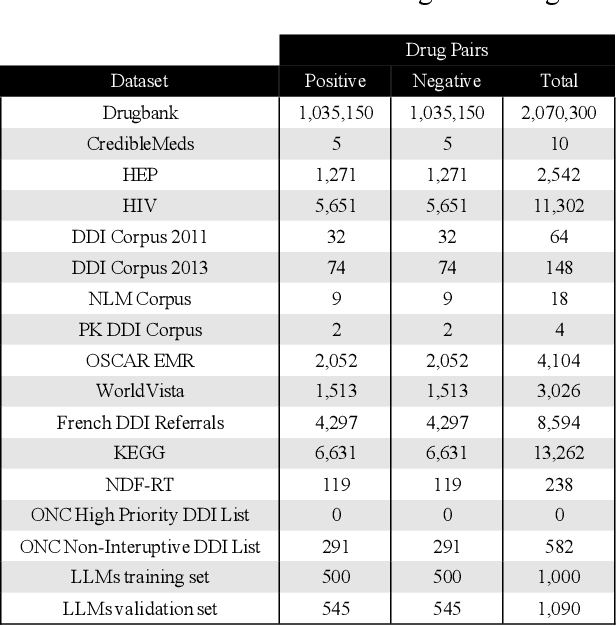
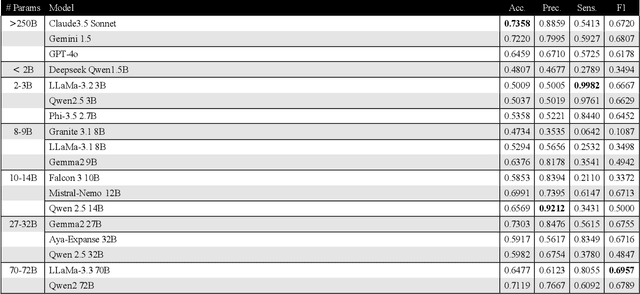
The increasing volume of drug combinations in modern therapeutic regimens needs reliable methods for predicting drug-drug interactions (DDIs). While Large Language Models (LLMs) have revolutionized various domains, their potential in pharmaceutical research, particularly in DDI prediction, remains largely unexplored. This study thoroughly investigates LLMs' capabilities in predicting DDIs by uniquely processing molecular structures (SMILES), target organisms, and gene interaction data as raw text input from the latest DrugBank dataset. We evaluated 18 different LLMs, including proprietary models (GPT-4, Claude, Gemini) and open-source variants (from 1.5B to 72B parameters), first assessing their zero-shot capabilities in DDI prediction. We then fine-tuned selected models (GPT-4, Phi-3.5 2.7B, Qwen-2.5 3B, Gemma-2 9B, and Deepseek R1 distilled Qwen 1.5B) to optimize their performance. Our comprehensive evaluation framework included validation across 13 external DDI datasets, comparing against traditional approaches such as l2-regularized logistic regression. Fine-tuned LLMs demonstrated superior performance, with Phi-3.5 2.7B achieving a sensitivity of 0.978 in DDI prediction, with an accuracy of 0.919 on balanced datasets (50% positive, 50% negative cases). This result represents an improvement over both zero-shot predictions and state-of-the-art machine-learning methods used for DDI prediction. Our analysis reveals that LLMs can effectively capture complex molecular interaction patterns and cases where drug pairs target common genes, making them valuable tools for practical applications in pharmaceutical research and clinical settings.
Design and Evaluation of a CDSS for Drug Allergy Management Using LLMs and Pharmaceutical Data Integration
Sep 24, 2024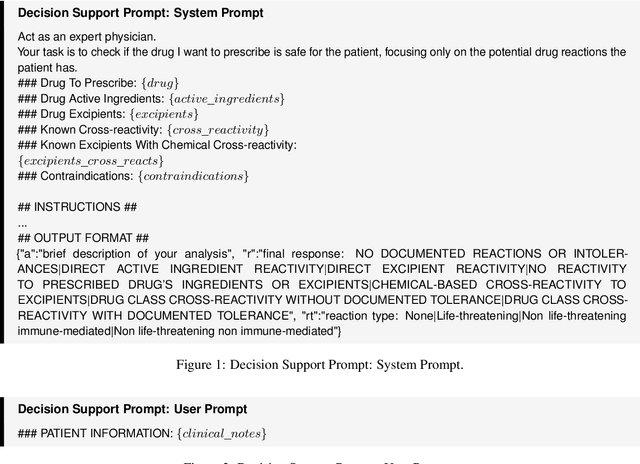

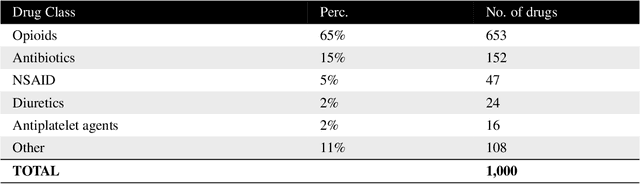
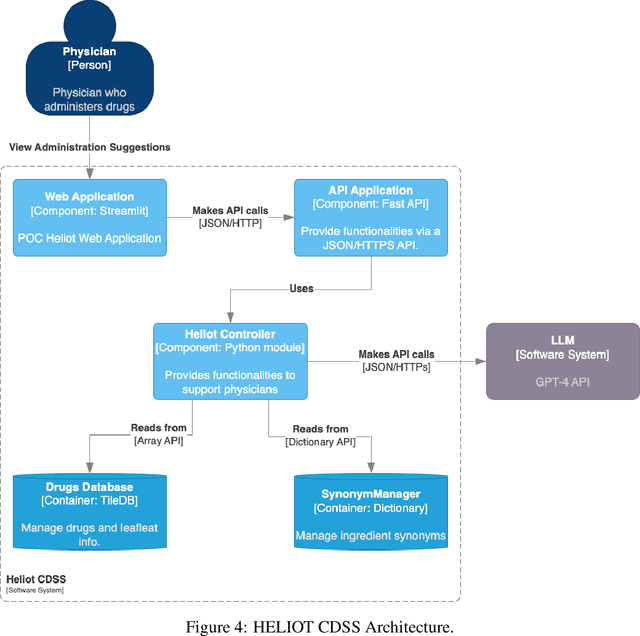
Medication errors significantly threaten patient safety, leading to adverse drug events and substantial economic burdens on healthcare systems. Clinical Decision Support Systems (CDSSs) aimed at mitigating these errors often face limitations, including reliance on static databases and rule-based algorithms, which can result in high false alert rates and alert fatigue among clinicians. This paper introduces HELIOT, an innovative CDSS for drug allergy management, integrating Large Language Models (LLMs) with a comprehensive pharmaceutical data repository. HELIOT leverages advanced natural language processing capabilities to interpret complex medical texts and synthesize unstructured data, overcoming the limitations of traditional CDSSs. An empirical evaluation using a synthetic patient dataset and expert-verified ground truth demonstrates HELIOT's high accuracy, precision, recall, and F1 score, uniformly reaching 100\% across multiple experimental runs. The results underscore HELIOT's potential to enhance decision support in clinical settings, offering a scalable, efficient, and reliable solution for managing drug allergies.